Gumireddy Kiranmai, Li Anping, Gimotty Phyllis A, Klein-Szanto Andres J, Showe Louise C, Katsaros Dionyssios, Coukos George, Zhang Lin, Huang Qihong
The Wistar Institute, 3601 Spruce Street, PA 19104, USA.
Nat Cell Biol. 2009 Nov;11(11):1297-304. doi: 10.1038/ncb1974. Epub 2009 Oct 4.
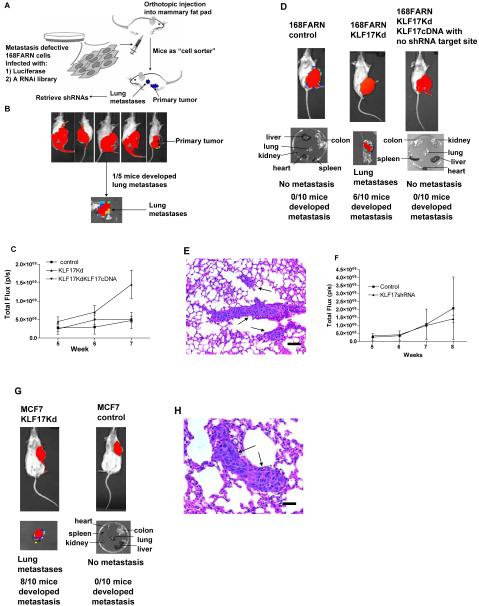
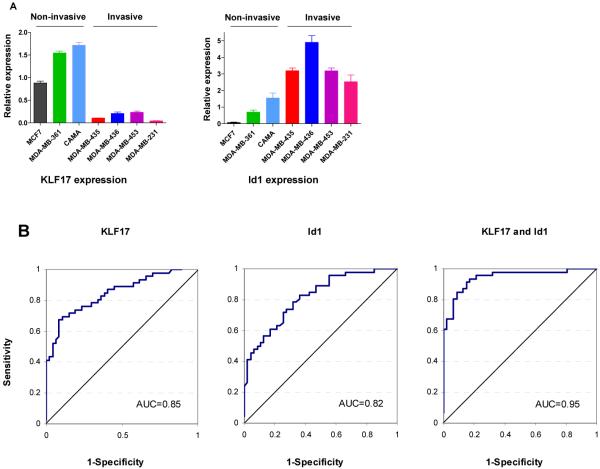
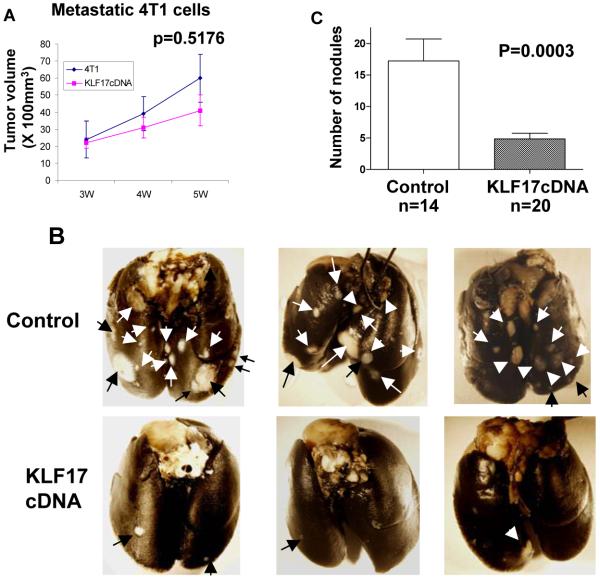
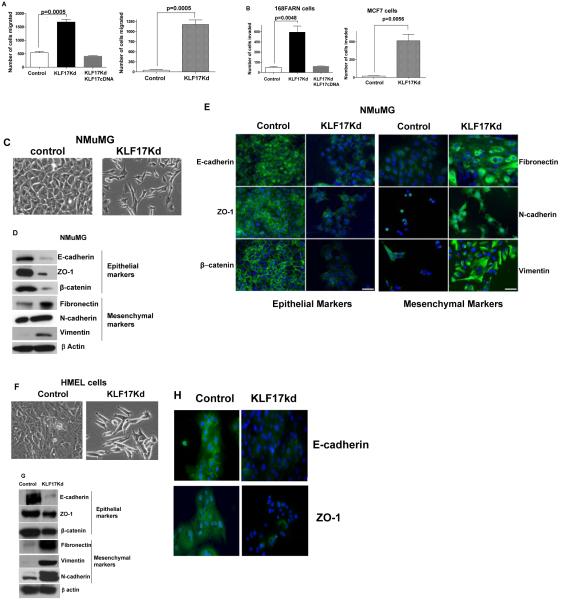
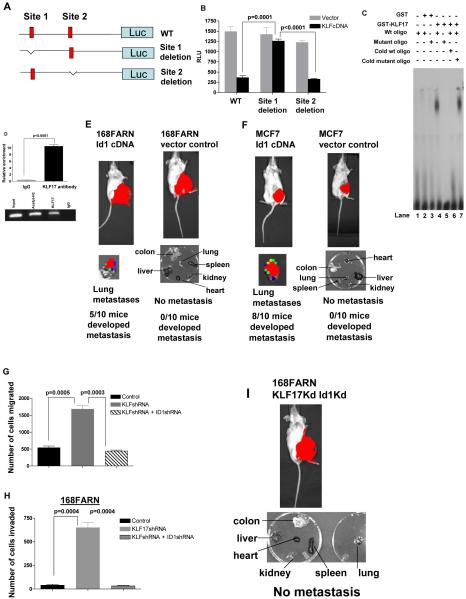
Metastasis is a complex multistep process, which requires the concerted action of many genes and is the primary cause of cancer death. Both pathways that regulate metastasis enhancement and those that regulate its suppression contribute to the tumour dissemination process. To identify new metastasis suppressors, we set up a forward genetic screen in a mouse model. We transduced a genome-wide RNA interference (RNAi) library into the non-metastatic 168FARN breast cancer cell line and orthotopically transplanted the cells into mouse mammary fat pads. We then selected cells that could metastasize to the lung and identified an RNAi for the KLF17 gene. Conversely, we demonstrate that ectopic expression of KLF17 in a highly metastatic 4T1 breast cancer cell line inhibits the ability of cells to metastasize from the mammary fat pad to the lung. We also show that suppression of KLF17 expression promotes breast cancer cell invasion and epithelial-mesenchymal transition (EMT), and that KLF17 protein functions by directly binding to the promoter region of Id1 (which encodes a key metastasis regulator in breast cancer) to inhibit its transcription. Finally, we demonstrate that KLF17 expression is significantly downregulated in primary human breast cancer samples and that the combined expression pattern of KLF17 and Id1 can serve as a potential biomarker for lymph node metastasis in breast cancer.
转移是一个复杂的多步骤过程,需要许多基因协同作用,是癌症死亡的主要原因。调节转移增强的途径和调节转移抑制的途径都对肿瘤扩散过程有影响。为了鉴定新的转移抑制因子,我们在小鼠模型中进行了正向遗传学筛选。我们将全基因组RNA干扰(RNAi)文库转导至非转移性168FARN乳腺癌细胞系中,并将这些细胞原位移植到小鼠乳腺脂肪垫中。然后我们筛选出能够转移至肺部的细胞,并鉴定出针对KLF17基因的一种RNAi。相反,我们证明在高转移性4T1乳腺癌细胞系中异位表达KLF17可抑制细胞从乳腺脂肪垫转移至肺部的能力。我们还表明,抑制KLF17表达可促进乳腺癌细胞侵袭和上皮-间质转化(EMT),并且KLF17蛋白通过直接结合Id1(其编码乳腺癌中的一种关键转移调节因子)的启动子区域来抑制其转录发挥作用。最后,我们证明在原发性人类乳腺癌样本中KLF17表达显著下调,并且KLF17和Id1的联合表达模式可作为乳腺癌淋巴结转移的潜在生物标志物。