Monell Chemical Senses Center, Philadelphia, Pennsylvania, United States of America.
PLoS One. 2009 Oct 8;4(10):e7347. doi: 10.1371/journal.pone.0007347.
The perception of sour taste in humans is incompletely understood at the receptor cell level. We report here on two patients with an acquired sour ageusia. Each patient was unresponsive to sour stimuli, but both showed normal responses to bitter, sweet, and salty stimuli.
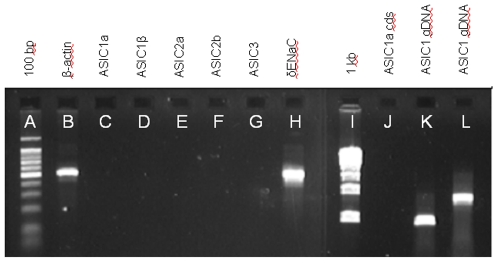
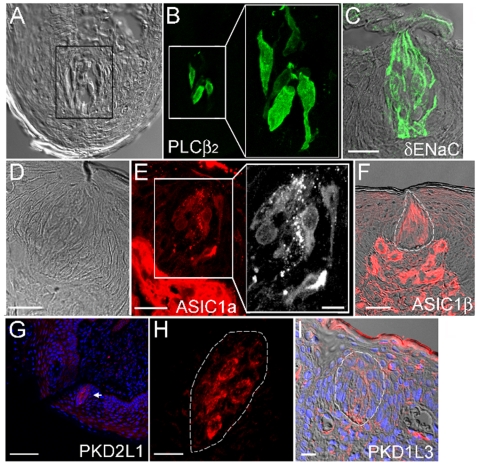
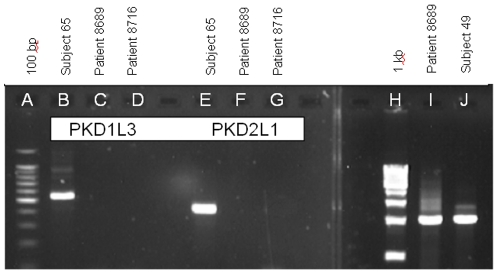
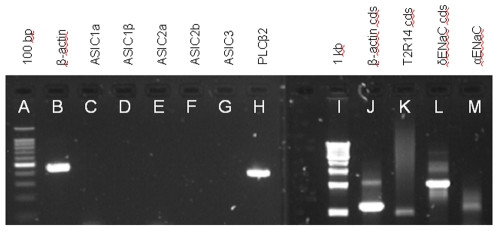
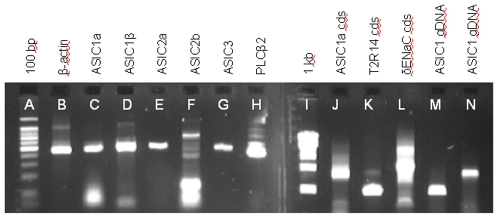
Lingual fungiform papillae, containing taste cells, were obtained by biopsy from the two patients, and from three sour-normal individuals, and analyzed by RT-PCR. The following transcripts were undetectable in the patients, even after 50 cycles of amplification, but readily detectable in the sour-normal subjects: acid sensing ion channels (ASICs) 1a, 1beta, 2a, 2b, and 3; and polycystic kidney disease (PKD) channels PKD1L3 and PKD2L1. Patients and sour-normals expressed the taste-related phospholipase C-beta2, the delta-subunit of epithelial sodium channel (ENaC) and the bitter receptor T2R14, as well as beta-actin. Genomic analysis of one patient, using buccal tissue, did not show absence of the genes for ASIC1a and PKD2L1. Immunohistochemistry of fungiform papillae from sour-normal subjects revealed labeling of taste bud cells by antibodies to ASICs 1a and 1beta, PKD2L1, phospholipase C-beta2, and delta-ENaC. An antibody to PKD1L3 labeled tissue outside taste bud cells.
These data suggest a role for ASICs and PKDs in human sour perception. This is the first report of sour ageusia in humans, and the very existence of such individuals ("natural knockouts") suggests a cell lineage for sour that is independent of the other taste modalities.
人类对酸味的感知在受体细胞水平上还不完全清楚。我们在这里报告了两名获得性酸味味觉丧失的患者。每位患者对酸味刺激均无反应,但对苦味、甜味和咸味刺激均有正常反应。
从两名患者和三名酸味正常的个体中采集舌菌状乳头活检标本,获得含有味觉细胞的标本,并通过 RT-PCR 进行分析。即使在扩增 50 个循环后,患者标本中仍无法检测到以下转录物,但在酸味正常的个体中可轻易检测到:酸敏离子通道 (ASICs) 1a、1beta、2a、2b 和 3;多囊肾病 (PKD) 通道 PKD1L3 和 PKD2L1。患者和酸味正常者表达味觉相关的磷脂酶 C-β2、上皮钠通道 (ENaC) 的 δ 亚基和苦味受体 T2R14,以及β-肌动蛋白。使用颊组织对一名患者进行的基因组分析并未显示出 ASIC1a 和 PKD2L1 基因缺失。对酸味正常者菌状乳头进行免疫组织化学染色显示,ASICs 1a 和 1beta、PKD2L1、磷脂酶 C-β2 和 δ-ENaC 的抗体可标记味觉感受器细胞。针对 PKD1L3 的抗体标记了味觉感受器细胞外的组织。
这些数据表明 ASICs 和 PKDs 在人类酸味感知中起作用。这是人类首次报告酸味味觉丧失,而这些个体(“天然敲除”)的存在表明酸味存在独立于其他味觉的细胞谱系。