Center for Gastrointestinal Nerve & Muscle Function & GI Motility, University of Kansas Medical Center, Kansas City, USA.
Aliment Pharmacol Ther. 2010 Jan 15;31(2):313-22. doi: 10.1111/j.1365-2036.2009.04162.x. Epub 2009 Oct 8.
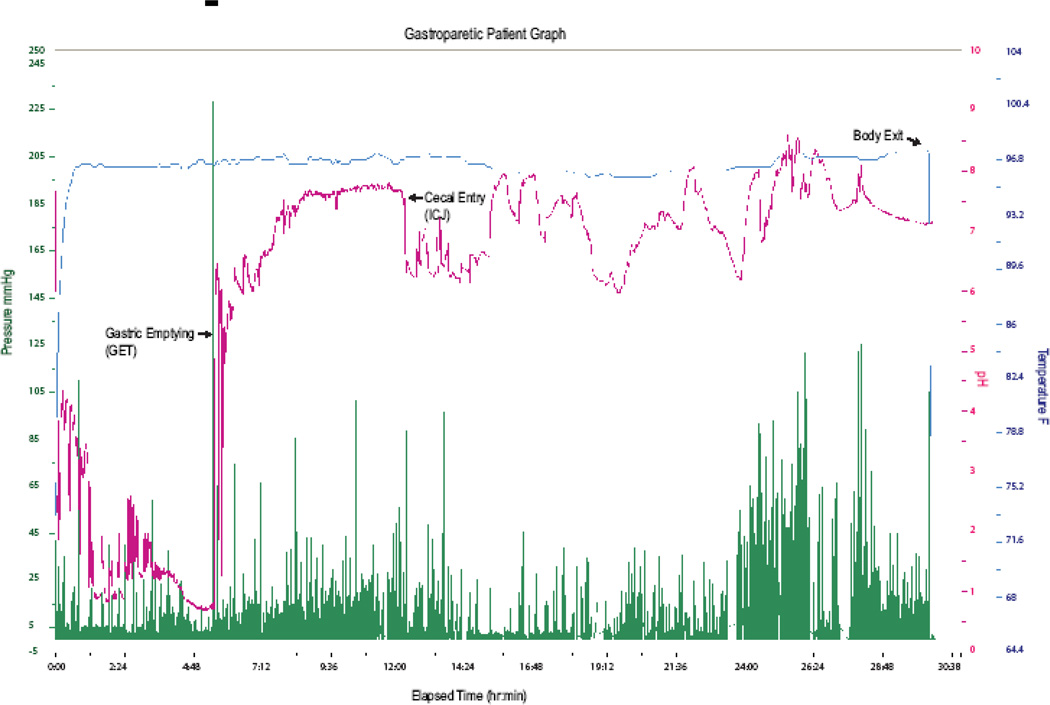
Wireless pH and pressure motility capsule (wireless motility capsule) technology provides a method to assess regional gastrointestinal transit times.
To analyse data from a multi-centre study of gastroparetic patients and healthy controls and to compare regional transit times measured by wireless motility capsule in healthy controls and gastroparetics (GP).
A total of 66 healthy controls and 34 patients with GP (15 diabetic and 19 idiopathic) swallowed wireless motility capsule together with standardized meal (255 kcal). Gastric emptying time (GET), small bowel transit time (SBTT), colon transit time (CTT) and whole gut transit time (WGTT) were calculated using the wireless motility capsule.
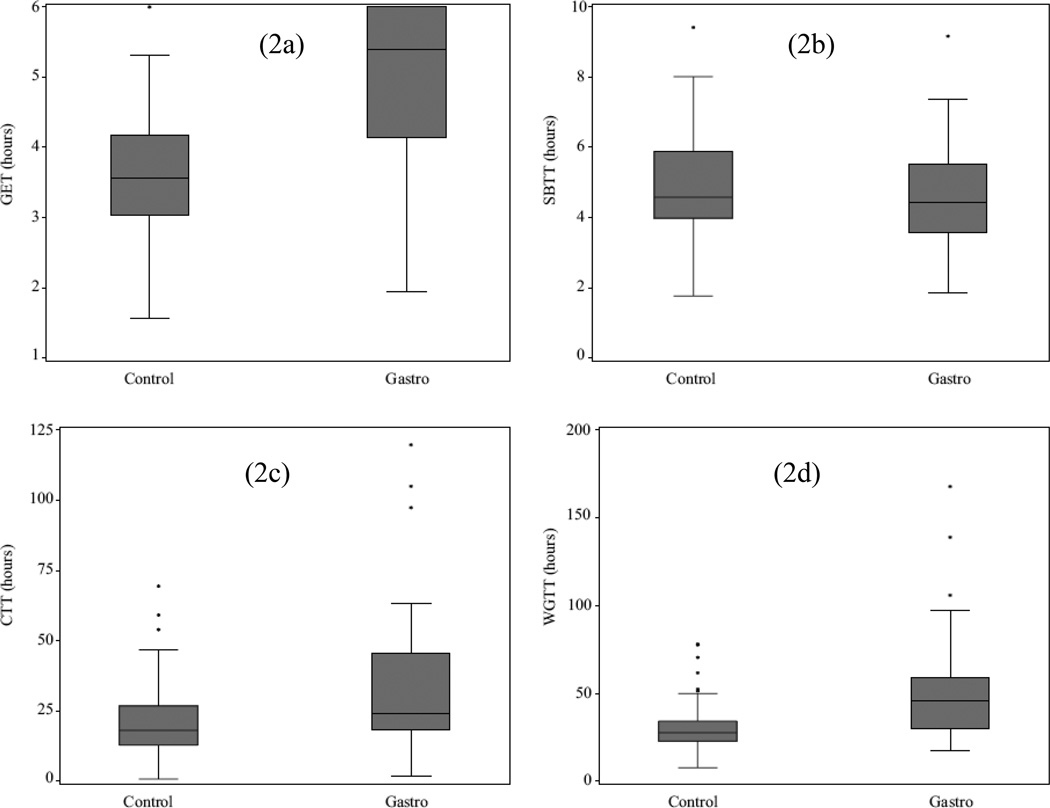
Gastric emptying time, CTT and WGTT but not SBTT were significantly longer in GP than in controls. Eighteen percent of gastroparetic patients had delayed WGTT. Both diabetic and idiopathic aetiologies of gastroparetics had significantly slower WGTT (P < 0.0001) in addition to significantly slower GET than healthy controls. Diabetic gastroparetics additionally had significantly slower CTT than healthy controls (P = 0.0054).
In addition to assessing gastric emptying, regional transit times can be measured using wireless motility capsule. The prolongation of CTT in gastroparetic patients indicates that dysmotility beyond the stomach in GP is present, and it could be contributing to symptom presentation.
无线 pH 值和压力动力胶囊(无线动力胶囊)技术为评估胃肠道区域通过时间提供了一种方法。
分析胃轻瘫患者和健康对照多中心研究的数据,并比较健康对照者和胃轻瘫(GP)患者中无线动力胶囊测量的区域通过时间。
共 66 名健康对照者和 34 名 GP 患者(15 名糖尿病和 19 名特发性)一起吞下无线动力胶囊和标准化餐(255 卡路里)。使用无线动力胶囊计算胃排空时间(GET)、小肠通过时间(SBTT)、结肠通过时间(CTT)和全肠道通过时间(WGTT)。
与对照组相比,GP 患者的胃排空时间、CTT 和 WGTT 明显延长,但 SBTT 无明显差异。18%的胃轻瘫患者 WGTT 延迟。除了与健康对照组相比 GET 明显减慢外,糖尿病和特发性胃轻瘫患者的 WGTT 也明显减慢(P < 0.0001)。糖尿病胃轻瘫患者的 CTT 也明显慢于健康对照组(P = 0.0054)。
除了评估胃排空外,无线动力胶囊还可以测量区域通过时间。胃轻瘫患者 CTT 的延长表明,胃以外的动力障碍在 GP 中存在,并且可能对症状表现有影响。