Nottingham Visual Neuroscience, School of Psychology, University of Nottingham, Nottingham, UK.
Neuroimage. 2010 Jan 15;49(2):1632-40. doi: 10.1016/j.neuroimage.2009.09.066. Epub 2009 Oct 6.
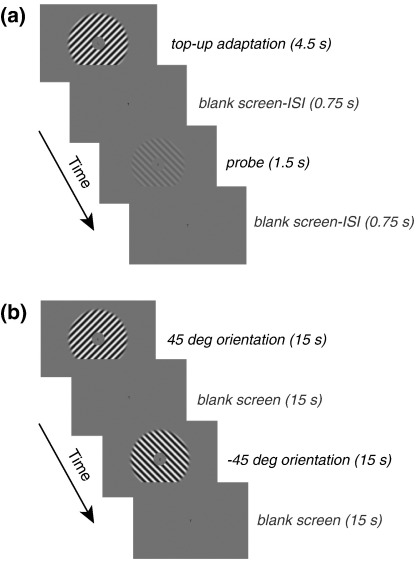
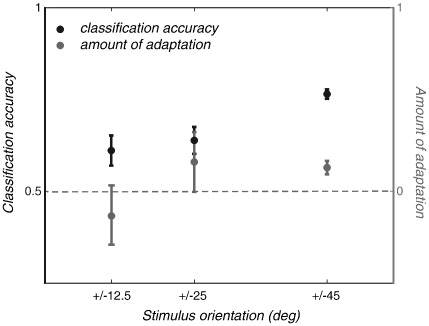
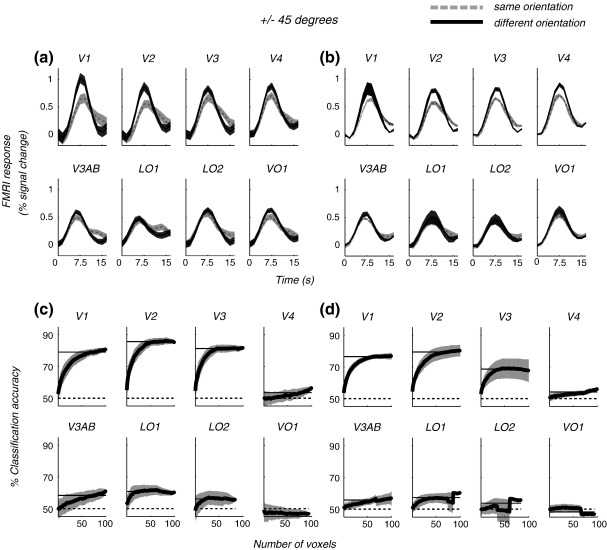
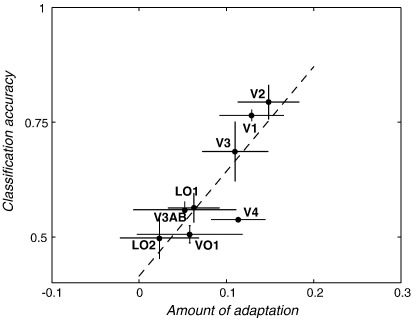
Functional magnetic resonance imaging (fMRI) has become a ubiquitous tool in cognitive neuroscience. The technique allows noninvasive measurements of cortical responses in the human brain, but only on the millimeter scale. Because a typical voxel contains many thousands of neurons with varied properties, establishing the selectivity of their responses directly is impossible. In recent years, two methods using fMRI aimed at studying the selectivity of neuronal populations on a 'subvoxel' scale have been heavily used. The first technique, fMRI adaptation, relies on the observation that the blood oxygen level-dependent (BOLD) response in a given voxel is reduced after prolonged presentation of a stimulus, and that this reduction is selective to the characteristics of the repeated stimuli (adapters). The second technique, multivariate pattern analysis (MVPA), makes use of multivariate statistics to recover small biases in individual voxels in their responses to different stimuli. It is thought that these biases arise due to the uneven distribution of neurons (with different properties) sampled by the many voxels in the imaged volume. These two techniques have not been compared explicitly, however, and little is known about their relative sensitivities. Here, we compared fMRI results from orientation-specific visual adaptation and orientation-classification by MVPA, using optimized experimental designs for each, and found that the multivariate pattern classification approach was more sensitive to small differences in stimulus orientation than the adaptation paradigm. Estimates of orientation selectivity obtained with the two methods were, however, very highly correlated across visual areas.
功能磁共振成像(fMRI)已成为认知神经科学中无处不在的工具。该技术允许对人类大脑皮层反应进行非侵入性测量,但只能在毫米尺度上进行。由于一个典型的体素包含数千个具有不同特性的神经元,因此不可能直接确定它们反应的选择性。近年来,两种使用 fMRI 的方法旨在研究神经元群体在“亚体素”尺度上的选择性,被广泛应用。第一种技术,功能磁共振成像适应,依赖于这样一个观察结果,即在一个给定的体素中,血液氧合水平依赖性(BOLD)反应在长时间呈现刺激后会降低,并且这种降低对重复刺激的特征具有选择性(适应器)。第二种技术,多元模式分析(MVPA),利用多元统计学来恢复个体体素在对不同刺激的反应中的小偏差。据认为,这些偏差是由于成像体积中许多体素所采样的神经元(具有不同的特性)分布不均匀造成的。然而,这两种技术并没有被明确比较,它们的相对敏感性知之甚少。在这里,我们比较了使用优化实验设计的定向视觉适应和 MVPA 的定向分类的 fMRI 结果,发现多元模式分类方法比适应范式对刺激方向的微小差异更敏感。然而,两种方法获得的取向选择性估计在视觉区域之间具有非常高的相关性。