
唑来膦酸通过靶向甲羟戊酸途径使肿瘤相关巨噬细胞再极化,从而抑制乳腺肿瘤发生。
Zoledronic acid repolarizes tumour-associated macrophages and inhibits mammary carcinogenesis by targeting the mevalonate pathway.
机构信息
Divisione di Ematologia dell'Università di Torino, Azienda Ospedaliero Universitaria S. Giovanni Battista di Torino, Torino, Italy.
出版信息
J Cell Mol Med. 2010 Dec;14(12):2803-15. doi: 10.1111/j.1582-4934.2009.00926.x.
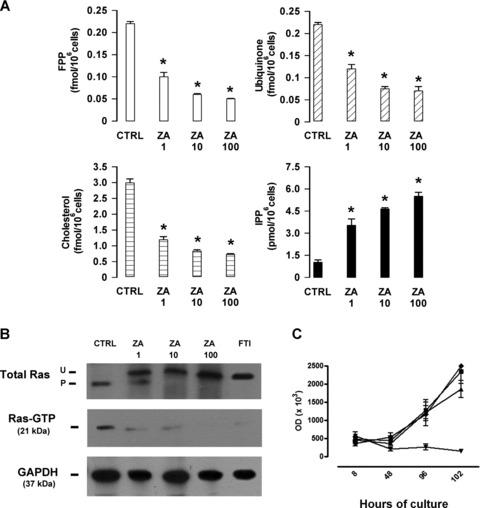
It is unknown whether zoledronic acid (ZA) at clinically relevant doses is active against tumours not located in bone. Mice transgenic for the activated ErbB-2 oncogene were treated with a cumulative number of doses equivalent to that recommended in human beings. A significant increase in tumour-free and overall survival was observed in mice treated with ZA. At clinically compatible concentrations, ZA modulated the mevalonate pathway and affected protein prenylation in both tumour cells and macrophages. A marked reduction in the number of tumour-associated macrophages was paralleled by a significant decrease in tumour vascularization. The local production of vascular endothelial growth factor and interleukin-10 was drastically down-regulated in favour of interferon-γ production. Peritoneal macrophages and tumour-associated macrophages of ZA-treated mice recovered a full M1 antitumoral phenotype, as shown by nuclear translocation of nuclear factor kB, inducible nitric oxide synthase expression and nitric oxide production. These data indicate that clinically achievable doses of ZA inhibit spontaneous mammary cancerogenesis by targeting the local microenvironment, as shown by a decreased tumour vascularization, a reduced number of tumour-associated macrophages and their reverted polarization from M2 to M1 phenotype.
唑来膦酸(ZA)在临床相关剂量下是否对非骨骼部位的肿瘤有效尚不清楚。用相当于推荐给人类的累积剂量对转染激活的 ErbB-2 癌基因的小鼠进行治疗。在接受 ZA 治疗的小鼠中,观察到无肿瘤和总生存的显著增加。在临床相容浓度下,ZA 调节甲羟戊酸途径并影响肿瘤细胞和巨噬细胞中的蛋白质异戊烯化。肿瘤相关巨噬细胞数量的明显减少伴随着肿瘤血管生成的显著减少。血管内皮生长因子和白细胞介素-10 的局部产生被急剧下调,转而有利于干扰素-γ的产生。ZA 治疗的小鼠的腹腔巨噬细胞和肿瘤相关巨噬细胞恢复了完全的 M1 抗肿瘤表型,表现为核因子 kB 的核易位、诱导型一氧化氮合酶的表达和一氧化氮的产生。这些数据表明,临床可达到的 ZA 剂量通过靶向局部微环境抑制自发性乳腺癌发生,表现为肿瘤血管生成减少、肿瘤相关巨噬细胞数量减少以及它们从 M2 表型向 M1 表型的极化逆转。




 Zotero 插件