Dermatology Service, Veterans Affairs Medical Center, University of California, San Francisco, CA, USA.
J Allergy Clin Immunol. 2010 Jan;125(1):160-9.e1-5. doi: 10.1016/j.jaci.2009.06.049. Epub 2009 Oct 8.
Atopic dermatitis (AD) is a chronic inflammatory dermatosis now increasingly linked to mutations that alter the structure and function of the stratum corneum. Activators of peroxisome proliferator-activated receptors (PPARs) alpha, beta/delta, and gamma and liver X receptor (LXR) regulate epidermal protein and lipid production, leading to superior barrier function. Additionally, some of these activators exhibit potent antihyperplastic and anti-inflammatory activity in irritant contact dermatitis and acute allergic contact dermatitis murine models.
We evaluated the efficacy of PPAR/LXR activation in a hapten (oxazolone [Ox])-induced AD-like model (Ox-AD) in hairless mice.
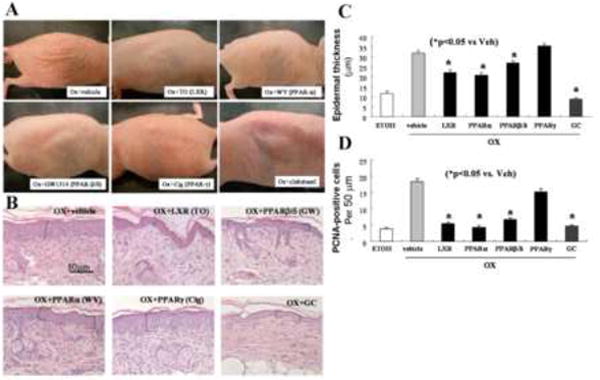
Ox-AD was established with 10 Ox challenges (every other day) on the flank. After the establishment of Ox-AD, twice-daily topical application with individual PPAR/LXR activators was then performed for 4 days, with continued Ox challenges every other day. The efficacy of topical PPAR/LXR activators to reduce parameters of Ox-AD was assessed physiologically, morphologically, and immunologically.
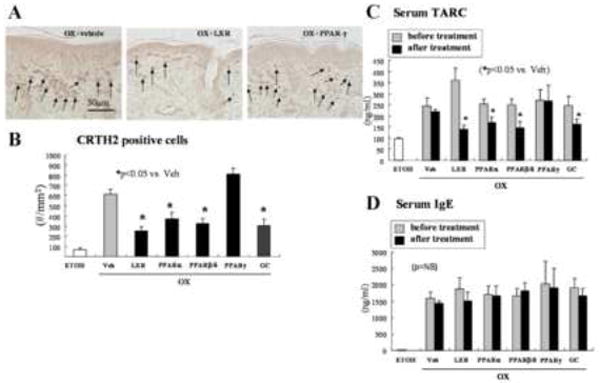
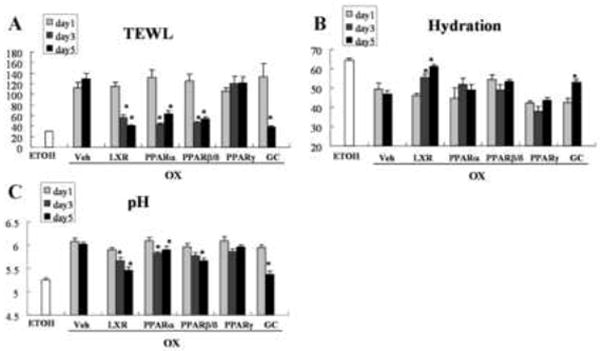
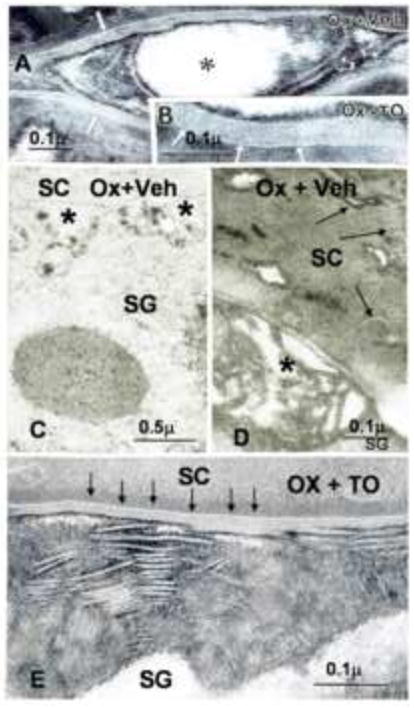
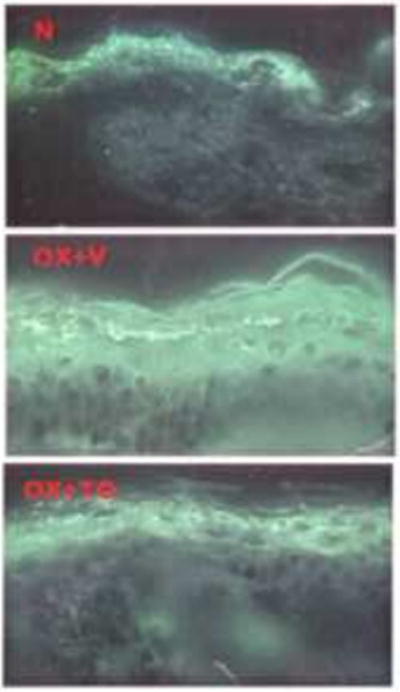
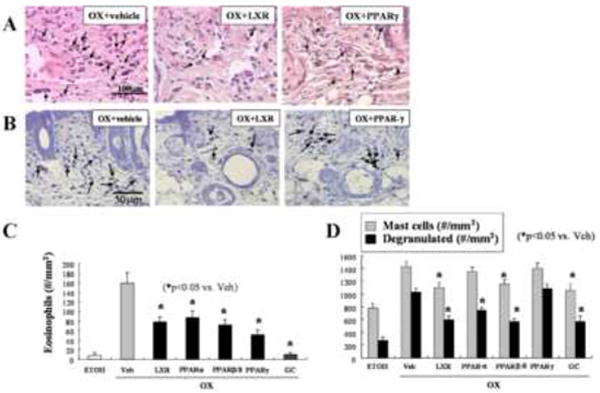
Certain topical activators of PPARalpha, PPARbeta/delta, and LXR, but not activators of PPARgamma, reversed the clinical dermatosis, significantly improved barrier function, and increased stratum corneum hydration in Ox-AD mice. In addition, the same activators, but again not PPARgamma, largely reversed the immunologic abnormalities in Ox-AD mice, including the increased T(H)2 markers, such as tissue eosinophil/mast cell density, serum thymus and activation-related chemokine levels, the density of chemoattractant receptor-homologous molecule expressed on T(H)2-positive lymphocytes (but not serum IgE levels), and reduced IL-1alpha and TNF-alpha activation, despite ongoing hapten challenges.
These results suggest that topical applications of certain activators/ligands of PPARalpha, PPARbeta/delta, and LXR could be useful for the treatment of AD in human subjects.
特应性皮炎(AD)是一种慢性炎症性皮肤病,现在越来越多地与改变角质层结构和功能的突变有关。过氧化物酶体增殖物激活受体(PPAR)α、β/δ和γ以及肝 X 受体(LXR)的激活剂调节表皮蛋白和脂质的产生,从而导致更好的屏障功能。此外,这些激活剂中的一些在激惹性接触性皮炎和急性过敏性接触性皮炎的小鼠模型中表现出很强的抗增生和抗炎活性。
我们评估了过氧化物酶体增殖物激活受体/肝 X 受体(PPAR/LXR)激活在无毛小鼠变应原(氧化唑啉[Ox])诱导的 AD 样模型(Ox-AD)中的疗效。
在肋部用 10 次 Ox 挑战(每隔一天一次)建立 Ox-AD。建立 Ox-AD 后,每天两次局部应用单一的 PPAR/LXR 激活剂,持续 4 天,每隔一天进行 Ox 挑战。评估局部应用 PPAR/LXR 激活剂降低 Ox-AD 参数的疗效,从生理、形态和免疫方面进行评估。
某些 PPARalpha、PPARbeta/delta 和 LXR 的局部激活剂,但不是 PPARgamma 的激活剂,逆转了 Ox-AD 小鼠的临床皮肤病,显著改善了屏障功能,并增加了 Ox-AD 小鼠的角质层水分。此外,同样的激活剂,但再次不是 PPARgamma,在很大程度上逆转了 Ox-AD 小鼠的免疫异常,包括增加 T(H)2 标志物,如组织嗜酸性粒细胞/肥大细胞密度、血清胸腺和激活相关趋化因子水平、表达于 T(H)2 阳性淋巴细胞上的趋化因子受体同源分子的密度(但不是血清 IgE 水平),以及减少 IL-1alpha 和 TNF-alpha 激活,尽管持续存在变应原挑战。
这些结果表明,某些 PPARalpha、PPARbeta/delta 和 LXR 的局部应用激活剂/配体可能对治疗人类 AD 有用。