Cancer Epidemiology Research Unit, Cancer Council New South Wales, PO Box 572, Kings Cross, NSW 1340, Australia.
BMC Cancer. 2009 Oct 14;9:364. doi: 10.1186/1471-2407-9-364.
Previous studies have documented lower breast cancer survival among women with lower socioeconomic status (SES) in the United States. In this study, I examined the extent to which socioeconomic disparity in breast cancer survival was explained by stage at diagnosis, treatment, race and rural/urban residence using the Surveillance, Epidemiology, and End Results (SEER) data.
Women diagnosed with breast cancer during 1998-2002 in the 13 SEER cancer registry areas were followed-up to the end of 2005. The association between an area-based measure of SES and cause-specific five-year survival was estimated using Cox regression models. Six models were used to assess the extent to which SES differences in survival were explained by clinical and demographical factors. The base model estimated the hazard ratio (HR) by SES only and then additional adjustments were made sequentially for: 1) age and year of diagnosis; 2) stage at diagnosis; 3) first course treatment; 4) race; and 5) rural/urban residence.
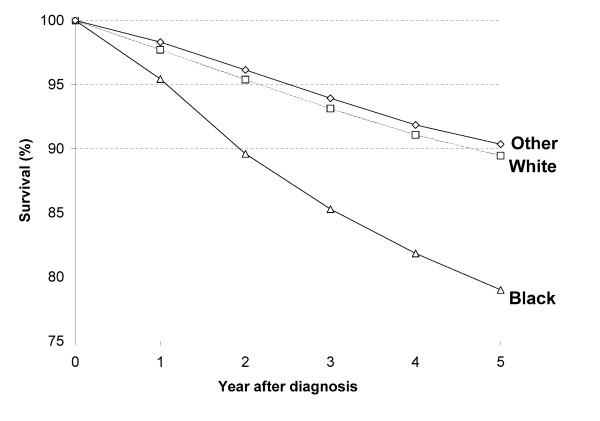
An inverse association was found between SES and risk of dying from breast cancer (p < 0.0001). As area-level SES falls, HR rises (1.00 --> 1.05 --> 1.23 --> 1.31) with the two lowest SES groups having statistically higher HRs. This SES differential completely disappeared after full adjustment for clinical and demographical factors (p = 0.20).
Stage at diagnosis, first course treatment and race explained most of the socioeconomic disparity in breast cancer survival. Targeted interventions to increase breast cancer screening and treatment coverage in patients with lower SES could reduce much of socioeconomic disparity.
先前的研究记录表明,在美国,社会经济地位(SES)较低的女性乳腺癌生存率较低。在这项研究中,我使用监测、流行病学和最终结果(SEER)数据,检查了在诊断时的分期、治疗、种族和城乡居住情况等方面,SES 差异对乳腺癌生存的影响程度。
在 1998 年至 2002 年期间,在 13 个 SEER 癌症登记处被诊断患有乳腺癌的女性被随访至 2005 年底。使用 Cox 回归模型估计了基于区域的 SES 与特定原因五年生存率之间的关联。使用六个模型来评估 SES 差异对生存率的解释程度,这些模型分别考虑了临床和人口统计学因素。基础模型仅通过 SES 来估计风险比(HR),然后依次进行以下调整:1)年龄和诊断年份;2)诊断时的分期;3)初始治疗方案;4)种族;5)城乡居住情况。
SES 与死于乳腺癌的风险之间存在负相关(p<0.0001)。随着区域 SES 的下降,HR 上升(1.00->1.05->1.23->1.31),两个最低 SES 组的 HR 统计上更高。在对临床和人口统计学因素进行充分调整后,这种 SES 差异完全消失(p=0.20)。
诊断时的分期、初始治疗方案和种族解释了乳腺癌生存中 SES 差异的大部分原因。针对 SES 较低的患者增加乳腺癌筛查和治疗覆盖率的靶向干预措施,可以减少 SES 差异的大部分原因。