
隐匿性极小肺癌伴孤立性脑转移,临床诊断为海绵状血管瘤:一例报告
Occult very small lung carcinoma with a solitary brain metastasis that is clinically diagnosed as cavernous hemangioma: a case report.
作者信息
Terada Tadashi
机构信息
Department of Pathology, Shizuoka City Shimizu Hospital Miyakami 1231 Shimizu-Ku, Shizuoka 424-8636 Japan.
出版信息
Cases J. 2009 Aug 19;2:7475. doi: 10.4076/1757-1626-2-7475.
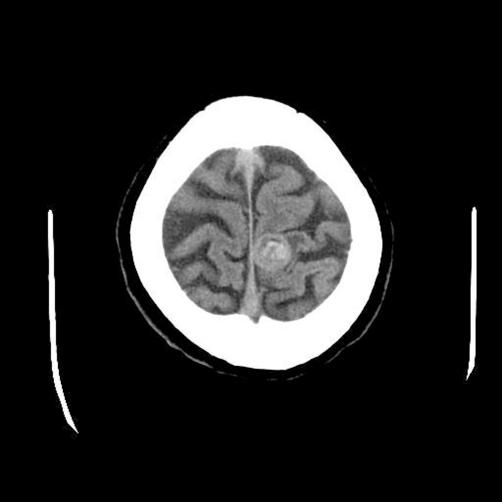
The author reports herein a case of occult very small lung carcinoma with a solitary brain metastasis that is clinically diagnosed as cavernous hemangioma, with an emphasis on pathologic findings. A 48-year-old Japanese man was admitted to our hospital complaining of mild paresis of left leg. Brain CT and MRI showed a solitary tumor (2 cm) with features of cavernous hemangioma in the right temporal lobe. Tumorectomy was performed, and it was pathologically undifferentiated carcinoma. An immunohistochemical analysis reveled that the carcinoma cells were positive for four types of pancytokeratin, cytokeratin (CK) 5/6, CK7, CK18, CK19, p63, and Ki-67 (78%). They were negative for high molecular weight CK, CK14, CK20, TTF-1, PE-10, melanosome, S100 protein, EMA, vimentin, CD34, myoglobin, CEA, p53, desmin, alpha-smooth muscle actin, chromogranin, synaptophysin, CD56, neuron-specific enolase, CD68, KIT, and PDGFRA. The positive CK7 and negative CK20 suggested lung origin, and cytokeratin profiles and positive CK5/6 and p63 suggested a squamous differentiation. The pathological diagnosis was undifferentiated carcinoma with squamous differentiation probably of lung origin. Later, systemic CT, MRI and PET were performed, and they detected a small lung tumor (8 mm) in the right apex. The lung biopsy revealed an undifferentiated carcinoma with focal squamous differentiation; the immunohistochemical findings were the same as those of the brain tumor. These findings suggest that occult very small lung carcinoma can metastasize to brain and such a metastasis may mimic cavernous hemangioma radiologically. Pathologic observations using many antibodies are very useful to determine the origin and histological type in solitary brain nodule.
本文作者报告了一例隐匿性微小肺癌伴孤立性脑转移瘤的病例,该脑转移瘤临床诊断为海绵状血管瘤,重点介绍其病理表现。一名48岁的日本男性因左腿轻度无力入院。脑部CT和MRI显示右颞叶有一个具有海绵状血管瘤特征的孤立性肿瘤(2厘米)。行肿瘤切除术,病理检查为未分化癌。免疫组化分析显示,癌细胞对四种全细胞角蛋白、细胞角蛋白(CK)5/6、CK7、CK18、CK19、p63和Ki-67(78%)呈阳性。它们对高分子量CK、CK14、CK20、TTF-1、PE-10、黑素体、S100蛋白、EMA、波形蛋白、CD34、肌红蛋白、CEA、p53、结蛋白、α-平滑肌肌动蛋白、嗜铬粒蛋白、突触素、CD56、神经元特异性烯醇化酶、CD68、KIT和PDGFRA呈阴性。CK7阳性和CK20阴性提示肺来源,细胞角蛋白谱以及CK5/6和p63阳性提示鳞状分化。病理诊断为可能起源于肺的伴鳞状分化的未分化癌。后来,进行了全身CT、MRI和PET检查,发现右肺尖有一个小的肺部肿瘤(8毫米)。肺活检显示为伴有局灶性鳞状分化的未分化癌;免疫组化结果与脑肿瘤相同。这些发现表明,隐匿性微小肺癌可转移至脑部,且这种转移在影像学上可能类似海绵状血管瘤。使用多种抗体进行病理观察对于确定孤立性脑结节的起源和组织学类型非常有用。



 Zotero 插件