Department of Medicine, Karolinska Institutet at Karolinska University Hospital, Stockholm, Sweden.
Diabetes. 2010 Jan;59(1):105-9. doi: 10.2337/db09-0942. Epub 2009 Oct 21.
Adipose tissue may contain few large adipocytes (hypertrophy) or many small adipocytes (hyperplasia). We investigated factors of putative importance for adipose tissue morphology.
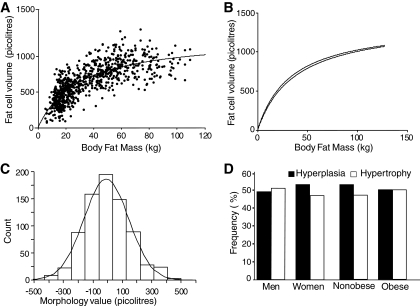
Subcutaneous adipocyte size and total fat mass were compared in 764 subjects with BMI 18-60 kg/m(2). A morphology value was defined as the difference between the measured adipocyte volume and the expected volume given by a curved-line fit for a given body fat mass and was related to insulin values. In 35 subjects, in vivo adipocyte turnover was measured by exploiting incorporation of atmospheric (14)C into DNA.
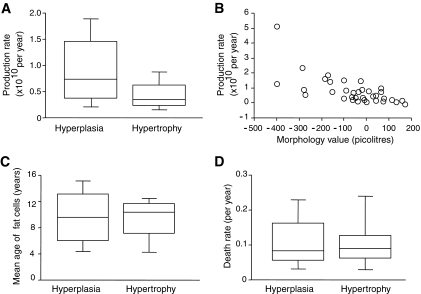
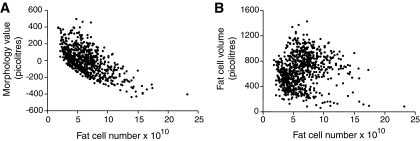
Occurrence of hyperplasia (negative morphology value) or hypertrophy (positive morphology value) was independent of sex and body weight but correlated with fasting plasma insulin levels and insulin sensitivity, independent of adipocyte volume (beta-coefficient = 0.3, P < 0.0001). Total adipocyte number and morphology were negatively related (r = -0.66); i.e., the total adipocyte number was greatest in pronounced hyperplasia and smallest in pronounced hypertrophy. The absolute number of new adipocytes generated each year was 70% lower (P < 0.001) in hypertrophy than in hyperplasia, and individual values for adipocyte generation and morphology were strongly related (r = 0.7, P < 0.001). The relative death rate (approximately 10% per year) or mean age of adipocytes (approximately 10 years) was not correlated with morphology.
Adipose tissue morphology correlates with insulin measures and is linked to the total adipocyte number independently of sex and body fat level. Low generation rates of adipocytes associate with adipose tissue hypertrophy, whereas high generation rates associate with adipose hyperplasia.
脂肪组织可能含有少数大脂肪细胞(肥大)或许多小脂肪细胞(增生)。我们研究了脂肪组织形态的潜在重要因素。
在 BMI 为 18-60 kg/m(2)的 764 名受试者中比较了皮下脂肪细胞大小和总脂肪质量。形态值定义为测量的脂肪细胞体积与给定体脂质量的曲线拟合所预期的体积之间的差异,并与胰岛素值相关。在 35 名受试者中,通过利用大气(14)C 掺入 DNA 来测量体内脂肪细胞的周转率。
增生(负形态值)或肥大(正形态值)的发生与性别和体重无关,但与空腹血浆胰岛素水平和胰岛素敏感性相关,与脂肪细胞体积无关(β系数=0.3,P<0.0001)。总脂肪细胞数量和形态呈负相关(r=-0.66);也就是说,在明显的增生中总脂肪细胞数量最大,在明显的肥大中最小。每年生成的新脂肪细胞数量减少了 70%(P<0.001),肥大比增生少,并且脂肪细胞生成和形态的个体值密切相关(r=0.7,P<0.001)。脂肪细胞的相对死亡率(每年约 10%)或平均年龄(约 10 年)与形态无关。
脂肪组织形态与胰岛素测量值相关,并与性别和体脂水平无关,与总脂肪细胞数量有关。脂肪细胞生成率低与脂肪组织肥大有关,而生成率高与脂肪组织增生有关。