Division of Endocrinology, University of Toronto, Toronto, Ontario, Canada.
Kidney Int. 2010 Jan;77(1):57-64. doi: 10.1038/ki.2009.399.
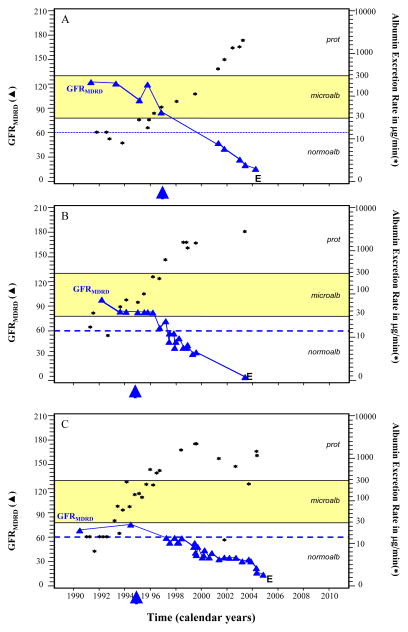
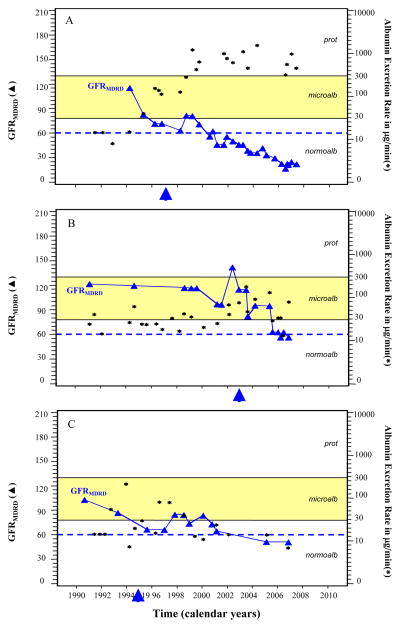
We sought to study new-onset microalbuminuria, its progression, and the decline of renal function in patients with type 1 diabetes. Using a cohort of 109 patients who developed new-onset microalbuminuria in the first 4 years following enrollment in the 1st Joslin Kidney Study, we simultaneously tracked the change in their renal function and urinary albumin excretion. Of these, 79 patients were followed for an average of 12 years after microalbuminuria onset, wherein their glomerular filtration rate was estimated by the Modification of Diet in Renal Disease Study formula and compared with their microalbuminuria and proteinuria. The concordance between these outcomes was weak. Only 12 of the 23 patients who progressed to advanced (stage 3-5) chronic kidney disease developed proteinuria, which, in general, did not precede but accompanied the progression to advanced chronic kidney disease. The remaining 11 patients who developed advanced disease had persistent microalbuminuria or returned to normal albuminuria. Thus, we found that one-third of patients with type 1 diabetes developed advanced chronic kidney disease relatively soon after the onset of microalbuminuria and this was not conditional on the presence of proteinuria. Contrary to the existing concept of early nephropathy in type 1 diabetes, less emphasis should be placed on the mechanisms of progression to proteinuria and more placed on mechanisms initiating and promoting the early decline of renal function that eventually progresses to advanced chronic kidney disease.
我们旨在研究 1 型糖尿病患者中新发微量白蛋白尿的发生、进展以及肾功能下降情况。本研究纳入了 109 名在第 1 次 Joslin 肾脏研究入组后 4 年内发生新发微量白蛋白尿的患者,我们同步追踪了他们的肾功能和尿白蛋白排泄变化。其中,79 名患者在微量白蛋白尿发病后平均随访 12 年,在此期间,我们采用肾脏病饮食改良研究公式估计了他们的肾小球滤过率,并将其与微量白蛋白尿和蛋白尿进行了比较。这些结果之间的一致性较弱。在进展为晚期(3-5 期)慢性肾脏病的 23 名患者中,仅有 12 名患者出现蛋白尿,一般来说,蛋白尿并没有先于进展为晚期慢性肾脏病,而是伴随其发生。其余 11 名进展为晚期疾病的患者一直存在微量白蛋白尿或恢复至正常白蛋白尿。因此,我们发现,1/3 的 1 型糖尿病患者在微量白蛋白尿发生后不久就会发展为晚期慢性肾脏病,而且这并不取决于蛋白尿的存在。与 1 型糖尿病早期肾病的现有概念相反,应该较少关注向蛋白尿进展的机制,而更多地关注启动和促进最终进展为晚期慢性肾脏病的早期肾功能下降的机制。