Mora Thierry, Yu Howard, Sowa Yoshiyuki, Wingreen Ned S
Lewis-Sigler Institute for Integrative Genomics, Princeton University, Princeton, New Jersey, United States of America.
PLoS Comput Biol. 2009 Oct;5(10):e1000540. doi: 10.1371/journal.pcbi.1000540. Epub 2009 Oct 23.
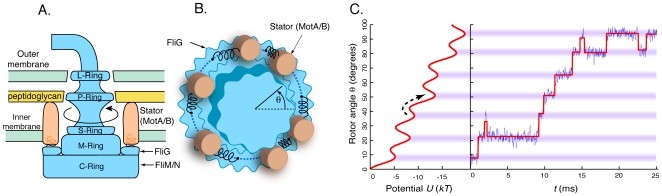
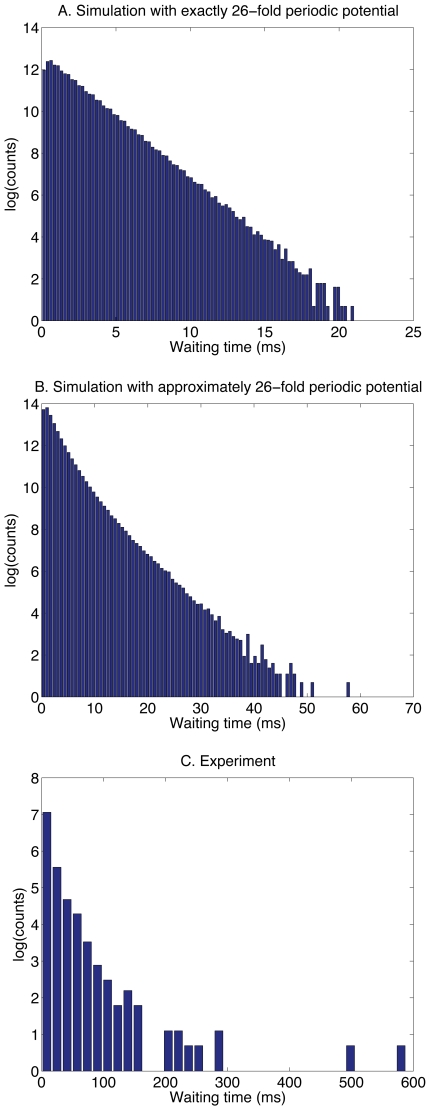
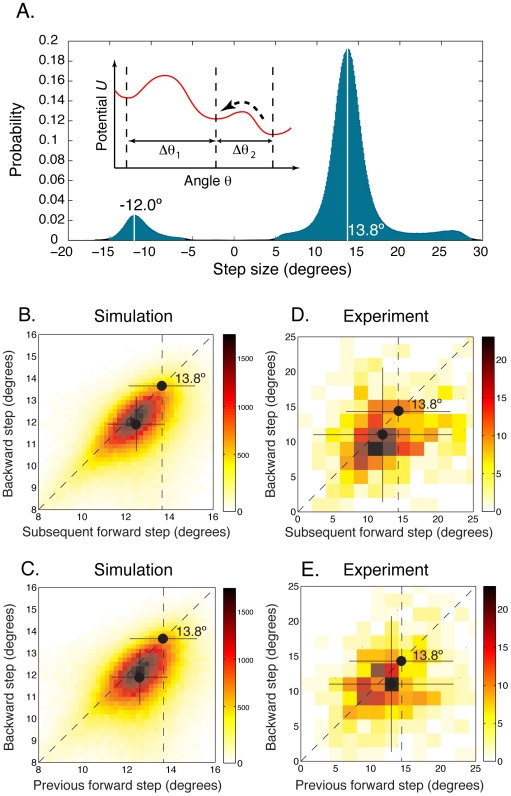
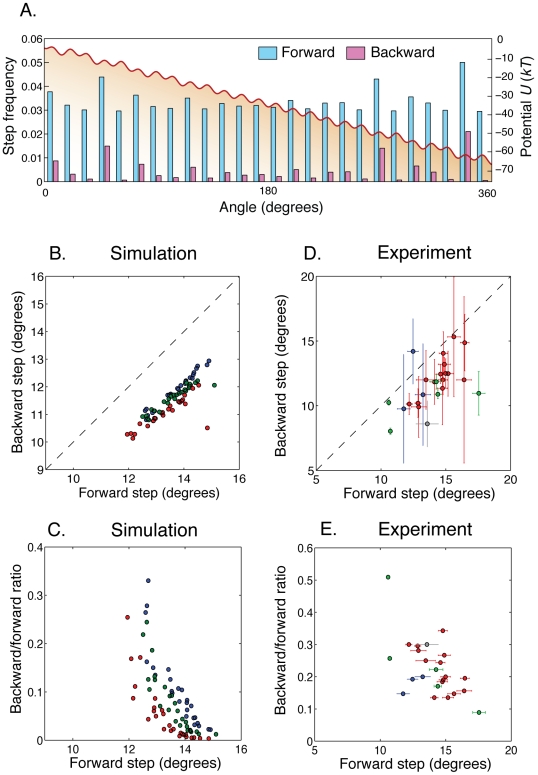
The bacterial flagellar motor is a highly efficient rotary machine used by many bacteria to propel themselves. It has recently been shown that at low speeds its rotation proceeds in steps. Here we propose a simple physical model, based on the storage of energy in protein springs, that accounts for this stepping behavior as a random walk in a tilted corrugated potential that combines torque and contact forces. We argue that the absolute angular position of the rotor is crucial for understanding step properties and show this hypothesis to be consistent with the available data, in particular the observation that backward steps are smaller on average than forward steps. We also predict a sublinear speed versus torque relationship for fixed load at low torque, and a peak in rotor diffusion as a function of torque. Our model provides a comprehensive framework for understanding and analyzing stepping behavior in the bacterial flagellar motor and proposes novel, testable predictions. More broadly, the storage of energy in protein springs by the flagellar motor may provide useful general insights into the design of highly efficient molecular machines.
细菌鞭毛马达是许多细菌用于推动自身的高效旋转机器。最近研究表明,在低速时其旋转呈阶梯式进行。在此,我们基于蛋白质弹簧中能量的存储提出一个简单的物理模型,该模型将这种阶梯行为解释为在结合了扭矩和接触力的倾斜波纹势场中的随机游走。我们认为转子的绝对角位置对于理解阶梯特性至关重要,并表明这一假设与现有数据一致,特别是观察到向后的阶梯平均比向前的阶梯小。我们还预测了在低扭矩下固定负载时速度与扭矩的亚线性关系,以及转子扩散随扭矩变化的峰值。我们的模型为理解和分析细菌鞭毛马达中的阶梯行为提供了一个全面的框架,并提出了新颖且可测试的预测。更广泛地说,鞭毛马达通过蛋白质弹簧存储能量可能为高效分子机器的设计提供有用的一般性见解。