Ollivier Lénaïck, Romand Olivier, Marimoutou Catherine, Michel Rémy, Pognant Corinne, Todesco Alain, Migliani René, Baudon Dominique, Boutin Jean-Paul
Institut de médecine tropicale du Service de santé des armées, Département d'épidémiologie et de santé publique Sud, Marseille, France.
Malar J. 2009 Oct 23;8:236. doi: 10.1186/1475-2875-8-236.
Malaria chemoprophylaxis compliance is suboptimal among French soldiers despite the availability of free malaria chemoprophylaxis and repeated health education before, during and after deployment to malaria endemic areas.
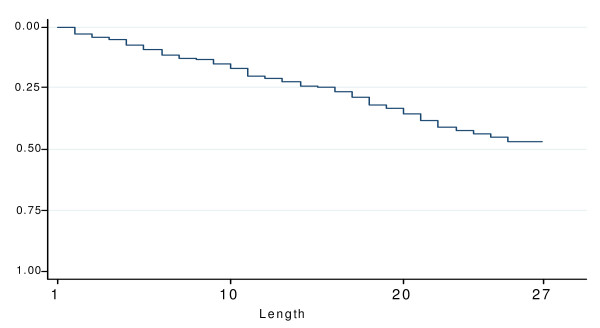
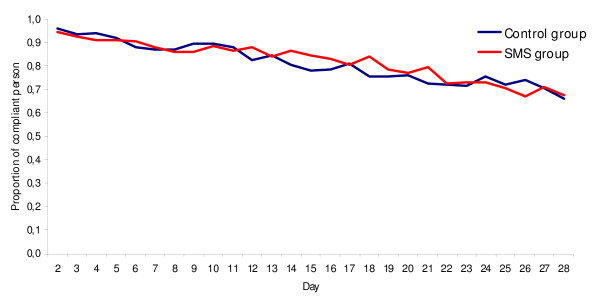
In 2007, a randomized controlled study was performed among a cohort of French soldiers returning from Côte d'Ivoire to assess the feasibility and acceptability of sending a daily short message service (SMS) reminder message via mobile device to remind soldiers to take their malaria chemoprophylaxis, and to assess the impact of the daily reminder SMS on chemoprophylaxis compliance. Malaria chemoprophylaxis consisted of a daily dose of 100 mg doxycycline monohydrate, which began upon arrival in Côte d'Ivoire and was to be continued for 28 days following return to France. Feasibility and acceptability were assessed by questionnaire. Cohort members were followed for a 28 day period, with compliance assessed by use of an electronic medication monitoring device, from which several indicators were developed: daily proportion of compliant individuals, average number of pills taken, and early discontinuation.
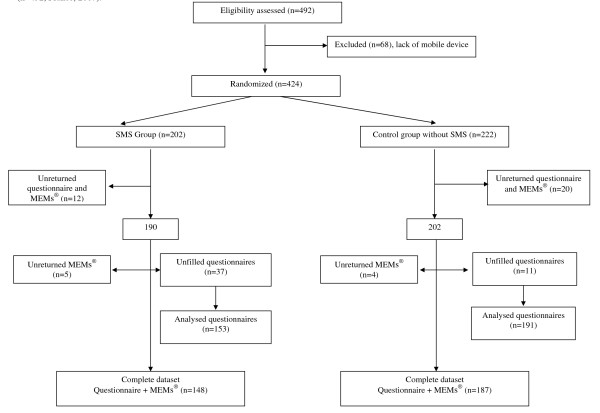
Among 424 volunteers randomized to the study, 47.6% were assigned to the SMS group and 52.3% to the control group. Approximately 90% of subjects assigned to the SMS group received a daily SMS at midday during the study. Persons of the SMS group agreed more frequently that SMS reminders were very useful and that the device was not annoying. Compliance did not vary significantly between groups across the compliance indicators.
SMS did not increase malaria chemoprophylaxis compliance above baseline, likely because the persons did not benefit from holidays after the return and stayed together. So the reminder by SMS was noted by all subjects of the study. Another study should be done to confirm these results on soldiers going on holidays from employment after return or with individual travellers.
尽管有免费的疟疾预防药物,且在法国士兵部署到疟疾流行地区之前、期间和之后都进行了反复的健康教育,但他们对疟疾预防药物的依从性仍不理想。
2007年,对一组从科特迪瓦返回的法国士兵进行了一项随机对照研究,以评估通过移动设备发送每日短信提醒信息,提醒士兵服用疟疾预防药物的可行性和可接受性,并评估每日提醒短信对预防药物依从性的影响。疟疾预防药物为每日服用100毫克一水合多西环素,抵达科特迪瓦后开始服用,返回法国后持续服用28天。通过问卷调查评估可行性和可接受性。对队列成员进行为期28天的随访,使用电子药物监测设备评估依从性,并据此制定了几个指标:依从个体的每日比例、平均服药片数和提前停药情况。
在随机分组参与研究的424名志愿者中,47.6%被分配到短信组,52.3%被分配到对照组。在研究期间,分配到短信组的受试者中约90%每天中午收到短信。短信组的人更频繁地认为短信提醒非常有用,且该设备不烦人。在各项依从性指标上,两组之间的依从性没有显著差异。
短信并没有使疟疾预防药物的依从性高于基线水平,可能是因为这些人返回后没有享受假期且一直在一起。因此,研究中的所有受试者都注意到了短信提醒。应该进行另一项研究,以证实这些结果是否适用于返回后休假的士兵或个体旅行者。