Vermeulen E, Schmidt M K, Aaronson N K, Kuenen M, Baas-Vrancken Peeters M-J, van der Poel H, Horenblas S, Boot H, Verwaal V J, Cats A, van Leeuwen F E
The Netherlands Cancer Institute, Plesmanlaan 121, Amsterdam 1066 CX, The Netherlands.
Br J Cancer. 2009 Nov 3;101(9):1505-12. doi: 10.1038/sj.bjc.6605339. Epub 2009 Sep 29.
The aims of this study were to determine which consent procedure patients prefer for use of stored tissue for research purposes and what the effects of consent procedures on actual consenting behaviour are.
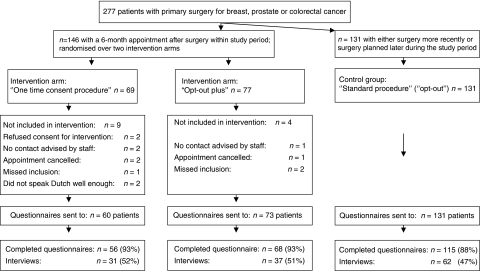
We offered 264 cancer patients three different consent procedures: 'one-time general consent' (asked written informed consent), 'opt-out plus' (had the opportunity to opt out by a form), or the standard hospital procedure (control group). The two intervention groups received a specific leaflet about research with residual tissue and verbal information. The control group only received a general hospital leaflet including opt-out information, which is the procedure currently in use. Subsequently, all patients received a questionnaire to examine their preferences for consent procedures.
In all, 99% of patients consented to research with their residual tissue. In the 'one-time consent' group 85% sent back their consent form. Patients preferred 'opt-out plus' (43%) above 'one-time consent' (34%) or 'opt-out' (16%), whereas 8% indicated that they did not need to receive information about research with residual tissues or be given the opportunity to make a choice.
The 'opt-out plus' procedure, which places fewer demands on administrative resources than 'one-time consent', can also address the information needs of patients.
本研究旨在确定患者更倾向于哪种用于研究目的的储存组织的同意程序,以及同意程序对实际同意行为有何影响。
我们为264名癌症患者提供了三种不同的同意程序:“一次性通用同意”(要求书面知情同意)、“选择退出加”(有机会通过表格选择退出)或标准医院程序(对照组)。两个干预组收到了一份关于使用剩余组织进行研究的特定传单和口头信息。对照组只收到一份包含选择退出信息的普通医院传单,这是目前正在使用的程序。随后,所有患者都收到一份问卷,以调查他们对同意程序的偏好。
总体而言,99%的患者同意使用其剩余组织进行研究。在“一次性同意”组中,85%的患者寄回了同意书。患者更喜欢“选择退出加”(43%),而不是“一次性同意”(34%)或“选择退出”(16%),而8%的患者表示他们不需要收到关于使用剩余组织进行研究的信息,也不需要有机会做出选择。
“选择退出加”程序对行政资源的要求低于“一次性同意”,同时也能满足患者的信息需求。