Barbaro Vanessa, Ferrari Stefano, Fasolo Adriano, Ponzin Diego, Di Iorio Enzo
The Veneto Eye Bank Foundation, Venice, Italy.
Mol Vis. 2009 Oct 17;15:2084-93.
To reconstruct a human hemicornea in vitro by means of limbal stem cells cultured onto human keratoplasty lenticules (HKLs) and to obtain a natural corneal graft for clinical applications.
Limbal stem cells were seeded onto HKLs with or without the presence of feeder layers of lethally irradiated 3T3-J2 cells and compared with the current "gold standard" scaffold, i.e., the fibrin glue. The effects of the scaffold on the preservation of stemness and/or induction of differentiation pathways were investigated through analysis of a variety of markers, including p63 and DeltaNp63alpha for stemness, 14-3-3sigma for early differentiation, keratins 3, 14, 12, and 19 to determine cell phenotype, and alpha6, beta1, and beta4 integrins to evaluate interactions with the stroma. Integrity of the stroma was assessed through analysis of keratan sulfate, CD-34 and aldehyde dehydrogenase 3A1 (ALDH3A1) (for keratocytes), visual system homeobox 1 (VSX1), and alpha-smooth muscle actin (alpha-SMA) (for fibroblasts and myofibroblasts). The structural properties of the reconstructed "hemicornea" were investigated through scanning electron microscopy. To evaluate the preservation of the stemness potential, cells were trypsinized from each scaffold and clonogenic/proliferative characteristics analyzed.
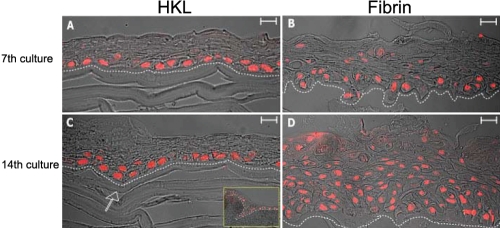
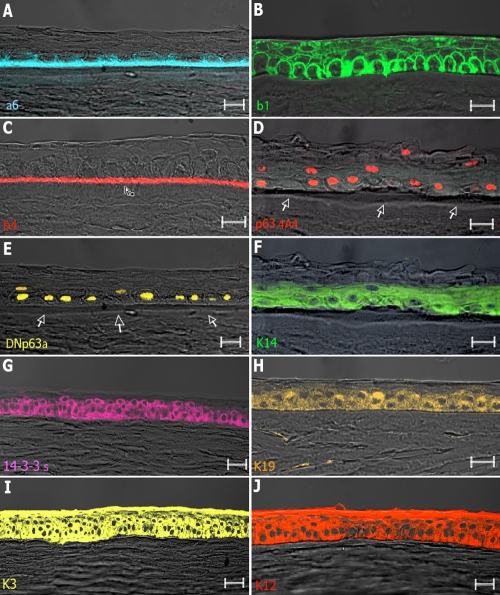
Limbal stem cells expanded onto HKLs gave rise to a stratified squamous keratinized epithelium morphologically similar to that of normal corneas. The resulting corneal epithelium was characterized by basal expression of p63 and DeltaNp63alpha, while expression of 14-3-3sigma, keratin 3, and keratin 12 was found in the upper cell layers. The basal cuboidal epithelial cells were anchored to the basement membrane and expressed keratin 14 and alpha6, beta1, and beta4 integrins. In the stroma of HKLs, keratocytes maintained the biosynthetic and phenotypic appearances typical of resting/quiescent cells and expressed keratan sulfate, CD-34, and ALDH3A1. Fibroblastic transformation was observed with the appearance of VSX1 and alpha-SMA. Scanning electron microscopy analysis showed that HKLs maintained their native conformation with collagen fibrils interconnected to the network and parallel to the corneal surface. HKLs did not alter the clonogenic/proliferative capacity of limbal stem cells. No differences were seen when HKL was compared to fibrin glue, one of the scaffolds currently used for limbal stem cell transplantation.
Our findings demonstrate that HKL could be a suitable scaffold for corneal epithelial stem cells as they were shown to proliferate, express differentiation markers, and bind to the underlying stroma with no alterations in clonogenic potential. HKLs have some advantages over currently used scaffolds, such as the possibility to allow cell growth with no feeder layers, to be freeze dried, and to preserve the integrity and viability of stromal keratocytes. The development of a tissue-engineered "hemicornea" might offer new therapeutic perspectives to patients affected by total limbal stem cell deficiency with stromal scarring.
通过将角膜缘干细胞接种到人类角膜移植片(HKLs)上,在体外重建人半角膜,并获得用于临床应用的天然角膜移植物。
将角膜缘干细胞接种到有或没有经致死剂量照射的3T3-J2细胞饲养层的HKLs上,并与当前的“金标准”支架即纤维蛋白胶进行比较。通过分析多种标志物来研究支架对干性维持和/或分化途径诱导的影响,包括用于干性的p63和DeltaNp63alpha、用于早期分化的14-3-3sigma、用于确定细胞表型的角蛋白3、14、12和19,以及用于评估与基质相互作用的α6、β1和β4整合素。通过分析硫酸角质素、CD-34和醛脱氢酶3A1(ALDH3A1)(用于角膜细胞)、视觉系统同源框1(VSX1)和α-平滑肌肌动蛋白(α-SMA)(用于成纤维细胞和肌成纤维细胞)来评估基质的完整性。通过扫描电子显微镜研究重建的“半角膜”的结构特性。为了评估干性潜能的维持情况,从每个支架上胰蛋白酶消化细胞并分析克隆形成/增殖特性。
接种到HKLs上的角膜缘干细胞产生了形态上类似于正常角膜的分层鳞状角化上皮。所得角膜上皮的特征是p63和DeltaNp63alpha的基础表达,而在细胞上层发现14-3-3sigma、角蛋白3和角蛋白12的表达。基底立方上皮细胞锚定在基底膜上并表达角蛋白14以及α6、β1和β4整合素。在HKLs的基质中,角膜细胞保持了静止/静息细胞典型的生物合成和表型外观,并表达硫酸角质素、CD-34和ALDH3A1。随着VSX1和α-SMA的出现观察到成纤维细胞转化。扫描电子显微镜分析表明,HKLs保持其天然构象,胶原纤维相互连接成网络并与角膜表面平行。HKLs没有改变角膜缘干细胞的克隆形成/增殖能力。将HKL与纤维蛋白胶(目前用于角膜缘干细胞移植的支架之一)进行比较时未发现差异。
我们的研究结果表明,HKL可能是角膜上皮干细胞的合适支架,因为它们显示出增殖、表达分化标志物并与下层基质结合,且克隆形成潜能没有改变。HKLs比目前使用的支架具有一些优势,例如无需饲养层即可允许细胞生长、可冻干以及保持基质角膜细胞的完整性和活力。组织工程“半角膜”的开发可能为受全角膜缘干细胞缺乏伴基质瘢痕影响的患者提供新的治疗前景。