Department of Psychiatry and Behavioral Sciences, School of Medicine, Duke Clinical Research Institute, Duke University Medical Center, Durham, North Carolina 27710, USA.
Am J Addict. 2009 Nov-Dec;18(6):452-61. doi: 10.3109/10550490903206049.
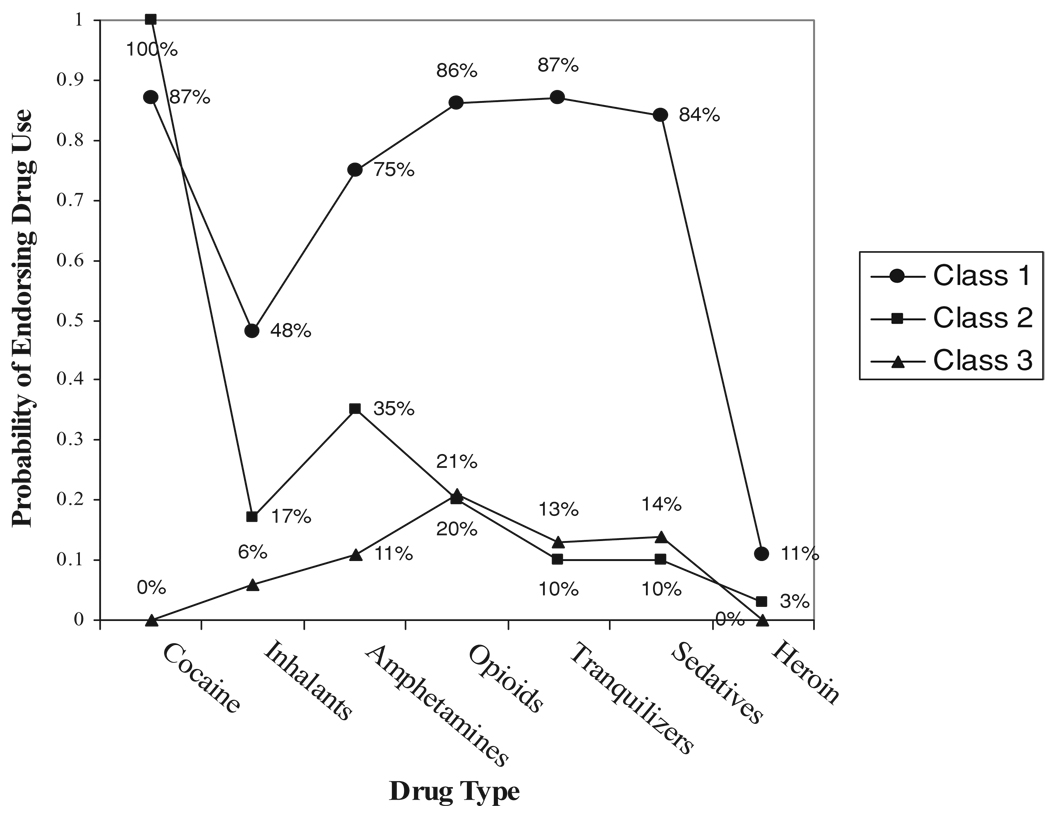
This study investigates the potential heterogeneity of ecstasy or MDMA (3,4-methylenedioxy-N-methylamphetamine) users. Data came from the 2001-2002 National Epidemiologic Survey on Alcohol and Related Conditions (NESARC). Latent class analysis (LCA) and multinomial logistic regression procedures were used to identify subtypes of ecstasy users. Approximately 1.6% (n = 562) of adult participants (N = 43,093) reported lifetime ecstasy use. LCA identified three subtypes of ecstasy users. Class 1 exhibited pervasive use of most drug classes (ecstasy-polydrug users, 37%). Class 2 reported a high rate of use of marijuana and cocaine and a moderate use of amphetamines (ecstasy-marijuana-stimulant users, 29%). Class 3 was characterized by a high rate of use of marijuana and a low use of primarily prescription-type drugs (ecstasy-marijuana users, 34%). Subtypes were distinguished by family income, history of substance abuse treatment, and familial substance abuse. Class 1 exhibited the highest prevalence of disorders related to the use of marijuana (77%), tobacco (66%), amphetamines (36%), opioids (35%), sedatives (31%), and tranquilizers (30%). The recent resurgence in ecstasy use among adults underscores the need to monitor trends in its use.
这项研究调查了摇头丸或 MDMA(3,4-亚甲基二氧甲基苯丙胺)使用者的潜在异质性。数据来自 2001-2002 年全国酒精和相关条件流行病学调查(NESARC)。潜在类别分析(LCA)和多项逻辑回归程序用于识别摇头丸使用者的亚型。大约 1.6%(n=562)的成年参与者(N=43093)报告有过摇头丸使用史。LCA 确定了三种摇头丸使用者的亚型。第 1 类表现出对大多数药物类别的普遍使用(摇头丸-多药使用者,37%)。第 2 类报告大麻和可卡因的使用率较高,安非他命的使用率中等(摇头丸-大麻-兴奋剂使用者,29%)。第 3 类的特点是大麻使用率高,主要处方药使用率低(摇头丸-大麻使用者,34%)。亚型通过家庭收入、药物滥用治疗史和家族药物滥用来区分。第 1 类与大麻(77%)、烟草(66%)、安非他命(36%)、阿片类(35%)、镇静剂(31%)和安定剂(30%)使用相关的障碍发生率最高。成年人中摇头丸使用的近期复苏突显了监测其使用趋势的必要性。