Division of Biological Sciences, Cell and Developmental Biology Section and Center for Molecular Genetics, University of California, San Diego, 9500 Gilman Drive, La Jolla, CA 92093-0116, USA.
Plant J. 2010 Jan;61(2):290-9. doi: 10.1111/j.1365-313X.2009.04054.x. Epub 2009 Oct 26.
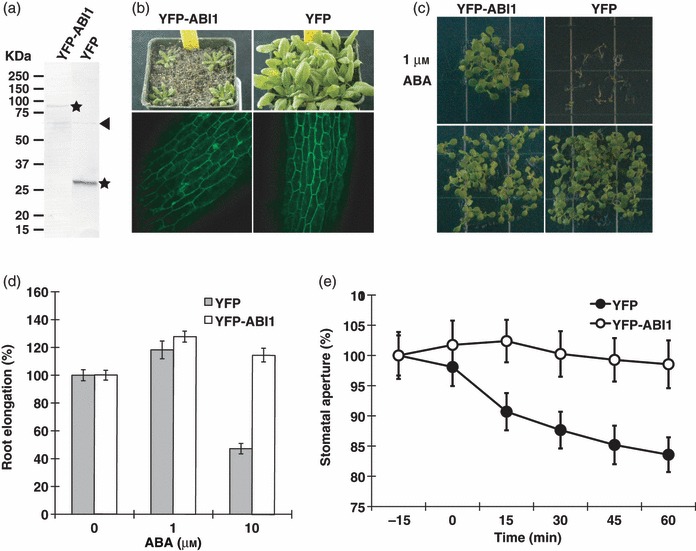
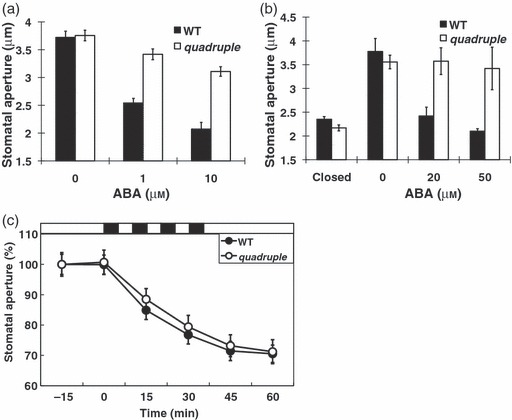
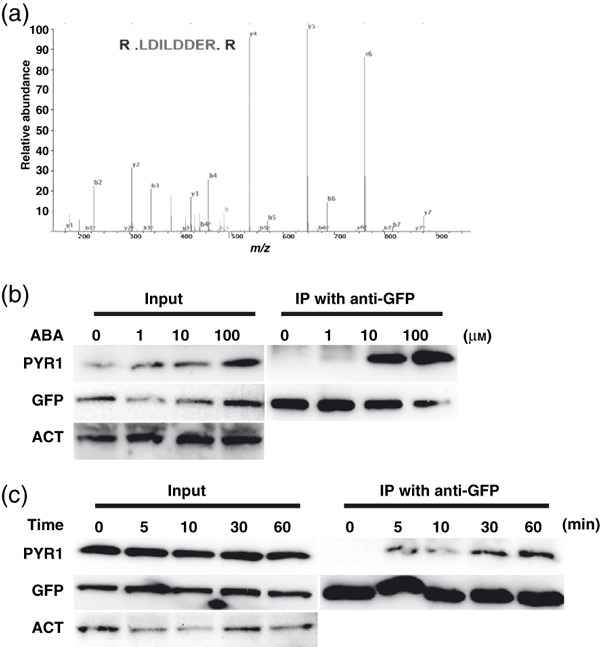
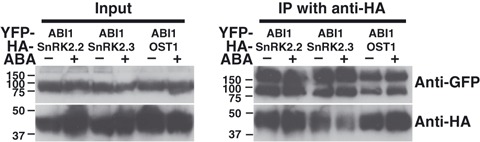
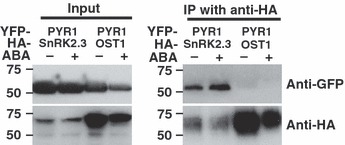
Abscisic acid (ABA) mediates resistance to abiotic stress and controls developmental processes in plants. The group-A PP2Cs, of which ABI1 is the prototypical member, are protein phosphatases that play critical roles as negative regulators very early in ABA signal transduction. Because redundancy is thought to limit the genetic dissection of early ABA signalling, to identify redundant and early ABA signalling proteins, we pursued a proteomics approach. We generated YFP-tagged ABI1 Arabidopsis expression lines and identified in vivo ABI1-interacting proteins by mass-spectrometric analyses of ABI1 complexes. Known ABA signalling components were isolated including SnRK2 protein kinases. We confirm previous studies in yeast and now show that ABI1 interacts with the ABA-signalling kinases OST1, SnRK2.2 and SnRK2.3 in plants. Interestingly, the most robust in planta ABI1-interacting proteins in all LC-MS/MS experiments were nine of the 14 PYR/PYL/RCAR proteins, which were recently reported as ABA-binding signal transduction proteins, providing evidence for in vivo PYR/PYL/RCAR interactions with ABI1 in Arabidopsis. ABI1-PYR1 interaction was stimulated within 5 min of ABA treatment in Arabidopsis. Interestingly, in contrast, PYR1 and SnRK2.3 co-immunoprecipitated equally well in the presence and absence of ABA. To investigate the biological relevance of the PYR/PYLs, we analysed pyr1/pyl1/pyl2/pyl4 quadruple mutant plants and found strong insensitivities in ABA-induced stomatal closure and ABA-inhibition of stomatal opening. These findings demonstrate that ABI1 can interact with several PYR/PYL/RCAR family members in Arabidopsis, that PYR1-ABI1 interaction is rapidly stimulated by ABA in Arabidopsis and indicate new SnRK2 kinase-PYR/PYL/RCAR interactions in an emerging model for PYR/PYL/RCAR-mediated ABA signalling.
脱落酸 (ABA) 介导植物对非生物胁迫的抗性并控制其发育过程。组-A PP2Cs 是蛋白磷酸酶,作为 ABA 信号转导早期的负调控因子发挥关键作用,其中 ABI1 是典型成员。由于冗余性被认为限制了早期 ABA 信号的遗传剖析,因此为了鉴定冗余和早期的 ABA 信号蛋白,我们采用了蛋白质组学方法。我们生成了 YFP 标记的 ABI1 拟南芥表达系,并通过对 ABI1 复合物的质谱分析鉴定了体内 ABI1 相互作用蛋白。包括 SnRK2 蛋白激酶在内的已知 ABA 信号成分被分离出来。我们证实了之前在酵母中的研究结果,现在表明 ABI1 在植物中与 ABA 信号激酶 OST1、SnRK2.2 和 SnRK2.3 相互作用。有趣的是,在所有 LC-MS/MS 实验中,与 ABI1 相互作用最强烈的植物体内蛋白是 14 个 PYR/PYL/RCAR 蛋白中的 9 个,这些蛋白最近被报道为 ABA 结合的信号转导蛋白,为 PYR/PYL/RCAR 在拟南芥中与 ABI1 的体内相互作用提供了证据。在 ABA 处理后 5 分钟内,ABI1-PYR1 相互作用被刺激。有趣的是,相比之下,在存在和不存在 ABA 的情况下,PYR1 和 SnRK2.3 同样很好地共免疫沉淀。为了研究 PYR/PYLs 的生物学相关性,我们分析了 pyr1/pyl1/pyl2/pyl4 四重突变体植物,发现其对 ABA 诱导的气孔关闭和 ABA 抑制的气孔开放具有强烈的不敏感性。这些发现表明,ABI1 可以与拟南芥中的几个 PYR/PYL/RCAR 家族成员相互作用,PYR1-ABI1 相互作用在 ABA 处理后迅速被刺激,并表明在新兴的 PYR/PYL/RCAR 介导的 ABA 信号模型中存在新的 SnRK2 激酶-PYR/PYL/RCAR 相互作用。