CAGT-Center for Applied Genotyping, Max Planck Institute of Psychiatry, Munich, Germany.
PLoS One. 2009 Nov 2;4(11):e7654. doi: 10.1371/journal.pone.0007654.
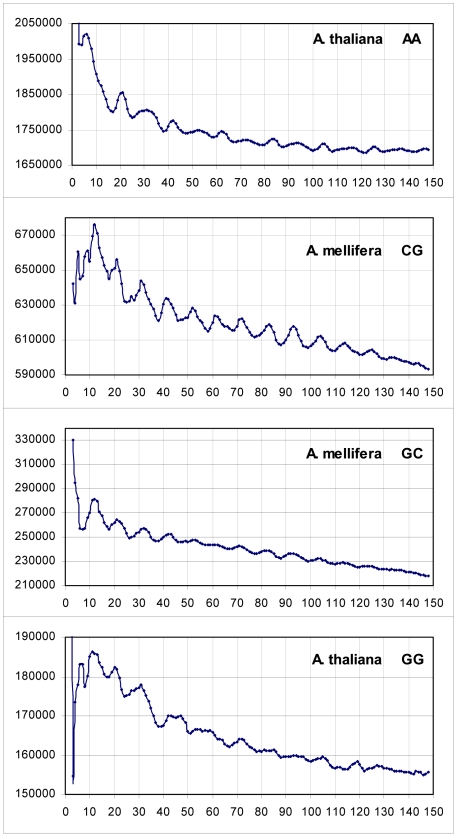
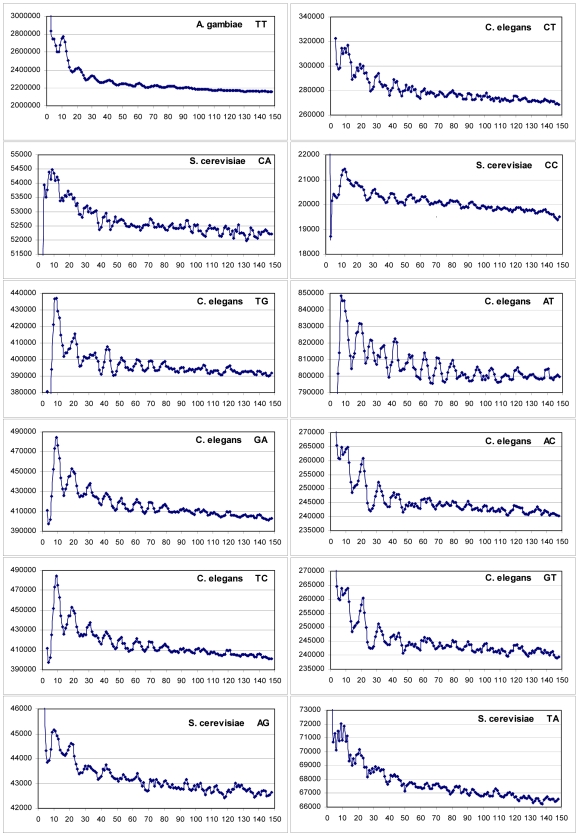
It is generally accepted that the organization of eukaryotic DNA into chromatin is strongly governed by a code inherent in the genomic DNA sequence. This code, as well as other codes, is superposed on the triplets coding for amino acids. The history of the chromatin code started three decades ago with the discovery of the periodic appearance of certain dinucleotides, with AA/TT and RR/YY giving the strongest signals, all with a period of 10.4 bases. Every base-pair stack in the DNA duplex has specific deformation properties, thus favoring DNA bending in a specific direction. The appearance of the corresponding dinucleotide at the distance 10.4 xn bases will facilitate DNA bending in that direction, which corresponds to the minimum energy of DNA folding in the nucleosome. We have analyzed the periodic appearances of all 16 dinucleotides in the genomes of thirteen different eukaryotic organisms. Our data show that a large variety of dinucleotides (if not all) are, apparently, contributing to the nucleosome positioning code. The choice of the periodical dinucleotides differs considerably from one organism to another. Among other 10.4 base periodicities, a strong and very regular 10.4 base signal was observed for CG dinucleotides in the genome of the honey bee A. mellifera. Also, the dinucleotide CG appears as the only periodical component in the human genome. This observation seems especially relevant since CpG methylation is well known to modulate chromatin packing and regularity. Thus, the selection of the dinucleotides contributing to the chromatin code is species specific, and may differ from region to region, depending on the sequence context.
普遍认为,真核生物 DNA 组织成染色质强烈地受到基因组 DNA 序列固有密码的控制。该密码以及其他密码叠加在编码氨基酸的三联体上。染色质密码的历史始于三十年前,当时发现了某些二核苷酸的周期性出现,其中 AA/TT 和 RR/YY 给出了最强的信号,其周期均为 10.4 个碱基。DNA 双螺旋中的每个碱基对堆叠都具有特定的变形特性,从而有利于特定方向的 DNA 弯曲。在 10.4 xn 碱基距离处出现相应的二核苷酸将有利于该方向的 DNA 弯曲,这对应于核小体中 DNA 折叠的最小能量。我们分析了十三个不同真核生物基因组中二核苷酸的周期性出现。我们的数据表明,大量的二核苷酸(如果不是全部)显然有助于核小体定位密码。周期性二核苷酸的选择因生物体而异。在其他 10.4 个碱基周期性中,在蜜蜂 A. mellifera 的基因组中观察到 CG 二核苷酸的强烈而非常规则的 10.4 个碱基信号。此外,CG 二核苷酸是人类基因组中唯一的周期性成分。这一观察结果似乎尤为重要,因为 CpG 甲基化众所周知会调节染色质包装和规律性。因此,有助于染色质密码的二核苷酸的选择是特定于物种的,并且可能因序列上下文而异而在不同区域有所不同。