Comparative Orthopaedic Research Laboratory, Department of Veterinary Clinical Sciences, The Ohio State University, 601 Tharp Street, Columbus, OH, 43210, USA.
Clin Orthop Relat Res. 2010 Apr;468(4):1157-64. doi: 10.1007/s11999-009-1150-x. Epub 2009 Nov 5.
Radiofrequency-generating energy devices have been used clinically in musculoskeletal procedures to provide hemostasis and capsular shrinkage (thermal capsulorrhaphy). However, the dose-effects are not well known.
QUESTIONS/PURPOSES: We therefore determined dosage effects of radiofrequency energy on bone, skin incisions, and joint capsule in sheep.
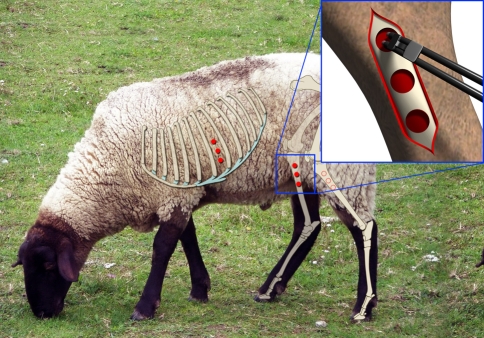
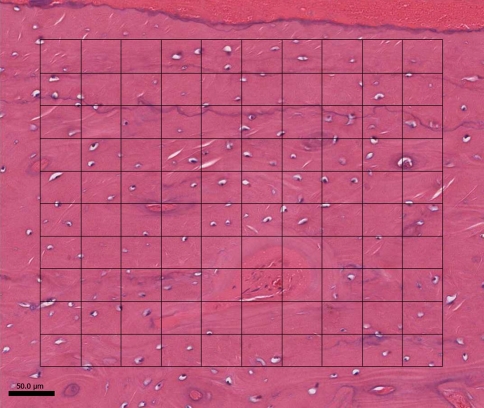
Five mature sheep had six 2.5-cm(2) tibial periosteal defects and six 1.0-cm skin incisions assigned to six treatments varying by watts and fluence (f = watts . seconds/cm(2)): (1) untreated control, (2) 50 W for 9.5 seconds (190f; n = 5), (3) 110 W for 4.3 seconds (190f; n = 5), (4) 170 W for 2.8 seconds (190f; n = 5), (5) 170 W for 5.6 seconds (380f; n = 5), or (6) 170 W for 8.4 seconds (570f; n = 5). Outcomes included hemostasis, contraction, healing, and histomorphometry for inflammation and necrosis at 2 weeks.
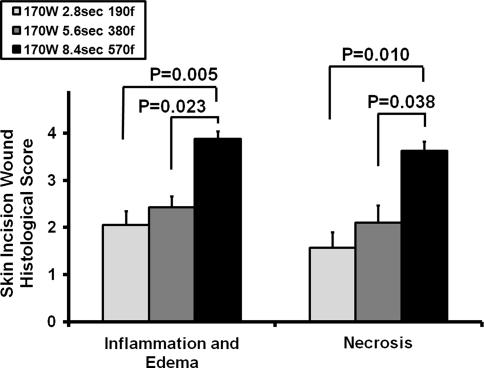
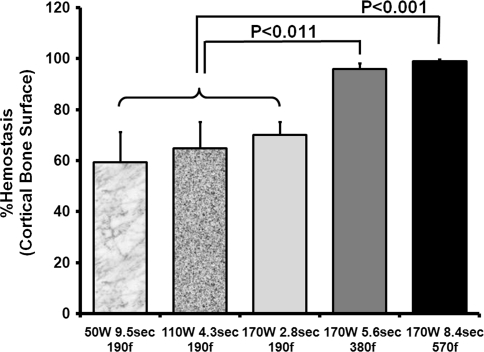
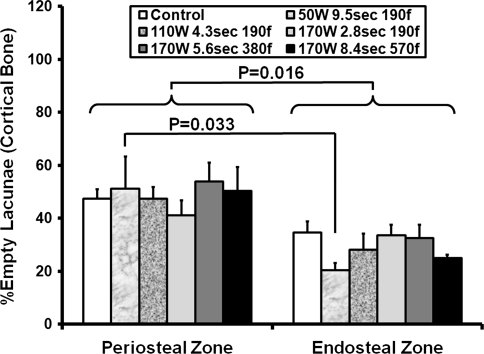
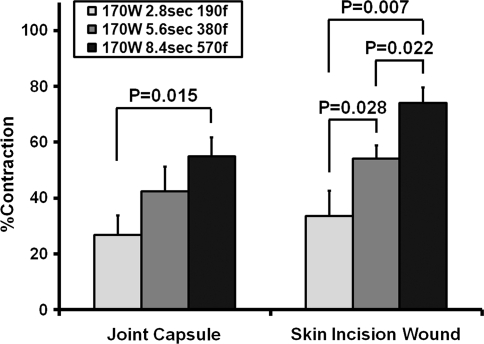
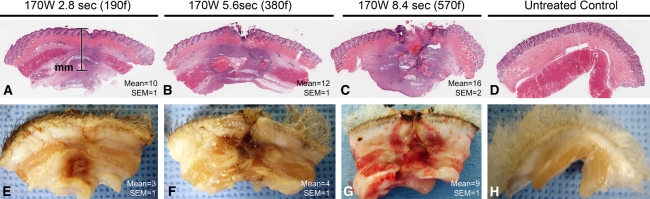
Radiofrequency energy application on skin at 190f or greater had more than 80% hemostasis and dose-dependent contraction, inflammation, and necrosis. Radiofrequency energy application on bone had good (70%) hemostasis at 190f and complete (> 95%) hemostasis at 380f and 570f, without histologic or clinically detectable necrosis.
Hemostasis can be achieved with radiofrequency energy at 190f in skin and bone. Bone necrosis was not detected at up to 570f. Using fluence greater than 190f in skin achieved dose-dependent necrosis and incisional contraction.
Radiofrequency energy can be used on bone and skin for hemostasis, but potential incisional complications, such as necrosis and an atypical firm and desiccated surface, should be expected.
射频产生能量的设备已在肌肉骨骼手术中临床应用,以提供止血和囊收缩(热囊紧缩术)。然而,剂量效应尚不清楚。
问题/目的:因此,我们确定了射频能量对羊骨、皮肤切口和关节囊的剂量效应。
5 只成熟绵羊有 6 个 2.5cm(2)胫骨骨膜缺损和 6 个 1.0cm 皮肤切口,分为 6 种不同瓦数和剂量(f = 瓦. 秒/cm(2))的治疗方法:(1)未处理的对照组,(2)50 瓦 9.5 秒(190f;n = 5),(3)110 瓦 4.3 秒(190f;n = 5),(4)170 瓦 2.8 秒(190f;n = 5),(5)170 瓦 5.6 秒(380f;n = 5),或(6)170 瓦 8.4 秒(570f;n = 5)。结果包括 2 周时止血、收缩、愈合和炎症及坏死的组织形态计量学。
皮肤在 190f 或更高温度下应用射频能量止血率超过 80%,且收缩、炎症和坏死呈剂量依赖性。骨骼在 190f 时止血效果良好(70%),在 380f 和 570f 时完全止血(>95%),无组织学或临床可检测的坏死。
皮肤和骨骼的射频能量止血率可达 190f。高达 570f 时未检测到骨坏死。皮肤的剂量大于 190f 可实现剂量依赖性坏死和切口收缩。
射频能量可用于骨和皮肤止血,但应预期可能出现切口并发症,如坏死和非典型的坚硬和干燥表面。