Blainey Paul C, Luo Guobin, Kou S C, Mangel Walter F, Verdine Gregory L, Bagchi Biman, Xie X Sunney
Department of Chemistry and Chemical Biology, Harvard University, Cambridge, Massachusetts, USA.
Nat Struct Mol Biol. 2009 Dec;16(12):1224-9. doi: 10.1038/nsmb.1716. Epub 2009 Nov 8.
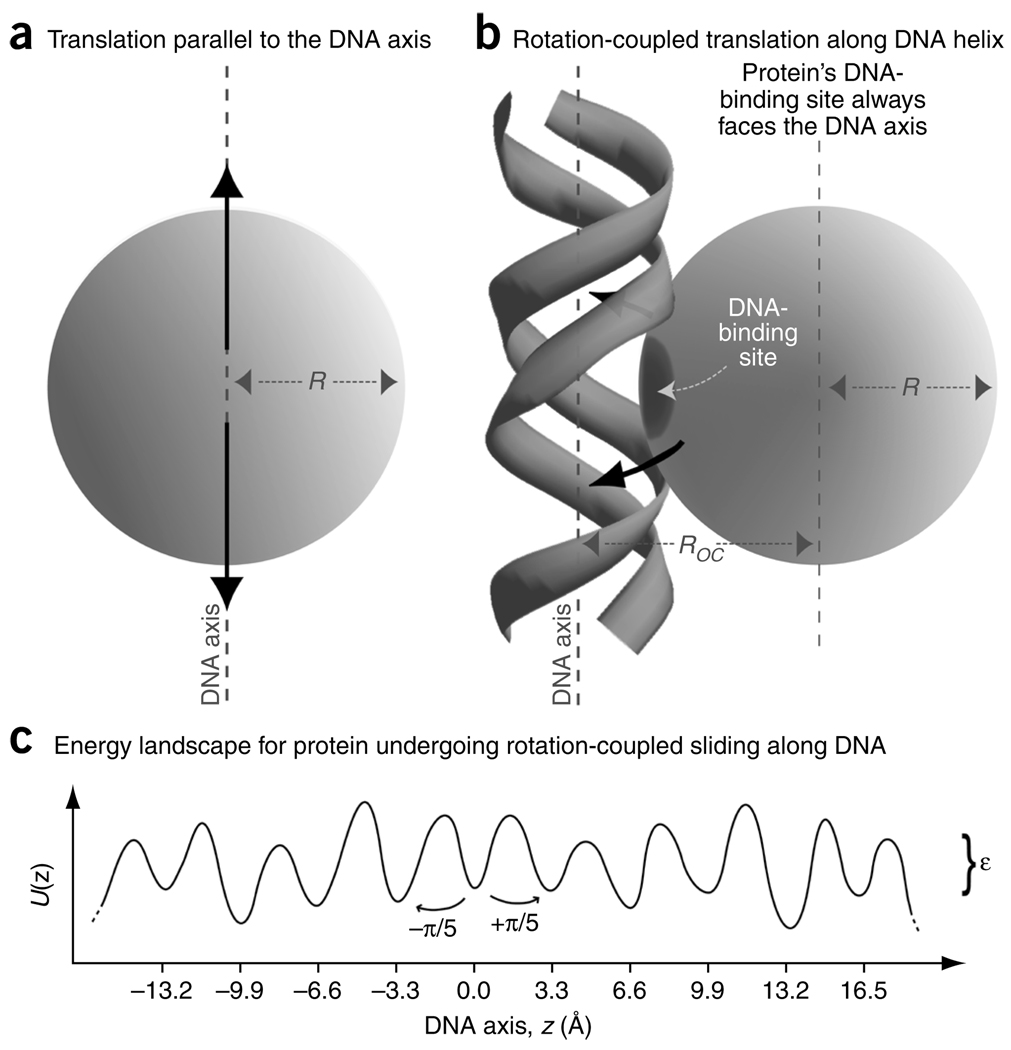
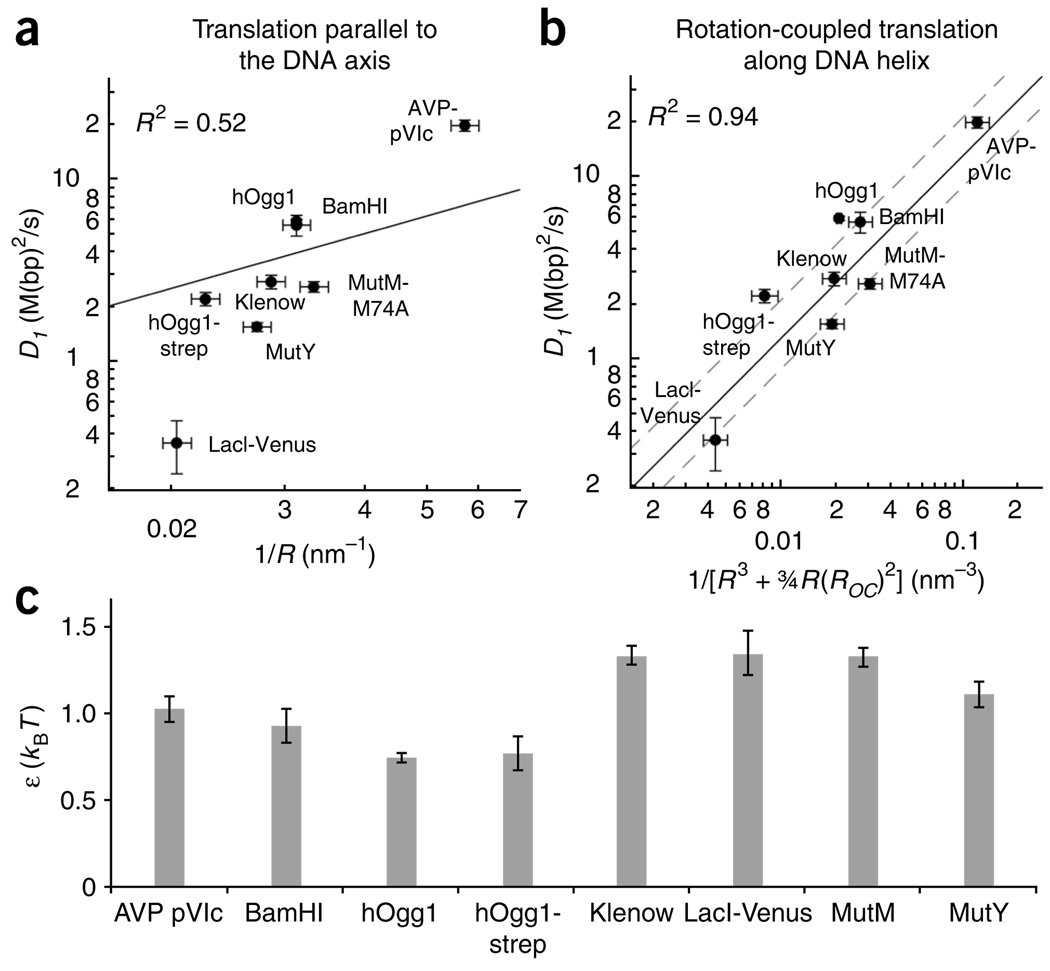
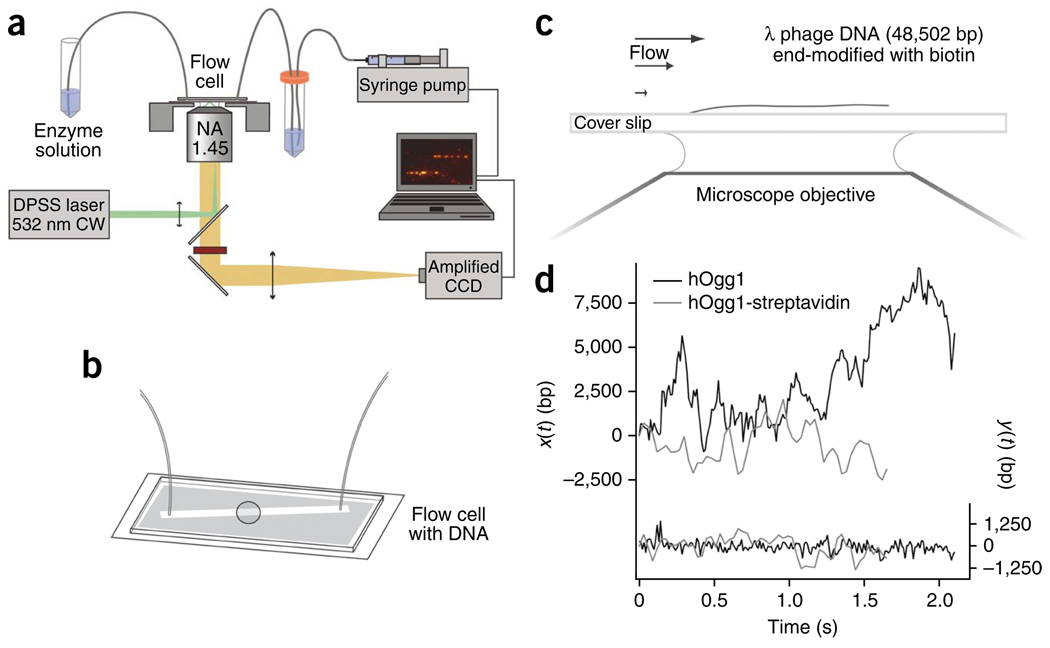
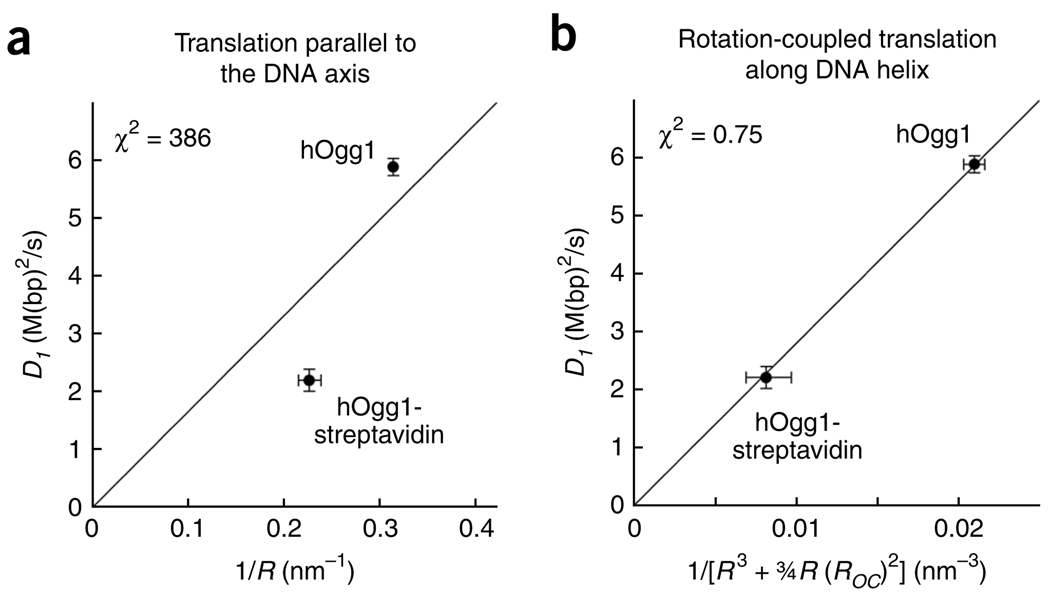
It is known that DNA-binding proteins can slide along the DNA helix while searching for specific binding sites, but their path of motion remains obscure. Do these proteins undergo simple one-dimensional (1D) translational diffusion, or do they rotate to maintain a specific orientation with respect to the DNA helix? We measured 1D diffusion constants as a function of protein size while maintaining the DNA-protein interface. Using bootstrap analysis of single-molecule diffusion data, we compared the results to theoretical predictions for pure translational motion and rotation-coupled sliding along the DNA. The data indicate that DNA-binding proteins undergo rotation-coupled sliding along the DNA helix and can be described by a model of diffusion along the DNA helix on a rugged free-energy landscape. A similar analysis including the 1D diffusion constants of eight proteins of varying size shows that rotation-coupled sliding is a general phenomenon. The average free-energy barrier for sliding along the DNA was 1.1 +/- 0.2 k(B)T. Such small barriers facilitate rapid search for binding sites.
已知DNA结合蛋白在寻找特定结合位点时可沿DNA螺旋滑动,但其运动路径仍不清楚。这些蛋白是进行简单的一维(1D)平移扩散,还是会旋转以维持相对于DNA螺旋的特定方向?我们在保持DNA-蛋白质界面的同时,测量了一维扩散常数作为蛋白质大小的函数。通过对单分子扩散数据进行自助分析,我们将结果与纯平移运动以及沿DNA的旋转耦合滑动的理论预测进行了比较。数据表明,DNA结合蛋白沿DNA螺旋进行旋转耦合滑动,并且可以用在崎岖自由能景观上沿DNA螺旋的扩散模型来描述。包括八种不同大小蛋白质的一维扩散常数的类似分析表明,旋转耦合滑动是一种普遍现象。沿DNA滑动的平均自由能垒为1.1 +/- 0.2 k(B)T。如此小的能垒有助于快速寻找结合位点。