Centre for Immunology, Burnet Institute, Melbourne, Victoria, Australia.
PLoS One. 2009 Nov 10;4(11):e7777. doi: 10.1371/journal.pone.0007777.
Lewis Y (Le(y)) is a blood group-related carbohydrate that is expressed at high surface densities on the majority of epithelial carcinomas and is a promising target for antibody-based immunotherapy. A humanized Le(y)-specific antibody (hu3S193) has shown encouraging safety, pharmacokinetic and tumor-targeting properties in recently completed Phase I clinical trials.
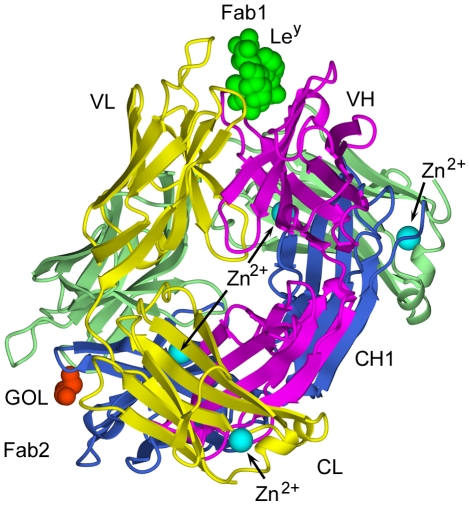
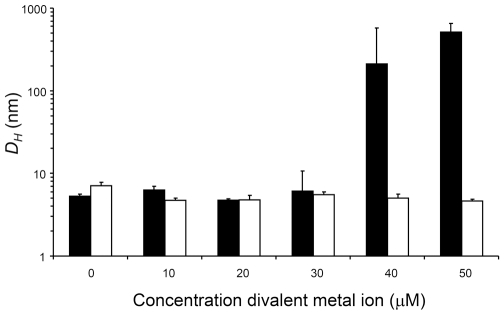
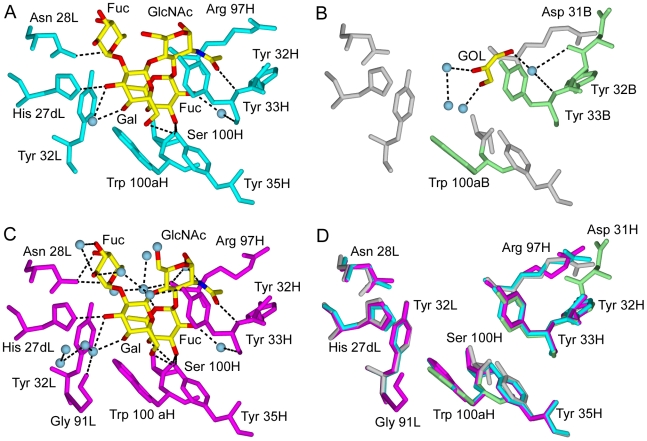
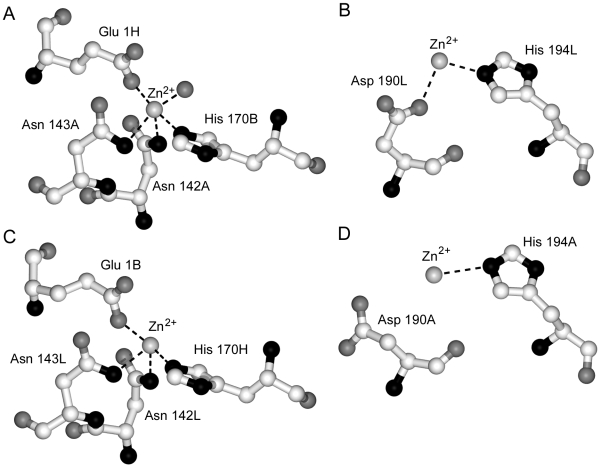
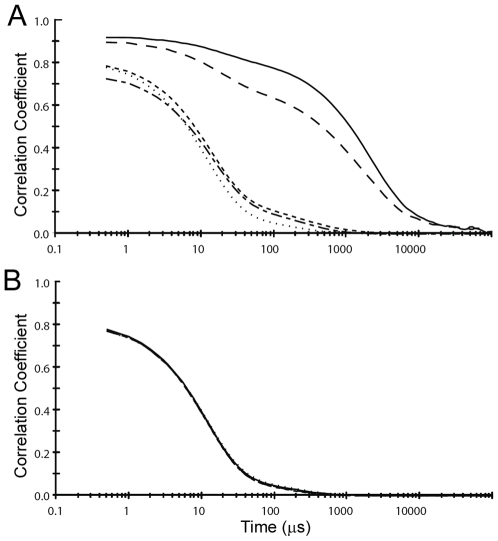
METHODOLOGY/PRINCIPAL FINDINGS: We report the three-dimensional structures for both the free (unliganded) and bound (Le(y) tetrasaccharide) hu3S193 Fab from the same crystal grown in the presence of divalent zinc ions. There is no evidence of significant conformational changes occurring in either the Le(y) carbohydrate antigen or the hu3S193 binding site, which suggests a rigid fit binding mechanism. In the crystal, the hu3S193 Fab molecules are coordinated at their protein-protein interface by two zinc ions and in solution aggregation of Fab can be initiated by zinc, but not magnesium ions. Dynamic light scattering revealed that zinc ions could initiate a sharp transition from hu3S193 Fab monomers to large multimeric aggregates in solution.
CONCLUSIONS/SIGNIFICANCE: Zinc ions can mediate interactions between hu3S193 Fab in crystals and in solution. Whether metallic ion mediated aggregation of antibody occurs in vivo is not known, but the present results suggest that similar clustering mechanisms could occur when hu3S193 binds to Le(y) on cells, particularly given the high surface densities of antigen on the target tumor cells.
Lewis Y(Le(y))是一种与血型相关的碳水化合物,在大多数上皮癌中高表达,是抗体免疫治疗的有前途的靶点。一种人源化的 Le(y)特异性抗体(hu3S193)在最近完成的 I 期临床试验中表现出了令人鼓舞的安全性、药代动力学和肿瘤靶向特性。
方法/主要发现:我们报告了来自同一晶体的游离(未配体)和结合(Le(y)四糖)hu3S193 Fab 的三维结构,该晶体是在二价锌离子存在下生长的。无论是 Le(y)碳水化合物抗原还是 hu3S193 结合位点都没有发生明显的构象变化,这表明存在刚性结合机制。在晶体中,hu3S193 Fab 分子在其蛋白-蛋白界面由两个锌离子配位,在溶液中,Fab 的聚集可以被锌而不是镁离子引发。动态光散射显示,锌离子可以在溶液中引发 hu3S193 Fab 单体向大的多聚体聚集的急剧转变。
结论/意义:锌离子可以介导晶体中和溶液中 hu3S193 Fab 之间的相互作用。体内是否存在抗体的金属离子介导的聚集尚不清楚,但目前的结果表明,当 hu3S193 与细胞上的 Le(y)结合时,可能会发生类似的聚集机制,特别是考虑到靶肿瘤细胞上抗原的高表面密度。