Rose William A, McGowin Chris L, Pyles Richard B
Department of Microbiology and Immunology, University of Texas Medical Branch, Galveston, TX, USA.
Virol J. 2009 Nov 10;6:195. doi: 10.1186/1743-422X-6-195.
Herpes simplex virus type 2 (HSV-2) is a leading cause of genital ulceration that can predispose individuals to an increased risk of acquiring other sexually transmitted infections. There are no approved HSV-2 vaccines and current suppressive therapies require daily compound administration that does not prevent all recurrences. A promising experimental strategy is the use of toll-like receptor (TLR) agonists to induce an innate immune response that provides resistance to HSV-2 infection. Previous studies showed that anti-herpetic activity varied based on origin of the agonists and activation of different TLR indicating that activity likely occurs through elaboration of a specific innate immune response. To test the hypothesis, we evaluated the ability of a bacterial-derived TLR2/6 agonist (FSL-1) to increase resistance to experimental genital HSV-2 infection.
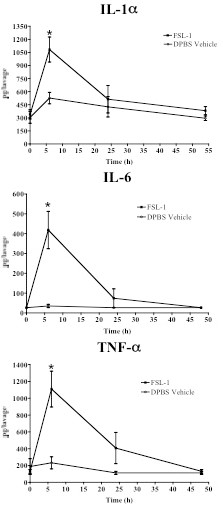
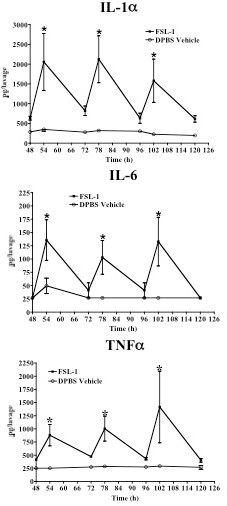
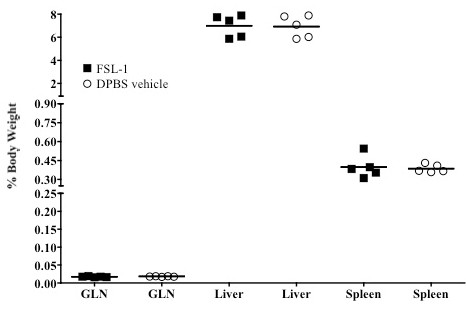
Vaginal application of FSL-1 at selected doses and times was evaluated to identify potential increased resistance to genital HSV-2 infection in the mouse model. The FSL-1 induced cytokine profile was quantified using kinetically collected vaginal lavages. Additionally, cytokine elaboration and organ weights were evaluated after single or multiple FSL-1 doses to establish a preliminary safety profile. Human vaginal EC cultures were used to confirm the mouse model outcomes.
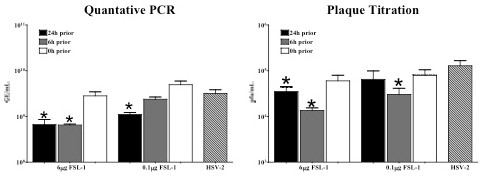
The results showed that vaginally-applied FSL-1 created an environment resistant to a 25-fold higher HSV-2 challenge dose. Mechanistically, vaginal FSL-1 application led to transient elaboration of cytokines linked to anti-herpetic innate immune responses. No gross local or peripheral immunotoxicity was observed even after multiple dosing. FSL-1 also created an anti-herpetic environment in cultures of human vaginal epithelial cells (EC).
The results showed, for the first time, that the bacterial-derived TLR2/6 agonist FSL-1 induced significant resistance to HSV-2 infection when applied in mice or human vaginal EC cultures. Cytokine evaluation illustrated that anti-herpetic activity correlated with induction of a specific profile. The identified anti-herpetic profile provides an invaluable resource for the future design of novel compounds to reduce genital HSV-2 transmission and improves understanding of the complex innate immune response to potential pathogens elicited by the vaginal mucosa.
2型单纯疱疹病毒(HSV - 2)是导致生殖器溃疡的主要原因,可使个体感染其他性传播感染的风险增加。目前尚无获批的HSV - 2疫苗,现有的抑制疗法需要每日给药,且不能预防所有复发。一种有前景的实验策略是使用 Toll样受体(TLR)激动剂来诱导先天免疫反应,从而提供对HSV - 2感染的抵抗力。先前的研究表明,抗疱疹活性因激动剂的来源和不同TLR的激活而有所不同,这表明活性可能是通过精心构建特定的先天免疫反应而产生的。为了验证这一假设,我们评估了一种细菌衍生的TLR2/6激动剂(FSL - 1)增强对实验性生殖器HSV - 2感染抵抗力的能力。
在小鼠模型中,评估在选定的剂量和时间阴道应用FSL - 1,以确定对生殖器HSV - 2感染的潜在抵抗力增强情况。使用动态收集的阴道灌洗液对FSL - 1诱导的细胞因子谱进行定量分析。此外,在单次或多次给予FSL - 1剂量后,评估细胞因子的产生情况和器官重量,以建立初步的安全性概况。使用人阴道上皮细胞(EC)培养物来确认小鼠模型的结果。
结果表明,阴道应用FSL - 1可创造一个对高25倍的HSV - 2攻击剂量具有抵抗力的环境。从机制上讲,阴道应用FSL - 1会导致与抗疱疹先天免疫反应相关的细胞因子短暂产生。即使多次给药后,也未观察到明显的局部或外周免疫毒性。FSL - 1还在人阴道上皮细胞(EC)培养物中创造了一个抗疱疹的环境。
结果首次表明,细菌衍生的TLR2/6激动剂FSL - 1在应用于小鼠或人阴道EC培养物时,可诱导对HSV - 2感染的显著抵抗力。细胞因子评估表明,抗疱疹活性与特定谱的诱导相关。所确定的抗疱疹谱为未来设计新型化合物以减少生殖器HSV - 2传播提供了宝贵资源,并有助于更好地理解阴道黏膜对潜在病原体引发的复杂先天免疫反应。