Centre for Population Studies, London School of Hygiene and Tropical Medicine, London, UK.
J Int AIDS Soc. 2009 Nov 11;12:31. doi: 10.1186/1758-2652-12-31.
Individuals diagnosed with HIV in developing countries are not always successfully linked to onward treatment services, resulting in missed opportunities for timely initiation of antiretroviral therapy, or prophylaxis for opportunistic infections. In collaboration with local stakeholders, we designed and assessed a referral system to link persons diagnosed at a voluntary counselling and testing (VCT) clinic in a rural district in northern Tanzania with a government-run HIV treatment clinic in a nearby city.
Two-part referral forms, with unique matching numbers on each side were implemented to facilitate access to the HIV clinic, and were subsequently reconciled to monitor the proportion of diagnosed clients who registered for these services, stratified by sex and referral period. Delays between referral and registration at the HIV clinic were calculated, and lists of non-attendees were generated to facilitate tracing among those who had given prior consent for follow up.Transportation allowances and a "community escort" from a local home-based care organization were introduced for patients attending the HIV clinic, with supportive counselling services provided by the VCT counsellors and home-based care volunteers. Focus group discussions and in-depth interviews were conducted with health care workers and patients to assess the acceptability of the referral procedures.
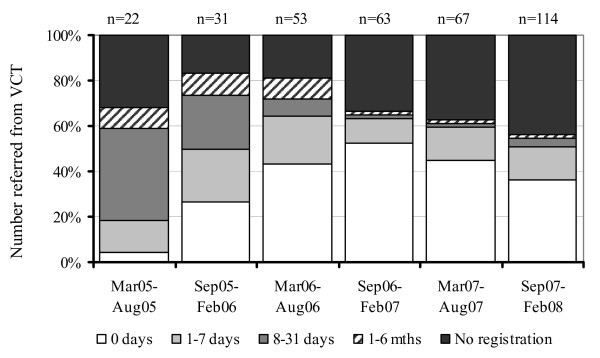
Referral uptake at the HIV clinic averaged 72% among men and 66% among women during the first three years of the national antiretroviral therapy (ART) programme, and gradually increased following the introduction of the transportation allowances and community escorts, but declined following a national VCT campaign. Most patients reported that the referral system facilitated their arrival at the HIV clinic, but expressed a desire for HIV treatment services to be in closer proximity to their homes. The referral forms proved to be an efficient and accepted method for assessing the effectiveness of the VCT clinic as an entry point for ART.
The referral system reduced delays in seeking care, and enabled the monitoring of access to HIV treatment among diagnosed persons. Similar systems to monitor referral uptake and linkages between HIV services could be readily implemented in other settings.
发展中国家的艾滋病毒感染者并不总能成功转入后续治疗服务,从而错失了及时开始抗逆转录病毒治疗或机会性感染预防的机会。我们与当地利益攸关方合作,设计并评估了一种转介系统,以将坦桑尼亚北部一个农村地区的自愿咨询和检测诊所诊断出的人员与附近城市的政府管理的艾滋病毒治疗诊所联系起来。
实施了两部分转介表,每一侧都有独特的匹配号码,以方便进入艾滋病毒诊所,并随后进行核对,以监测按性别和转介期分层的已诊断患者登记这些服务的比例。计算了从转介到艾滋病毒诊所登记的延迟时间,并生成了未到诊者名单,以便在那些事先同意进行随访的人之间进行追踪。为参加艾滋病毒诊所的患者提供了交通津贴和来自当地家庭护理组织的“社区护送人”,并由咨询员和家庭护理志愿者提供支持性咨询服务。与卫生保健工作者和患者进行了焦点小组讨论和深入访谈,以评估转介程序的可接受性。
在国家抗逆转录病毒治疗(ART)方案的头三年中,艾滋病毒诊所的转介率平均为男性 72%,女性 66%,在引入交通津贴和社区护送人后逐渐增加,但在全国性的 VCT 运动后下降。大多数患者表示,转介系统有助于他们到达艾滋病毒诊所,但表示希望艾滋病毒治疗服务更接近他们的家。转介表被证明是评估 VCT 诊所作为 ART 切入点的有效性的一种有效且可接受的方法。
转介系统减少了寻求护理的延迟,并使已诊断人员获得艾滋病毒治疗的情况得以监测。在其他环境中,可以轻松实施类似的系统来监测转介率和艾滋病毒服务之间的联系。