Verhamme Camiel, de Haan Rob J, Vermeulen Marinus, Baas Frank, de Visser Marianne, van Schaik Ivo N
Department of Neurology and Clinical Neurophysiology, Academic Medical Centre, University of Amsterdam, PO Box 22660, 1100 DD, Amsterdam, The Netherlands.
BMC Med. 2009 Nov 12;7:70. doi: 10.1186/1741-7015-7-70.
High dose oral ascorbic acid substantially improved myelination and locomotor function in a Charcot-Marie-Tooth type 1A mouse model. A phase II study was warranted to investigate whether high dose ascorbic acid also has such a substantial effect on myelination in Charcot-Marie-Tooth type 1A patients and whether this treatment is safe.
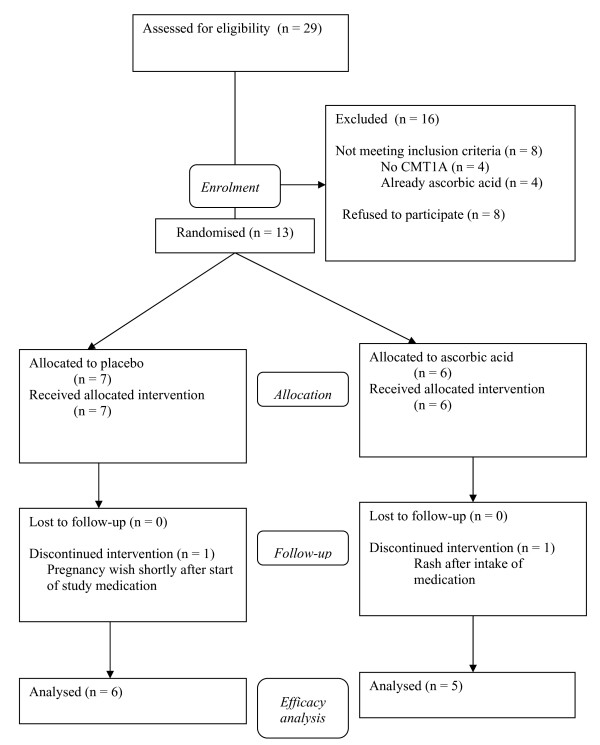
Patients below age 25 years were randomly assigned to receive placebo or ascorbic acid (one gram twice daily) in a double-blind fashion during one year. The primary outcome measure was the change over time in motor nerve conduction velocity of the median nerve. Secondary outcome measures included changes in minimal F response latencies, compound muscle action potential amplitude, muscle strength, sensory function, Charcot-Marie-Tooth neuropathy score, and disability.
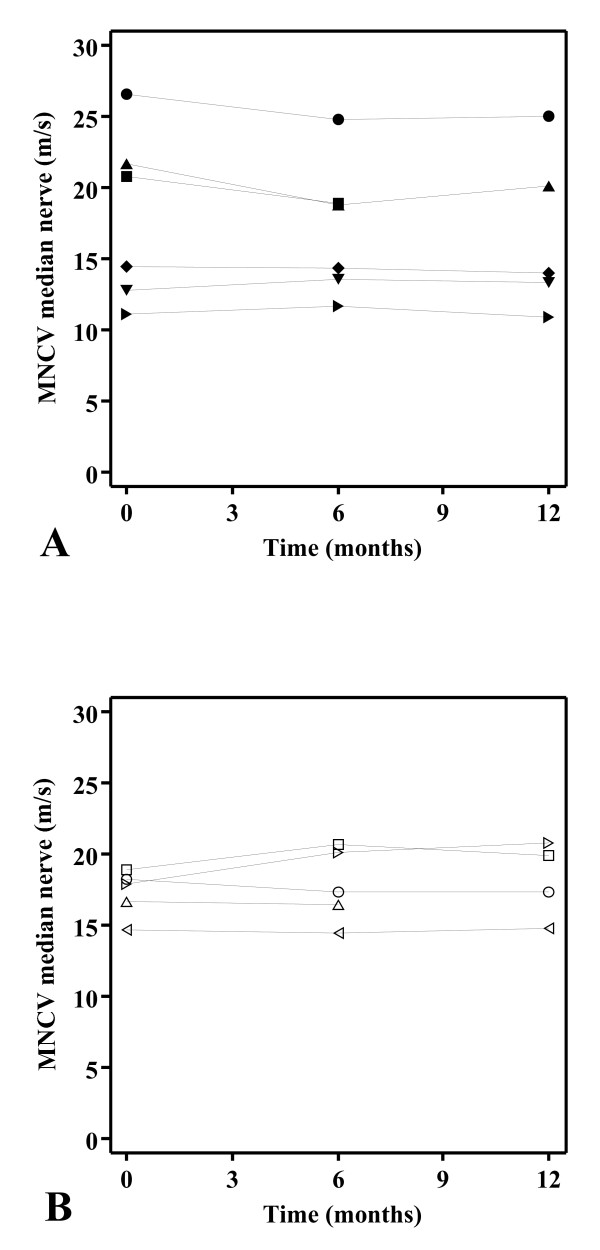
There were no significant differences between the six placebo-treated (median age 16 years, range 13 to 24) and the five ascorbic acid-treated (19, 14 to 24) patients in change in motor nerve conduction velocity of the median nerve (mean difference ascorbic acid as opposed to placebo treatment of 1.3 m/s, confidence interval -0.3 to 3.0 m/s, P = 0.11) or in change of any of the secondary outcome measures over time. One patient in the ascorbic acid group developed a skin rash, which led to discontinuation of the study medication.
Oral high dose ascorbic acid for one year did not improve myelination of the median nerve in young Charcot-Marie-Tooth type 1A patients. Treatment was relatively safe.
Current Controlled Trials ISRCTN56968278, ClinicalTrials.gov NCT00271635.
在1A型遗传性运动感觉神经病(Charcot-Marie-Tooth type 1A,CMT1A)小鼠模型中,高剂量口服抗坏血酸可显著改善髓鞘形成和运动功能。因此有必要开展一项II期研究,以调查高剂量抗坏血酸对1A型遗传性运动感觉神经病患者的髓鞘形成是否也有显著影响,以及这种治疗方法是否安全。
年龄在25岁以下的患者被随机分配,以双盲方式接受安慰剂或抗坏血酸治疗(每日两次,每次1克),为期一年。主要结局指标是正中神经运动神经传导速度随时间的变化。次要结局指标包括最小F波反应潜伏期、复合肌肉动作电位幅度、肌肉力量、感觉功能、遗传性运动感觉神经病神经病变评分和残疾情况的变化。
6名接受安慰剂治疗的患者(中位年龄16岁,范围13至24岁)和5名接受抗坏血酸治疗的患者(19岁,14至24岁)在正中神经运动神经传导速度的变化(抗坏血酸与安慰剂治疗的平均差异为1.3 m/s,置信区间为-0.3至3.0 m/s,P = 0.11)或任何次要结局指标随时间的变化方面均无显著差异。抗坏血酸组有1名患者出现皮疹,导致研究药物停用。
年轻的1A型遗传性运动感觉神经病患者口服高剂量抗坏血酸一年并未改善正中神经的髓鞘形成。治疗相对安全。
当前对照试验ISRCTN56968278,美国国立医学图书馆临床试验注册中心NCT00271635。