Clinic of Central and Peripheral Degenerative Neuropathies Unit, Department of Clinical Neurosciences, Istituto di Ricovero e Cura a Carattere Scientifico (IRCCS) Foundation, Carlo Besta Neurological Institute, Milan, Italy.
Lancet Neurol. 2011 Apr;10(4):320-8. doi: 10.1016/S1474-4422(11)70025-4.
Ascorbic acid reduced the severity of neuropathy in transgenic mice overexpressing peripheral myelin protein 22 (PMP22), a model of Charcot-Marie-Tooth disease type 1A (CMT1A) associated with the PMP22 duplication. However, in three 1-year trials, ascorbic acid had no benefit in human beings. We did a multicentre 2-year trial to test the efficacy and tolerability of ascorbic acid in patients with CMT1A.
Adult patients (aged 18-70 years) with symptomatic CMT1A were enrolled from nine centres in Italy and the UK, and were randomly assigned (1:1 ratio) to receive 1·5 g/day oral ascorbic acid or matching placebo for 24 months. The randomisation sequence was computer generated by block randomisation, stratified by centre and disease severity, and patients were allocated to treatment by telephone. The primary outcome was change in the CMT neuropathy score (CMTNS) at 24 months. Secondary outcomes were timed 10 m walk test, nine-hole peg test, overall neuropathy limitations scale, distal maximal voluntary isometric contraction, visual analogue scales for pain and fatigue, 36-item short-form questionnaire, and electrophysiological measurements. Patients, treating physicians, and physicians assessing outcome measures were masked to treatment allocation. Analysis of the primary outcome was done on all randomised patients who received at least one dose of study drug. This study is registered, numbers ISRCTN61074476 (CMT-TRAUK) and EudraCT 2006-000032-27 (CMT-TRIAAL).
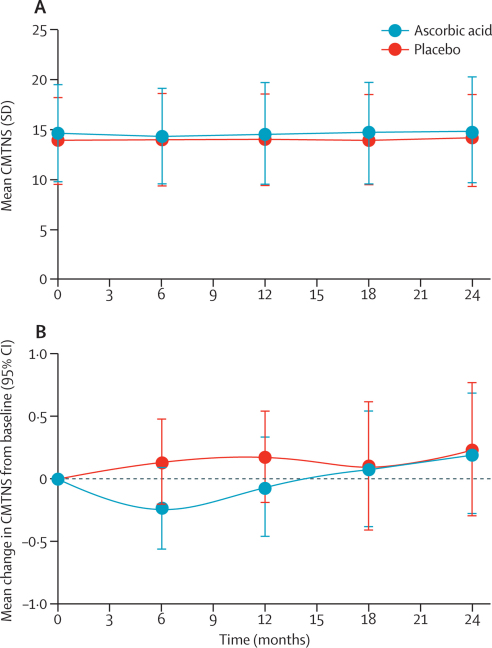
We enrolled and randomly assigned 277 patients, of whom six (four assigned to receive ascorbic acid) withdrew consent before receiving treatment; 138 receiving ascorbic acid and 133 receiving placebo were eligible for analysis. Treatment was well tolerated: 241 of 271 patients (89% in each group) completed the study; 20 patients (nine receiving ascorbic acid) dropped out because of adverse events. Mean CMTNS at baseline with missing data imputed was 14·7 (SD 4·8) in the ascorbic acid group and 13·9 (4·2) in the placebo group. Mean worsening of CMTNS was 0·2 (SD 2·8, 95% CI -0·3 to 0·7) in the ascorbic acid group and 0·2 (2·7, -0·2 to 0·7) in the placebo group (mean difference 0·0, 95% CI -0·6 to 0·7; p=0·93). We recorded no differences between the groups for the secondary outcomes at 24 months. 21 serious adverse events occurred in 20 patients, eight in the ascorbic acid group and 13 in the placebo group.
Ascorbic acid supplementation had no significant effect on neuropathy compared with placebo after 2 years, suggesting that no evidence is available to support treatment with ascorbic acid in adults with CMT1A.
Telethon-UILDM and AIFA (Italian Medicines Agency) for CMT-TRIAAL, and Muscular Dystrophy Campaign for CMT-TRAUK.

抗坏血酸可降低过表达周围髓鞘蛋白 22(PMP22)的转基因小鼠神经病变的严重程度,PMP22 是 1A 型遗传性运动感觉神经病(CMT1A)的模型,与 PMP22 重复有关。然而,在三项为期 1 年的试验中,抗坏血酸对人类没有益处。我们进行了一项多中心、为期 2 年的试验,以测试 CMT1A 患者中抗坏血酸的疗效和耐受性。
从意大利和英国的 9 个中心招募了有症状的 CMT1A 成年患者(年龄 18-70 岁),并随机(1:1 比例)接受 1.5 g/天的口服抗坏血酸或匹配的安慰剂治疗 24 个月。随机序列由计算机生成,采用区块随机化,按中心和疾病严重程度分层,通过电话为患者分配治疗。主要结局是 24 个月时 CMT 神经病变评分(CMTNS)的变化。次要结局是计时 10 m 步行测试、九孔钉测试、总体神经病变限制量表、远端最大自主等长收缩、疼痛和疲劳的视觉模拟量表、36 项简短健康调查问卷和电生理测量。患者、治疗医生和评估结局测量的医生对治疗分配进行了盲法。对接受至少一剂研究药物的所有随机患者进行了主要结局的分析。这项研究已注册,注册号为 ISRCTN61074476(CMT-TRAUK)和 EudraCT 2006-000032-27(CMT-TRIAAL)。
我们招募并随机分配了 277 名患者,其中 6 名(4 名接受抗坏血酸治疗)在接受治疗前撤回了同意;138 名接受抗坏血酸治疗和 133 名接受安慰剂治疗的患者有资格进行分析。治疗耐受性良好:271 名患者中有 241 名(每组各 89%)完成了研究;20 名患者(9 名接受抗坏血酸治疗)因不良事件退出。抗坏血酸组基线时缺失数据估计的平均 CMTNS 为 14.7(SD 4.8),安慰剂组为 13.9(4.2)。抗坏血酸组 CMTNS 的平均恶化程度为 0.2(SD 2.8,95%CI -0.3 至 0.7),安慰剂组为 0.2(2.7,-0.2 至 0.7)(平均差异 0.0,95%CI -0.6 至 0.7;p=0.93)。我们在 24 个月时没有记录到两组之间的次要结局有差异。20 名患者发生了 21 例严重不良事件,抗坏血酸组 8 例,安慰剂组 13 例。
抗坏血酸补充治疗与安慰剂组相比,在 2 年后对神经病变没有显著影响,这表明目前尚无证据支持 CMT1A 成人使用抗坏血酸治疗。
Telethon-UILDM 和 AIFA(意大利药品管理局)为 CMT-TRIAAL 提供资金,肌肉萎缩症运动为 CMT-TRAUK 提供资金。