Division Signaling and Functional Genomics, German Cancer Research Center and University of Heidelberg, Im Neuenheimer Feld 580, D-69120 Heidelberg, Germany.
Nucleic Acids Res. 2010 Jan;38(Database issue):D448-52. doi: 10.1093/nar/gkp1038. Epub 2009 Nov 12.
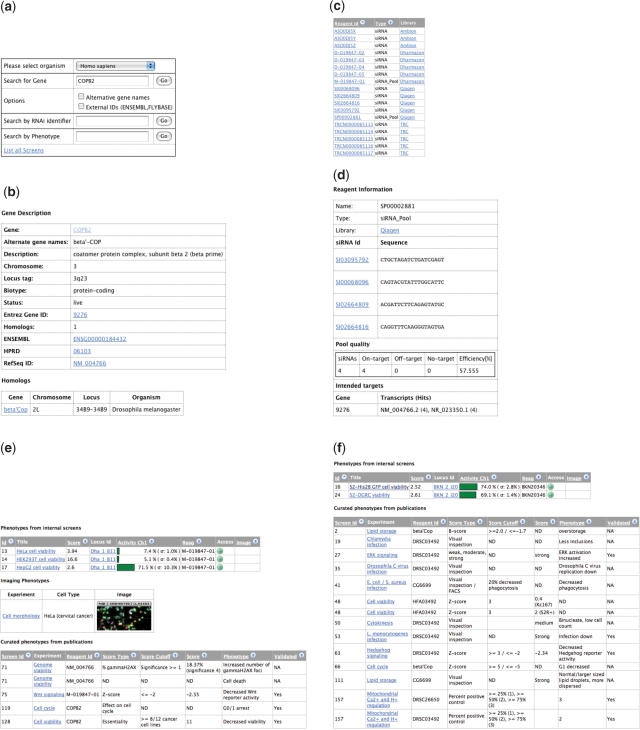
The GenomeRNAi database (http://www.genomernai.org/) contains phenotypes from published cell-based RNA interference (RNAi) screens in Drosophila and Homo sapiens. The database connects observed phenotypes with annotations of targeted genes and information about the RNAi reagent used for the perturbation experiment. The availability of phenotypes from Drosophila and human screens also allows for phenotype searches across species. Besides reporting quantitative data from genome-scale screens, the new release of GenomeRNAi also enables reporting of data from microscopy experiments and curated phenotypes from published screens. In addition, the database provides an updated resource of RNAi reagents and their predicted quality that are available for the Drosophila and the human genome. The new version also facilitates the integration with other genomic data sets and contains expression profiling (RNA-Seq) data for several cell lines commonly used in RNAi experiments.
GenomeRNAi 数据库(http://www.genomernai.org/)包含了已发表的果蝇和人类基于细胞的 RNA 干扰(RNAi)筛选的表型。该数据库将观察到的表型与靶向基因的注释以及用于扰动实验的 RNAi 试剂的信息联系起来。来自果蝇和人类筛选的表型的可用性也允许在物种间进行表型搜索。除了报告来自全基因组筛选的定量数据外,GenomeRNAi 的新版本还能够报告来自显微镜实验的数据和来自已发表筛选的精心策划的表型。此外,该数据库还提供了更新的 RNAi 试剂资源及其针对果蝇和人类基因组的预测质量。新版本还便于与其他基因组数据集集成,并包含几个常用于 RNAi 实验的细胞系的表达谱(RNA-Seq)数据。