Department of Orthopaedic Surgery, The Spine Center, Dartmouth-Hitchcock Medical Center, Lebanon, NH 03756, USA.
Spine (Phila Pa 1976). 2009 Dec 1;34(25):2797-802. doi: 10.1097/BRS.0b013e3181a9e640.
This prospective cohort study investigated personal goal achievement and satisfaction with progress in patients with chronic disabling spinal disorders (CDSD).
This study examined the relationships between satisfaction with progress and several alternative outcome measures for CDSD patients at least 1 year after completing a functional restoration program (FRP).
Treatment outcome measures for CDSD commonly include pain, physical capacities, and functional/vocational status. These factors are weakly correlated and may not reflect individual patients' perspectives and priorities.
On enrollment in the FRP, patients' pretreatment functional, work, and recreation goals were recorded. Pre- and end-of-program clinical measures included: pain, disability, fear avoidance, lifting, trunk flexibility, and treadmill endurance. At least 1 year after program completion surveys were mailed to consecutive FRP graduates. Nonresponders were surveyed by telephone when possible. Surveys included each patient's personal pretreatment goals, and assessed Average Pain, SF-36 Physical Function, and satisfaction "with the progress made with your pain problem." Each patient indicated levels of importance and achievement for each personal goal, and these scores were integrated to yield a goal achievement score (GAS). Linear regression was used to test the relationships between 1-year satisfaction with progress and the following variables: baseline to end-of-program change in clinical measures, and 1-year pain, physical function, and GAS.
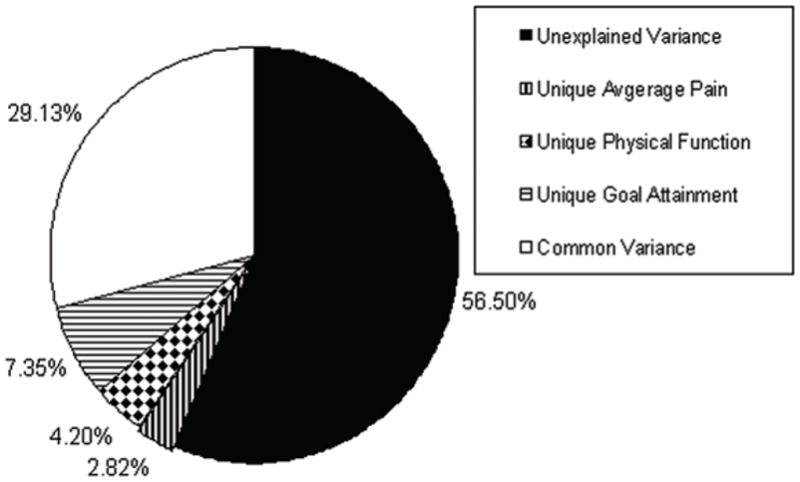
Of the 106 surveys mailed, 89 (84%) were returned and 86 (81%) had complete data for analysis. None of the pre-post-program clinical measures was significantly correlated with satisfaction (overall R2 = 0.013, P < 0.74). In contrast, year-end Average Pain (R2= 0.28), Physical Function (R2 = 0.29), and GAS (R2 = 0.29) were each significantly correlated (P < 0.0001) with satisfaction, with a combined R2 = 0.43, P < 0.0001. Of these variables, GAS had the highest unique contribution to satisfaction.
For CDSD patients 1 year after completing rehabilitation, compared to more traditional outcomes, GAS provided the greatest unique contribution to patient satisfaction. Goal achievement may be a valuable patient-centered measure of treatment outcome.
本前瞻性队列研究调查了慢性致残性脊柱疾病(CDSD)患者的个人目标实现和进展满意度。
本研究检查了在完成功能恢复计划(FRP)至少 1 年后,CDSD 患者对进展的满意度与几种替代结局测量之间的关系。
CDSD 的治疗结局测量通常包括疼痛、身体能力和功能/职业状态。这些因素相关性较弱,可能无法反映个体患者的观点和优先事项。
在 FRP 入组时,记录患者治疗前的功能、工作和娱乐目标。治疗前后的临床测量包括:疼痛、残疾、恐惧回避、举重、躯干柔韧性和跑步机耐力。在完成计划至少 1 年后,向连续的 FRP 毕业生邮寄调查问卷。当可能时,通过电话向未回复者进行调查。调查问卷包括每位患者的个人治疗前目标,并评估平均疼痛、SF-36 身体功能和“对您的疼痛问题取得的进展的满意度”。每位患者对每个个人目标的重要性和实现程度进行评分,并将这些分数整合为目标实现评分(GAS)。线性回归用于测试 1 年进展满意度与以下变量之间的关系:临床测量从基线到结束时的变化,以及 1 年疼痛、身体功能和 GAS。
在邮寄的 106 份调查问卷中,有 89 份(84%)被退回,其中 86 份(81%)有完整的数据进行分析。治疗前后的临床测量均与满意度无显著相关性(整体 R2=0.013,P<0.74)。相比之下,年末平均疼痛(R2=0.28)、身体功能(R2=0.29)和 GAS(R2=0.29)均与满意度显著相关(P<0.0001),合并 R2=0.43,P<0.0001。在这些变量中,GAS 对满意度的独特贡献最大。
对于在完成康复治疗后 1 年的 CDSD 患者,与更传统的结局相比,GAS 对患者满意度的独特贡献最大。目标实现可能是一种有价值的以患者为中心的治疗结局衡量标准。