Departamento de Anatomía y Biología Celular. Facultad de Medicina. Universidad de Cantabria, 39011 Santander, Spain.
Dev Biol. 2010 Jan 15;337(2):363-74. doi: 10.1016/j.ydbio.2009.11.007. Epub 2009 Nov 10.
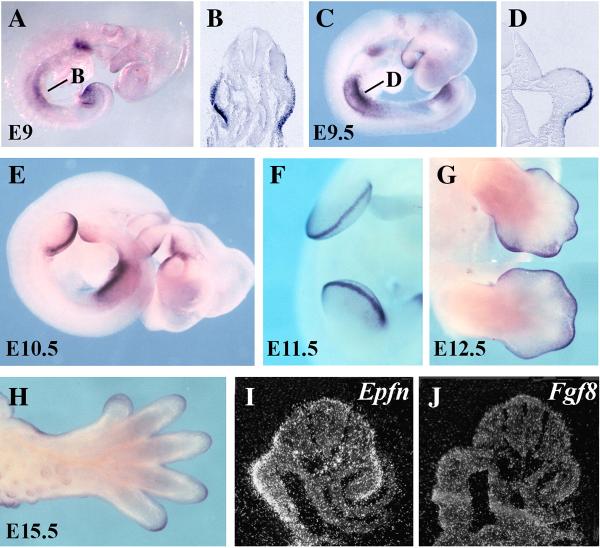
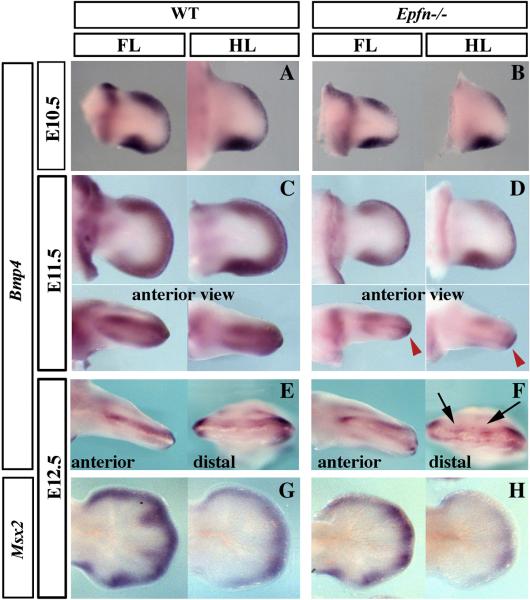
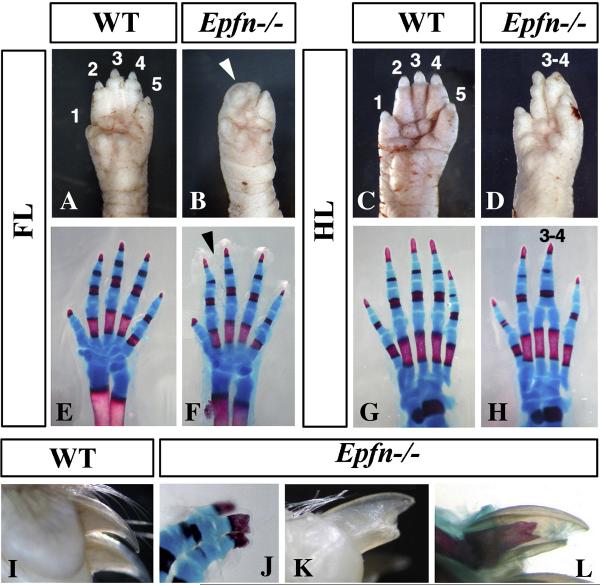
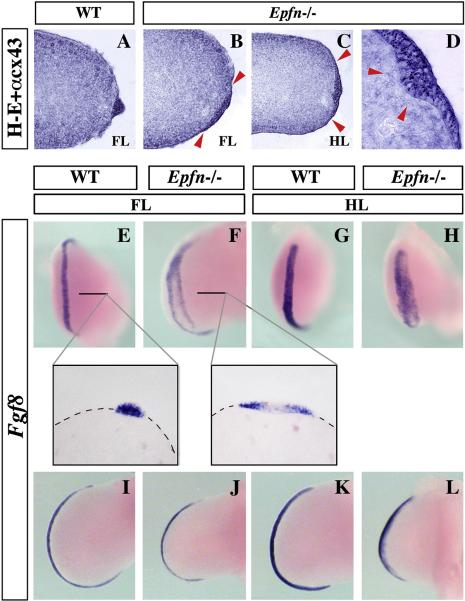
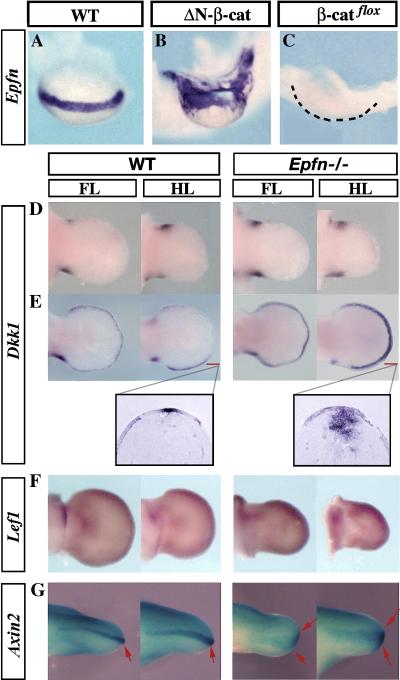
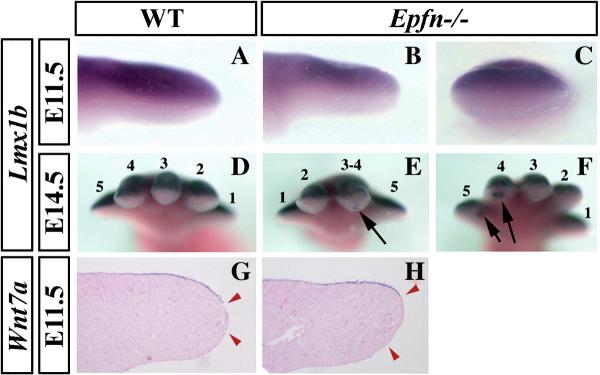
The formation and maintenance of the apical ectodermal ridge (AER) is critical for the outgrowth and patterning of the vertebrate limb. In the present work, we have investigated the role of Epiprofin (Epfn/Sp6), a member of the SP/KLF transcription factor family that is expressed in the limb ectoderm and the AER, during limb development. Epfn mutant mice have a defective autopod that shows mesoaxial syndactyly in the forelimb and synostosis (bony fusion) in the hindlimb and partial bidorsal digital tips. Epfn mutants also show a defect in the maturation of the AER that appears flat and broad, with a double ridge phenotype. By genetic analysis, we also show that Epfn is controlled by WNT/b-CATENIN signaling in the limb ectoderm. Since the less severe phenotypes of the conditional removal of b-catenin in the limb ectoderm strongly resemble the limb phenotype of Epfn mutants, we propose that EPFN very likely functions as a modulator of WNT signaling in the limb ectoderm.
顶外胚层嵴(AER)的形成和维持对于脊椎动物肢体的生长和模式形成至关重要。在本工作中,我们研究了 SP/KLF 转录因子家族成员 Epiprofin(Epfn/Sp6)在肢体发育过程中的作用,Epfn 在肢体外胚层和 AER 中表达。Epfn 突变小鼠的附肢缺陷,前肢出现中轴并指,后肢出现骨融合(骨性融合)和部分双背指端。Epfn 突变体也显示 AER 的成熟缺陷,AER 呈现平坦和宽阔的形态,具有双嵴表型。通过遗传分析,我们还表明 Epfn 受肢体外胚层中 WNT/b-CATENIN 信号的控制。由于肢体外胚层中 b-catenin 条件缺失的表型较轻,与 Epfn 突变体的肢体表型非常相似,因此我们提出 EPFN 很可能作为 WNT 信号在肢体外胚层中的调节剂发挥作用。