Psychiatry Neuroimaging Laboratory, Brigham and Women's Hospital, Harvard Medical School, Boston, MA 02215, USA.
Med Image Anal. 2010 Feb;14(1):58-69. doi: 10.1016/j.media.2009.10.003. Epub 2009 Oct 24.
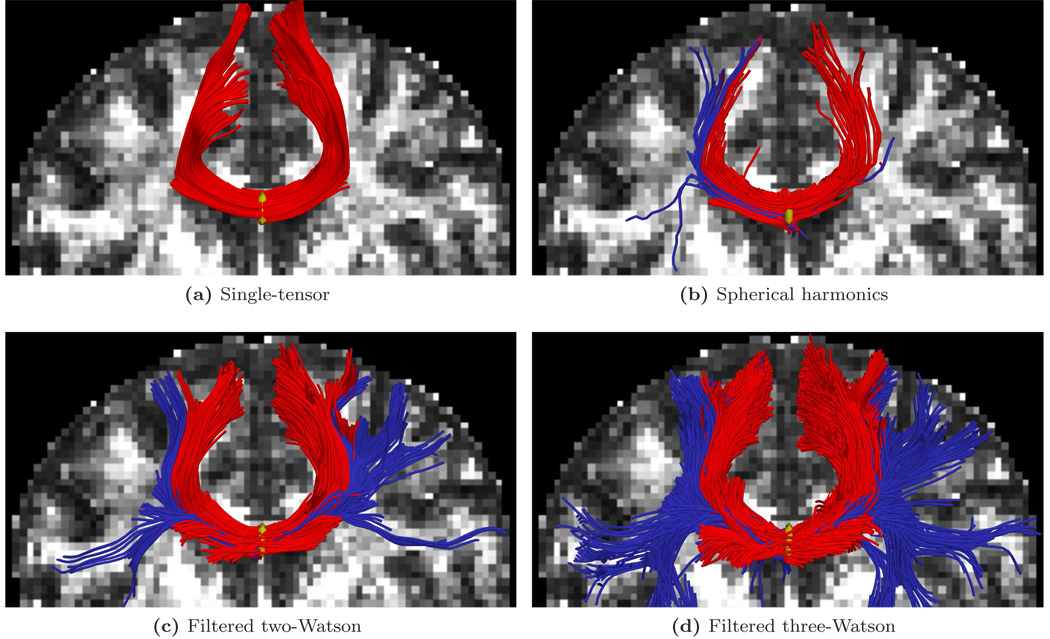
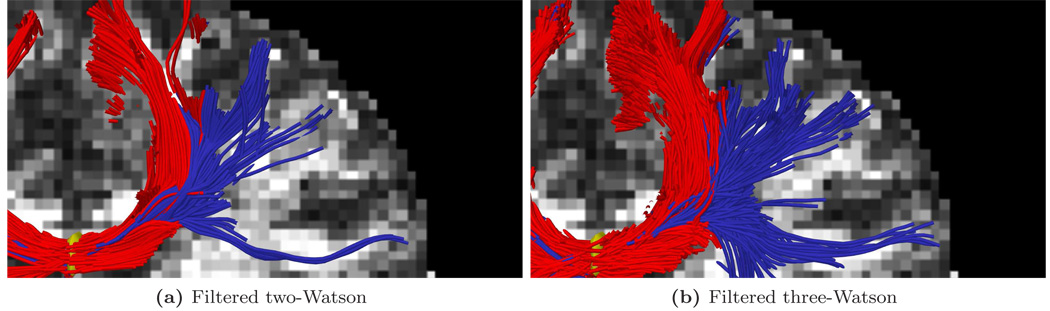
We propose a technique to simultaneously estimate the local fiber orientations and perform multi-fiber tractography. Existing techniques estimate the local fiber orientation at each voxel independently so there is no running knowledge of confidence in the measured signal or estimated fiber orientation. Further, to overcome noise, many algorithms use a filter as a post-processing step to obtain a smooth trajectory. We formulate fiber tracking as causal estimation: at each step of tracing the fiber, the current estimate of the signal is guided by the previous. To do this, we model the signal as a discrete mixture of Watson directional functions and perform tractography within a filtering framework. Starting from a seed point, each fiber is traced to its termination using an unscented Kalman filter to simultaneously fit the signal and propagate in the most consistent direction. Despite the presence of noise and uncertainty, this provides an accurate estimate of the local structure at each point along the fiber. We choose the Watson function since it provides a compact representation of the signal parameterized by the principal diffusion direction and a scaling parameter describing anisotropy, and also allows analytic reconstruction of the oriented diffusion function from those parameters. Using a mixture of two and three components (corresponding to two-fiber and three-fiber models) we demonstrate in synthetic experiments that this approach reduces signal reconstruction error and significantly improves the angular resolution at crossings and branchings. In vivo experiments examine the corpus callosum and internal capsule and confirm the ability to trace through regions known to contain such crossing and branching while providing inherent path regularization.
我们提出了一种同时估计局部纤维方向并进行多纤维束追踪的技术。现有的技术在每个体素上独立地估计局部纤维方向,因此没有对测量信号或估计纤维方向的置信度的运行知识。此外,为了克服噪声,许多算法使用滤波器作为后处理步骤来获得平滑的轨迹。我们将纤维追踪形式化为因果估计:在追踪纤维的每一步,当前的信号估计都由前一个信号引导。为此,我们将信号建模为沃森方向函数的离散混合,并在滤波框架内进行追踪。从种子点开始,每条纤维都使用无迹卡尔曼滤波器追踪到其终点,以同时拟合信号并沿最一致的方向传播。尽管存在噪声和不确定性,但这为纤维上的每个点提供了对局部结构的准确估计。我们选择 Watson 函数,因为它提供了一个紧凑的信号表示,参数化由主扩散方向和描述各向异性的缩放参数,并且还允许从这些参数重建定向扩散函数。通过使用两个和三个分量的混合(对应于两纤维和三纤维模型),我们在合成实验中证明了这种方法可以降低信号重建误差,并显著提高交叉和分支处的角度分辨率。体内实验检查胼胝体和内囊,并确认能够追踪已知包含此类交叉和分支的区域,同时提供固有路径正则化。