Ecology, Conservation, and Environment Center (ECEC), State Key Laboratory of Genetic Resources and Evolution, Kunming Institute of Zoology, Chinese Academy of Sciences, Kunming, Yunnan, China.
PLoS One. 2009 Nov 12;4(11):e7802. doi: 10.1371/journal.pone.0007802.
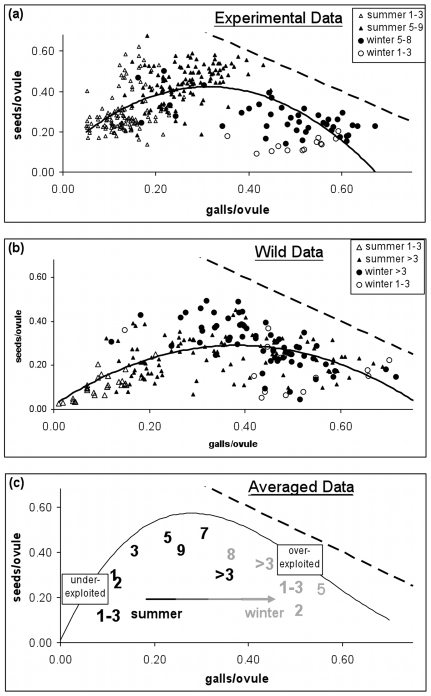
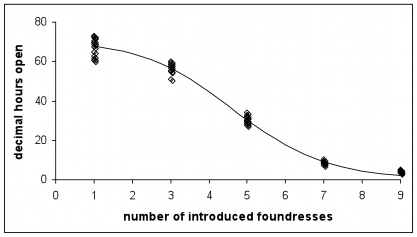
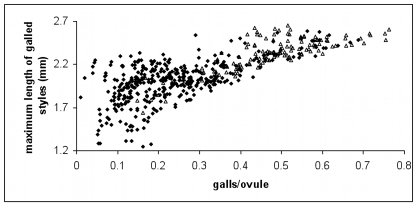
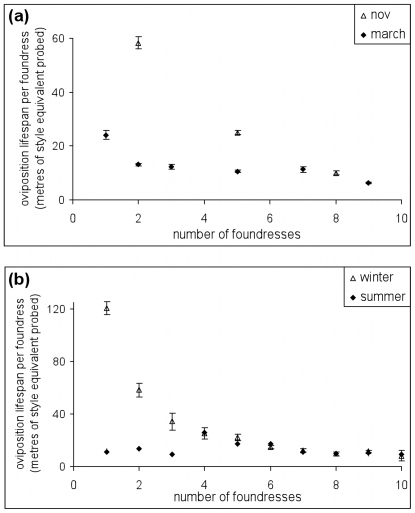
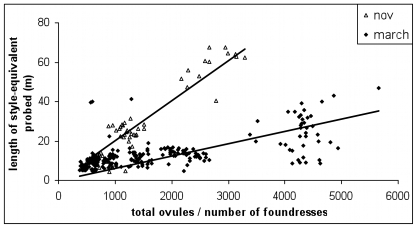
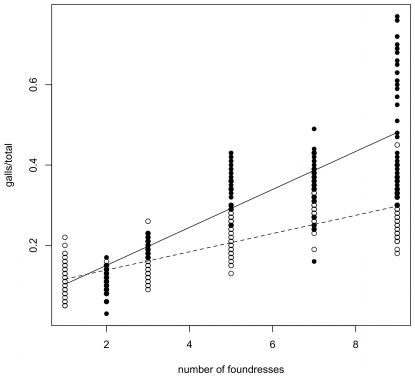
Fig trees are pollinated by fig wasps, which also oviposit in female flowers. The wasp larvae gall and eat developing seeds. Although fig trees benefit from allowing wasps to oviposit, because the wasp offspring disperse pollen, figs must prevent wasps from ovipositing in all flowers, or seed production would cease, and the mutualism would go extinct. In Ficus racemosa, we find that syconia ('figs') that have few foundresses (ovipositing wasps) are underexploited in the summer (few seeds, few galls, many empty ovules) and are overexploited in the winter (few seeds, many galls, few empty ovules). Conversely, syconia with many foundresses produce intermediate numbers of galls and seeds, regardless of season. We use experiments to explain these patterns, and thus, to explain how this mutualism is maintained. In the hot summer, wasps suffer short lifespans and therefore fail to oviposit in many flowers. In contrast, cooler temperatures in the winter permit longer wasp lifespans, which in turn allows most flowers to be exploited by the wasps. However, even in winter, only in syconia that happen to have few foundresses are most flowers turned into galls. In syconia with higher numbers of foundresses, interference competition reduces foundress lifespans, which reduces the proportion of flowers that are galled. We further show that syconia encourage the entry of multiple foundresses by delaying ostiole closure. Taken together, these factors allow fig trees to reduce galling in the wasp-benign winter and boost galling (and pollination) in the wasp-stressing summer. Interference competition has been shown to reduce virulence in pathogenic bacteria. Our results show that interference also maintains cooperation in a classic, cooperative symbiosis, thus linking theories of virulence and mutualism. More generally, our results reveal how frequency-dependent population regulation can occur in the fig-wasp mutualism, and how a host species can 'set the rules of the game' to ensure mutualistic behavior in its symbionts.
无花果树由榕小蜂授粉,榕小蜂也在雌花中产卵。榕小蜂的幼虫在发育中的种子中产卵并取食。尽管无花果树允许榕小蜂产卵,因为榕小蜂的后代会传播花粉,但无花果树必须防止榕小蜂在所有花朵中产卵,否则种子产量将会停止,共生关系也将灭绝。在榕属植物中,我们发现,具有较少筑巢蜂(产卵榕小蜂)的榕果(“无花果”)在夏季(种子少、榕果少、空胚珠多)被过度开发,而在冬季(种子少、榕果多、空胚珠少)则被过度开发。相反,具有较多筑巢蜂的榕果无论季节如何,都会产生中等数量的榕果和种子。我们利用实验来解释这些模式,从而解释这种共生关系是如何维持的。在炎热的夏天,榕小蜂的寿命很短,因此无法在许多花朵中产卵。相比之下,冬季较冷的温度允许榕小蜂的寿命更长,这反过来又使大多数花朵都能被榕小蜂利用。然而,即使在冬季,只有当筑巢蜂数量较少的榕果中,大多数花朵才会变成榕果。在筑巢蜂数量较高的榕果中,干扰竞争会降低筑巢蜂的寿命,从而降低变成榕果的花朵比例。我们进一步表明,榕果通过延迟孔口关闭来鼓励多个筑巢蜂的进入。总之,这些因素使无花果树能够减少冬季对榕小蜂友好的榕果,同时在夏季对榕小蜂产生压力时促进榕果(和授粉)。干扰竞争已被证明会降低病原菌的毒力。我们的结果表明,干扰也维持了经典合作共生中的合作关系,从而将毒力和共生理论联系起来。更普遍地说,我们的结果揭示了频率依赖的种群调节如何在榕果-榕小蜂共生关系中发生,以及宿主物种如何“制定游戏规则”以确保其共生体的共生行为。