Department of Pharmacology and Interdepartmental Program in Vascular Biology and Therapeutics, Yale University School of Medicine, New Haven, CT, USA.
PLoS One. 2009 Nov 13;4(11):e7830. doi: 10.1371/journal.pone.0007830.
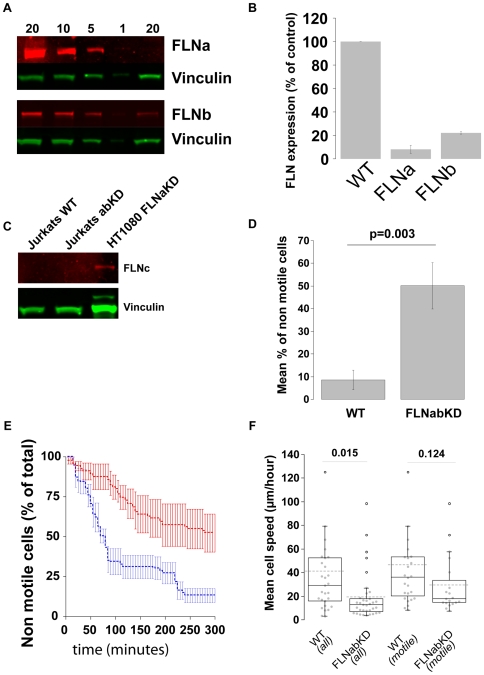
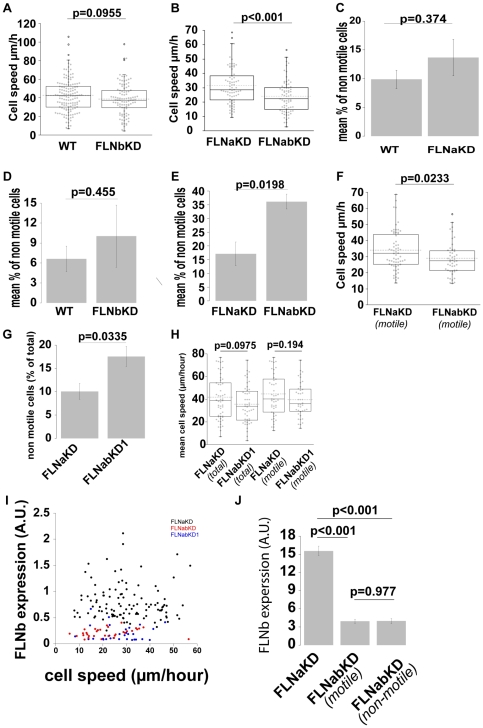
Mammalian filamins (FLNs) are a family of three large actin-binding proteins. FLNa, the founding member of the family, was implicated in migration by cell biological analyses and the identification of FLNA mutations in the neuronal migration disorder periventricular heterotopia. However, recent knockout studies have questioned the relevance of FLNa to cell migration. Here we have used shRNA-mediated knockdown of FLNa, FLNb or FLNa and FLNb, or, alternatively, acute proteasomal degradation of all three FLNs, to generate FLN-deficient cells and assess their ability to migrate. We report that loss of FLNa or FLNb has little effect on migration but that knockdown of FLNa and FLNb, or proteolysis of all three FLNs, impairs migration. The observed defect is primarily a deficiency in initiation of motility rather than a problem with maintenance of locomotion speed. FLN-deficient cells are also impaired in spreading. Re-expression of full length FLNa, but not re-expression of a mutated FLNa lacking immunoglobulin domains 19 to 21, reverts both the spreading and the inhibition of initiation of migration.Our results establish a role for FLNs in cell migration and spreading and suggest that compensation by other FLNs may mask phenotypes in single knockout or knockdown cells. We propose that interactions between FLNs and transmembrane or signalling proteins, mediated at least in part by immunoglobulin domains 19 to 21 are important for both cell spreading and initiation of migration.
哺乳动物细丝蛋白(FLNs)是一组三个大型肌动蛋白结合蛋白。FLNa 是该家族的创始成员,通过细胞生物学分析和神经元迁移障碍脑室周围异位症中 FLNA 突变的鉴定,与迁移有关。然而,最近的基因敲除研究对 FLNa 与细胞迁移的相关性提出了质疑。在这里,我们使用 shRNA 介导的 FLNa、FLNb 或 FLNa 和 FLNb 的敲低,或者,替代地,所有三种 FLN 的急性蛋白酶体降解,生成 FLN 缺陷细胞并评估它们的迁移能力。我们报告说,FLNa 或 FLNb 的缺失对迁移几乎没有影响,但 FLNa 和 FLNb 的敲低,或所有三种 FLN 的蛋白酶体降解,会损害迁移。观察到的缺陷主要是运动起始的缺陷,而不是运动速度维持的问题。FLN 缺陷细胞在扩散方面也受到损害。全长 FLNa 的重新表达,但不是缺乏免疫球蛋白结构域 19 至 21 的突变型 FLNa 的重新表达,可恢复扩散和迁移起始的抑制。我们的结果确立了 FLNs 在细胞迁移和扩散中的作用,并表明其他 FLNs 的代偿可能掩盖了单基因敲除或敲低细胞中的表型。我们提出,FLNs 与跨膜或信号蛋白之间的相互作用,至少部分通过免疫球蛋白结构域 19 至 21 介导,对于细胞扩散和迁移起始都是重要的。