Department of Surgical Sciences, Section of Orthopaedics, Uppsala University, Uppsala, Sweden.
PLoS One. 2009 Nov 13;4(11):e7747. doi: 10.1371/journal.pone.0007747.
Although environmental factors, mainly nutrition and UV-B radiation, have been considered major determinants of vitamin D status, they have only explained a modest proportion of the variation in serum 25-hydroxyvitamin D. We aimed to study the seasonal impact of genetic factors on serum 25-hydroxyvitamin D concentrations.
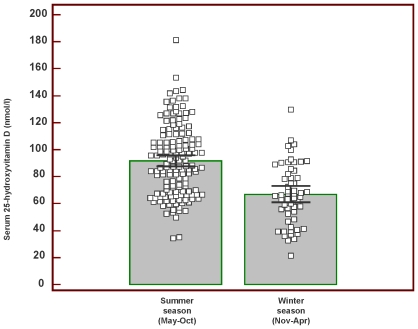
METHODOLOGY/PRINCIPAL FINDINGS: 204 same-sex twins, aged 39-85 years and living at northern latitude 60 degrees, were recruited from the Swedish Twin Registry. Serum 25-hydroxyvitamin D was analysed by high-pressure liquid chromatography and mass spectrometry. Genetic modelling techniques estimated the relative contributions of genetic, shared and individual-specific environmental factors to the variation in serum vitamin D. The average serum 25-hydroxyvitamin D concentration was 84.8 nmol/l (95% CI 81.0-88.6) but the seasonal variation was substantial, with 24.2 nmol/l (95% CI 16.3-32.2) lower values during the winter as compared to the summer season. Half of the variability in 25-hydroxyvitamin D during the summer season was attributed to genetic factors. In contrast, the winter season variation was largely attributable to shared environmental influences (72%; 95% CI 48-86%), i.e., solar altitude. Individual-specific environmental influences were found to explain one fourth of the variation in serum 25-hydroxyvitamin D independent of season.
CONCLUSIONS/SIGNIFICANCE: There exists a moderate genetic impact on serum vitamin D status during the summer season, probably through the skin synthesis of vitamin D. Further studies are warranted to identify the genes impacting on vitamin D status.
尽管环境因素(主要是营养和 UV-B 辐射)被认为是维生素 D 状态的主要决定因素,但它们仅能解释血清 25-羟维生素 D 变化的一部分。我们旨在研究遗传因素对血清 25-羟维生素 D 浓度的季节性影响。
方法/主要发现:从瑞典双胞胎登记处招募了 204 对年龄在 39-85 岁、生活在北纬 60 度的同性双胞胎。通过高压液相色谱和质谱分析法分析血清 25-羟维生素 D。遗传建模技术估计了遗传、共享和个体特异性环境因素对血清维生素 D 变化的相对贡献。平均血清 25-羟维生素 D 浓度为 84.8 nmol/L(95%CI 81.0-88.6),但季节性变化很大,冬季比夏季低 24.2 nmol/L(95%CI 16.3-32.2)。夏季 25-羟维生素 D 变异的一半归因于遗传因素。相比之下,冬季的变化主要归因于共享环境影响(72%;95%CI 48-86%),即太阳高度角。发现个体特异性环境影响在独立于季节的情况下解释了血清 25-羟维生素 D 变异的四分之一。
结论/意义:在夏季,血清维生素 D 状态存在中等程度的遗传影响,可能是通过皮肤合成维生素 D。需要进一步研究以确定影响维生素 D 状态的基因。