Department of Pharmacy, University of Copenhagen, 2100 Copenhagen, Denmark.
WHO Collaborating Center for Research and Training in Patient Perspective on Medicines Use, Department of Pharmacy, University of Copenhagen, 2100 Copenhagen, Denmark.
Int J Environ Res Public Health. 2020 Nov 1;17(21):8053. doi: 10.3390/ijerph17218053.
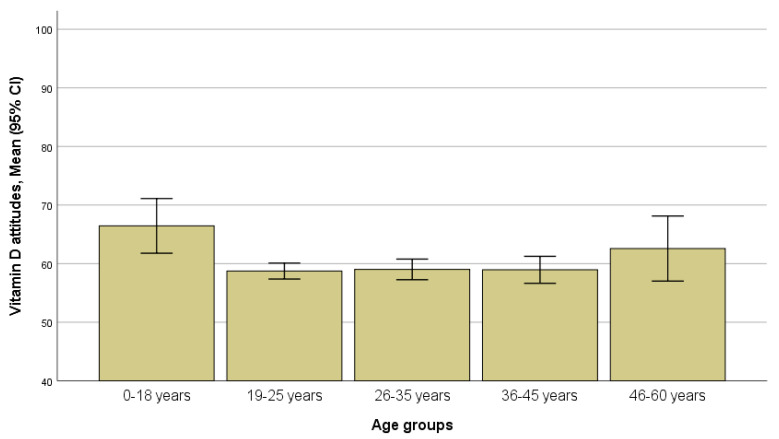
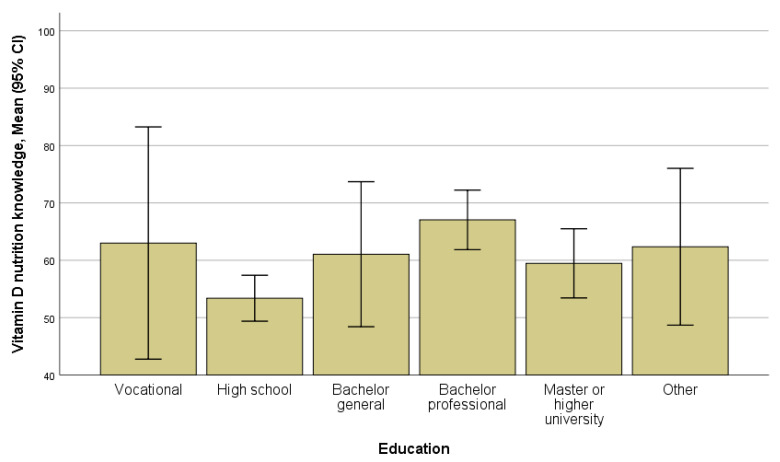
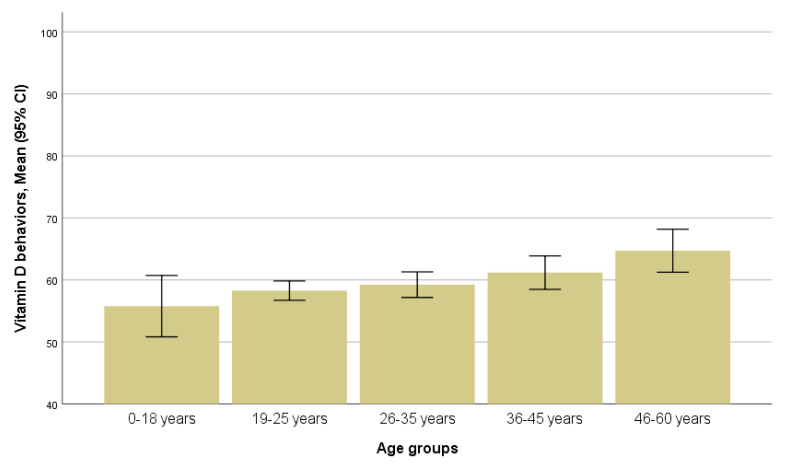
The prevalence of vitamin D deficiency in women with a non-Western ethnic minority background in Nordic countries is high. The aim of this study was to assess vitamin D knowledge, attitudes, and behaviors in women with a non-Western ethic minority background living in Denmark. A validated vitamin D knowledge, attitudes, and behaviors' questionnaire was translated into Danish, piloted, and distributed via relevant Facebook groups. The responses were analyzed using parametric and non-parametric tests for descriptive and bivariate analyses. In total, 254 women who considered themselves having a non-Western ethnic minority background responded to the questionnaire. The median age (IQR) was 25 (23-33) years old; 32% had a professional bachelor's, 28% had high school, and 22% had a master's or higher university education. Participants scored higher on vitamin D general knowledge (scores above 80 on the scale 0-100) compared to vitamin D nutrition knowledge or vitamin D attitudes and behaviors (scores around 60 on the scale 0-100). In conclusion, the vitamin D knowledge among study participants-i.e., young well-educated non-Western ethnic minority women in Denmark-was pretty good. The further examination of vitamin D knowledge, attitudes, and behaviors should explore specifics related to nationality and religion and focus on less-educated non-Western ethnic minority women in Denmark and other Nordic countries.
在北欧国家,具有非西方少数民族背景的女性维生素 D 缺乏症的患病率很高。本研究旨在评估丹麦生活的具有非西方少数民族背景的女性的维生素 D 知识、态度和行为。将经过验证的维生素 D 知识、态度和行为问卷翻译成丹麦语,并进行试点,然后通过相关的 Facebook 群组分发。使用参数和非参数检验对响应进行分析,以进行描述性和双变量分析。共有 254 名自认为具有非西方少数民族背景的女性对问卷做出了回应。中位数年龄(IQR)为 25 岁(23-33 岁);32%的人拥有专业学士学位,28%的人拥有高中学历,22%的人拥有硕士或更高学历。与维生素 D 营养知识或维生素 D 态度和行为(0-100 分制的得分约为 60)相比,参与者在维生素 D 一般知识(0-100 分制的得分高于 80)方面的得分更高。总之,研究参与者的维生素 D 知识——即丹麦受过良好教育的年轻非西方少数民族女性——相当不错。进一步检查维生素 D 知识、态度和行为应探讨与国籍和宗教相关的具体问题,并关注丹麦和其他北欧国家教育程度较低的非西方少数民族女性。