Pak Richard, Price Margaux M, Thatcher Jason
Department of Psychology, Clemson University, Clemson, SC 29634, USA.
J Med Internet Res. 2009 Nov 16;11(4):e45. doi: 10.2196/jmir.1220.
Older adults' health maintenance may be enhanced by having access to online health information. However, usability issues may prevent older adults from easily accessing such information. Prior research has shown that aging is associated with a unique pattern of cognitive changes, and knowledge of these changes may be used in the design of health websites for older adults.
The goal of the current study was to examine whether older adults use of a health information website was affected by an alternative information architecture and access interface (hierarchical versus tag-based).
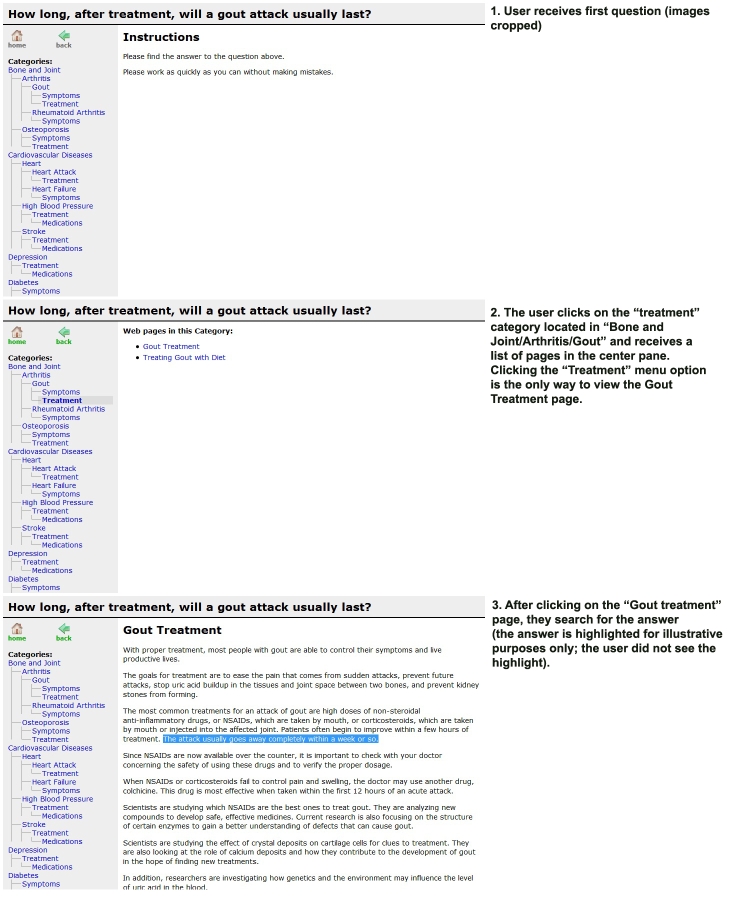
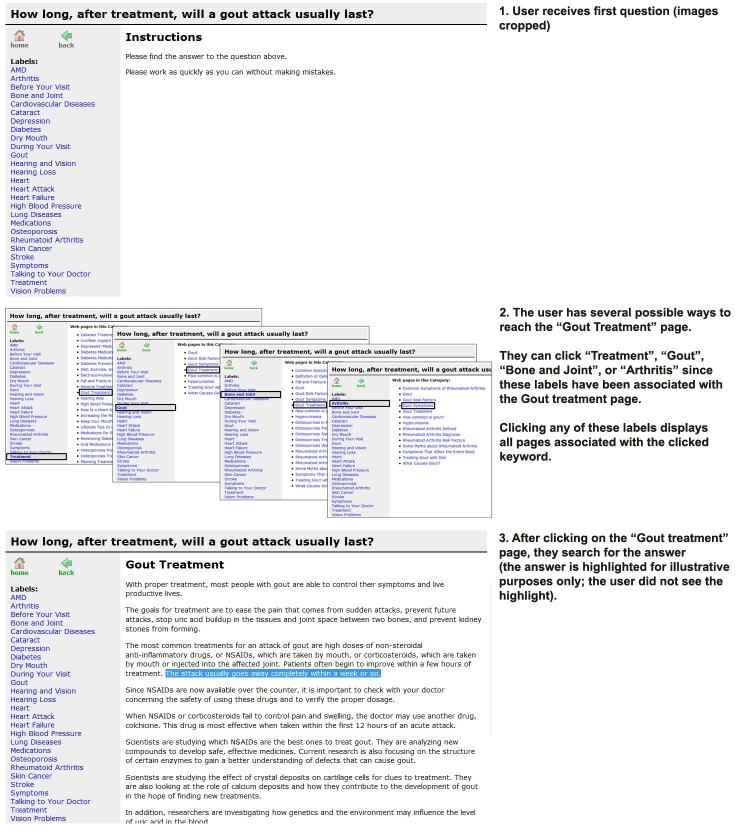
Fifty younger adults (aged 18-23) and 50 older adults (aged 60-80) navigated a health information website, which was organized hierarchically or used tags/keywords, to find answers to health-related questions while their performance was tracked. We hypothesized that older adults would perform better in the tag-based health information website because it placed greater demands on abilities that remain intact with aging (verbal ability and vocabulary).
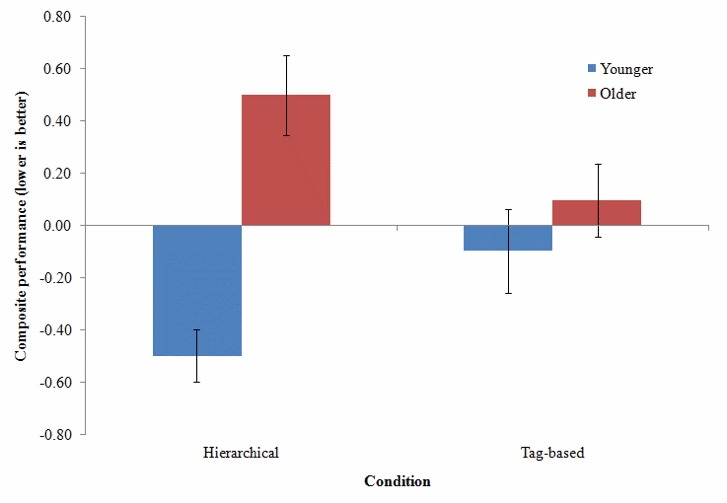
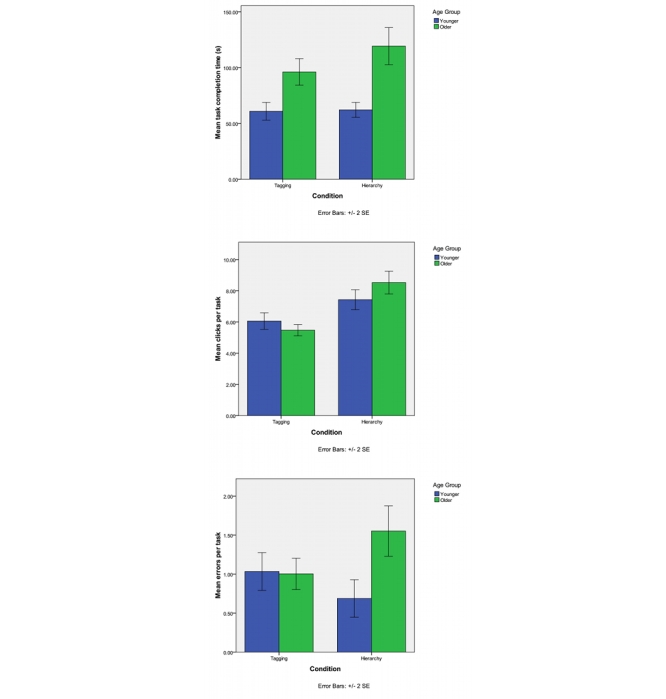
The pattern of age-related differences in computer use was consistent with prior research with older adults. We found that older adults had been using computers for less time (F(1,98)= 10.6, P= .002) and used them less often (F(1,98)= 11.3, P= .001) than younger adults. Also consistent with the cognitive aging literature, younger adults had greater spatial visualization and orientation abilities (F(1,98)= 34.6, P< .001 and F(1,98)= 6.8, P= .01) and a larger memory span (F(1,98)= 5.7, P= .02) than older adults, but older adults had greater vocabulary (F(1,98)= 11.4, P= .001). Older adults also took significantly more medications than younger adults (F(1,98)= 57.7, P< .001). In the information search task, older adults performed worse than younger adults (F(1,96)= 18.0, P< .001). However, there was a significant age x condition interaction indicating that while younger adults outperformed older adults in the hierarchical condition (F(1,96)= 25.2, P< .001), there were no significant age-related differences in the tag-based condition, indicating that older adults performed as well as younger adults in this condition.
Access to online health information is increasing in popularity and can lead to a more informed health consumer. However, usability barriers may differentially affect older adults. The results of the current study suggest that the design of health information websites that take into account age-related changes in cognition can enhance older adults' access to such information.
获取在线健康信息可能会促进老年人的健康维护。然而,可用性问题可能会阻碍老年人轻松获取此类信息。先前的研究表明,衰老与独特的认知变化模式相关,了解这些变化可用于设计针对老年人的健康网站。
本研究的目的是检验老年人对健康信息网站的使用是否会受到替代信息架构和访问界面(分层式与基于标签式)的影响。
50名年轻人(18 - 23岁)和50名老年人(60 - 80岁)浏览一个健康信息网站,该网站采用分层式组织或使用标签/关键词,他们在查找与健康相关问题的答案时,其操作表现会被跟踪。我们假设老年人在基于标签的健康信息网站上表现会更好,因为它对随着年龄增长仍保持完好的能力(语言能力和词汇量)有更高要求。
计算机使用方面与年龄相关的差异模式与先前对老年人的研究一致。我们发现,老年人使用计算机的时间比年轻人少(F(1,98)= 10.6,P = .002),使用频率也比年轻人低(F(1,98)= 11.3,P = .001)。同样与认知衰老文献一致的是,年轻人比老年人具有更强的空间可视化和定向能力(F(1,98)= 34.6,P < .001和F(1,98)= 6.8,P = .01)以及更大的记忆跨度(F(1,98)= 5.7,P = .02),但老年人的词汇量更大(F(1,98)= 11.4,P = .001)。老年人服用的药物也明显比年轻人多(F(1,98)= 57.7,P < .001)。在信息搜索任务中,老年人的表现比年轻人差(F(1,96)= 18.0,P < .001)。然而,存在显著的年龄×条件交互作用,表明虽然年轻人在分层条件下的表现优于老年人(F(1,96)= 25.2,P < .001),但在基于标签的条件下不存在显著的年龄相关差异,这表明老年人在这种条件下的表现与年轻人相当。
在线健康信息的获取越来越普遍,并且可以使健康消费者更加了解情况。然而,可用性障碍可能会对老年人产生不同的影响。本研究结果表明,考虑到与年龄相关的认知变化来设计健康信息网站,可以增强老年人对这类信息的获取。