Department of Radiation Oncology, University Clinics Heidelberg, 69120, Heidelberg, Germany.
J Appl Clin Med Phys. 2009 Oct 27;10(4):188-206. doi: 10.1120/jacmp.v10i4.2292.
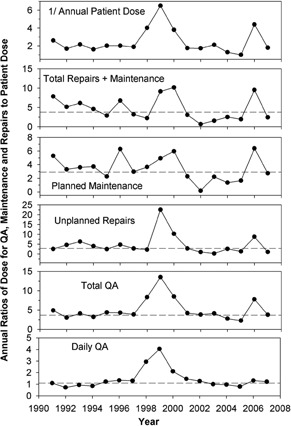
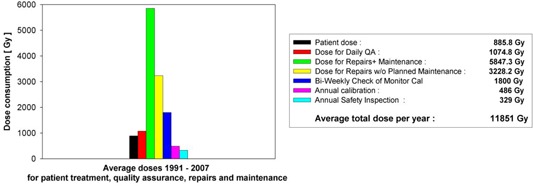
Dedicated accelerators for intra-operative radiation therapy (IORT) are operated at high dose rates in order to achieve short treatment times within which the anaesthetisized patient must be remotely monitored (e.g. via video cameras and telemetric anesthesia instruments). Due to these high dose rates, large doses accumulate from the irradiations necessary for quality assurance (QA) and maintenance. In practice, the dose load for QA, maintenance and repairs will probably far exceed the patient dose. The total dose consumption for all of these actions must be considered in facility licensing, in radiation protection assessments, and in the shielding calculations. Dose consumption for QA and maintenance was assessed for the dedicated IORT facility at Heidelberg University for the operation period between June 1991 and December 2007 (15.5 years). Average doses per year of 5847 Gy for maintenance and repairs and 3686 Gy for QA were needed during this period. The causes and composition of these high doses are analyzed and discussed separately for irradiations that need to be performed in the operation room and which, with a mobile accelerator, may be performed in a separate QA vault.
专用于术中放射治疗(IORT)的加速器以高剂量率运行,以便在麻醉患者必须远程监控的短治疗时间内(例如通过摄像机和遥测麻醉仪器)完成治疗。由于这些高剂量率,为了质量保证(QA)和维护而进行的辐照会累积大量剂量。实际上,QA、维护和维修的剂量负荷可能远远超过患者剂量。在设施许可、辐射防护评估和屏蔽计算中,必须考虑所有这些操作的总剂量消耗。对海德堡大学专用 IORT 设施在 1991 年 6 月至 2007 年 12 月(15.5 年)期间的 QA 和维护的剂量消耗进行了评估。在此期间,每年需要进行维护和维修的平均剂量为 5847 Gy,以及 QA 的平均剂量为 3686 Gy。对需要在手术室中进行的辐照以及使用移动加速器可在单独的 QA 屏蔽室中进行的辐照,分别分析和讨论了这些高剂量的原因和组成。