Department of Pathology, University College London, London, United Kingdom.
Clin Cancer Res. 2009 Dec 1;15(23):7335-44. doi: 10.1158/1078-0432.CCR-09-0882. Epub 2009 Nov 17.
The DNA replication licensing machinery is integral to the control of proliferation, differentiation, and maintenance of genomic stability in human cells. We have analyzed replication licensing factors (RLF), together with DNA ploidy status, to investigate their role in progression of penile squamous cell carcinoma and to assess their utility as novel prognostic tools.
In a cohort of 141 patients, we linked protein expression profiles of the standard proliferation marker Ki67 and the RLFs Mcm2 and geminin to clinicopathologic variables, ploidy status, and clinical outcome.
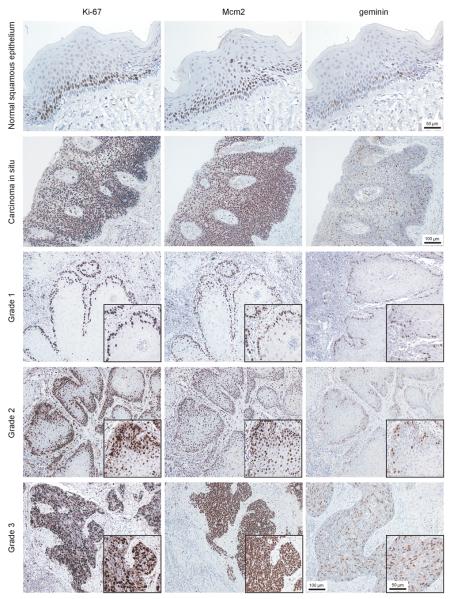
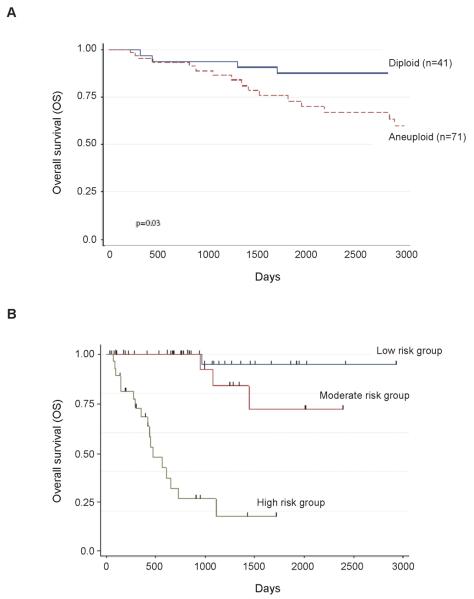
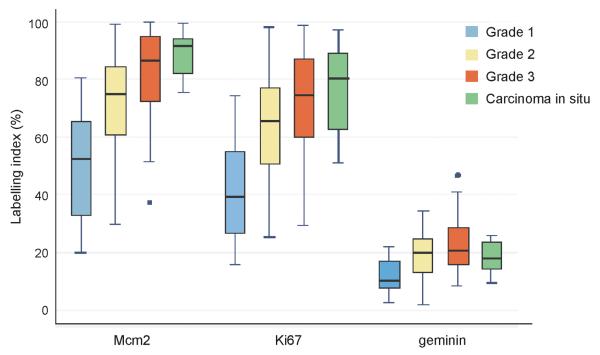
Increased Ki67, Mcm2, and geminin levels were each significantly associated with arrested tumor differentiation (P < 0.0001) and aneuploidy (P < or = 0.01). Accelerated cell cycle progression was linked to increasing tumor size, stage, and depth of invasion. Aneuploid tumors significantly correlated with tumor grade (P < 0.0001). Biomarker expression and DNA ploidy status were significant predictors of locoregional disease progression [Mcm2 (P = 0.02), geminin (P = 0.02), Ki67 (P = 0.03), and aneuploidy (P = 0.03)] in univariate analysis. Importantly, aneuploidy was a strong independent prognosticator for overall survival (hazard ratio, 4.19; 95% confidence interval, 1.17-14.95; P = 0.03). Used in conjunction with conventional pathologic information, multiparameter analysis of these variables can stratify patients into low- or high-risk groups for disease progression (Harrell's c-index = 0.88).
Our findings suggest that RLFs and tumor aneuploidy may be used as an adjunct to conventional prognostic indicators, identifying men at high risk of disease progression. Our results also identify the DNA replication initiation pathway as a potentially attractive therapeutic target in penile squamous cell carcinoma.
DNA 复制许可机制对于控制人类细胞的增殖、分化和维持基因组稳定性至关重要。我们分析了复制许可因子(RLF)以及 DNA ploidy 状态,以研究它们在阴茎鳞状细胞癌进展中的作用,并评估它们作为新型预后工具的效用。
在 141 例患者的队列中,我们将标准增殖标志物 Ki67 和 RLFs Mcm2 和 geminin 的蛋白表达谱与临床病理变量、ploidy 状态和临床结果联系起来。
Ki67、Mcm2 和 geminin 水平的增加均与肿瘤分化停滞(P<0.0001)和非整倍体(P<0.01)显著相关。细胞周期的加速进展与肿瘤的大小、分期和浸润深度的增加有关。非整倍体肿瘤与肿瘤分级显著相关(P<0.0001)。生物标志物表达和 DNA ploidy 状态是非局部疾病进展的显著预测因子[Mcm2(P=0.02)、geminin(P=0.02)、Ki67(P=0.03)和非整倍体(P=0.03)]。重要的是,非整倍体是总生存的独立强预后因素(危险比,4.19;95%置信区间,1.17-14.95;P=0.03)。与传统的病理信息结合使用,这些变量的多参数分析可以将患者分为低风险或高风险的疾病进展组(Harrell 的 c 指数=0.88)。
我们的研究结果表明,RLF 和肿瘤非整倍体可作为传统预后指标的辅助手段,识别出疾病进展风险高的男性。我们的研究结果还确定了 DNA 复制起始途径作为阴茎鳞状细胞癌潜在的有吸引力的治疗靶点。