Clinic of General, Visceral, and Transplantation Surgery, University of Ulm, Steinhoevelstrasse 9, Ulm 89075, Germany.
Br J Cancer. 2010 Jan 5;102(1):188-95. doi: 10.1038/sj.bjc.6605440. Epub 2009 Nov 17.
Secreted protein acidic and rich in cysteine (SPARC) is a multi-faceted protein-modulating cell-cell and cell-matrix interactions. In cancer, SPARC can be not only associated with a highly aggressive phenotype, but also acts as a tumour suppressor. The aim of this study was to characterise the function of SPARC and its modulation by fibroblast growth factor receptor (FGFR) 1 isoforms in pancreatic ductal adenocarcinoma (PDAC).
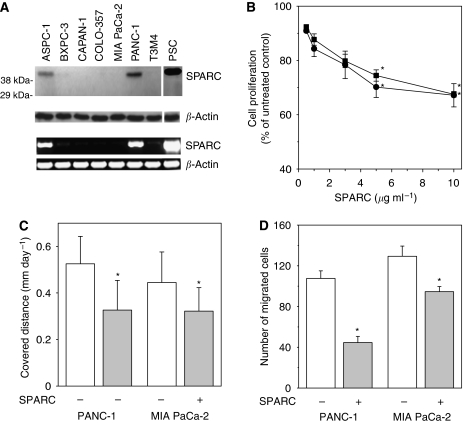
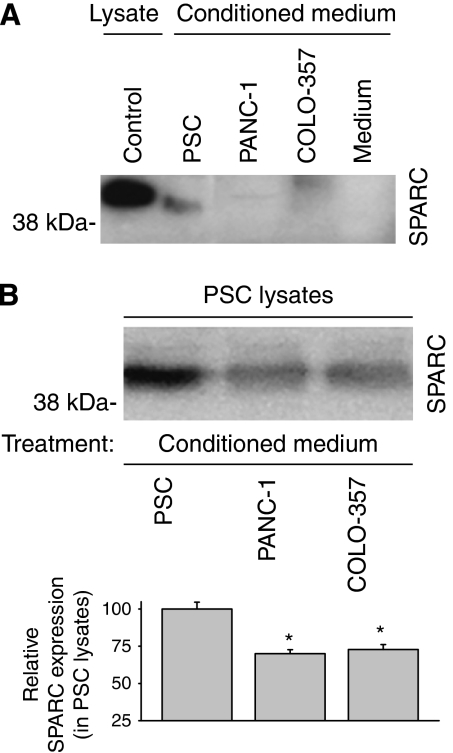
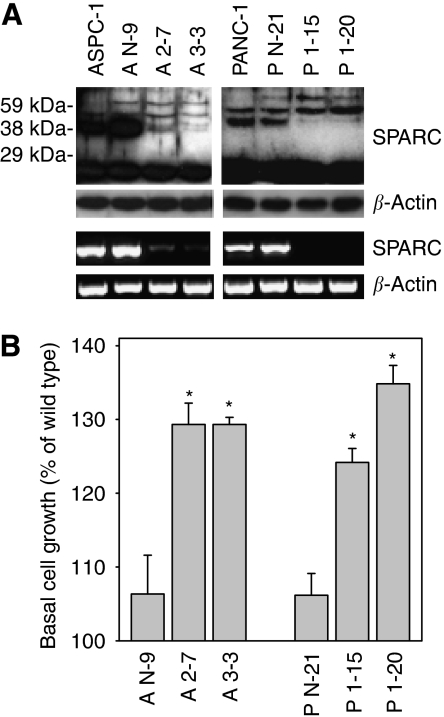
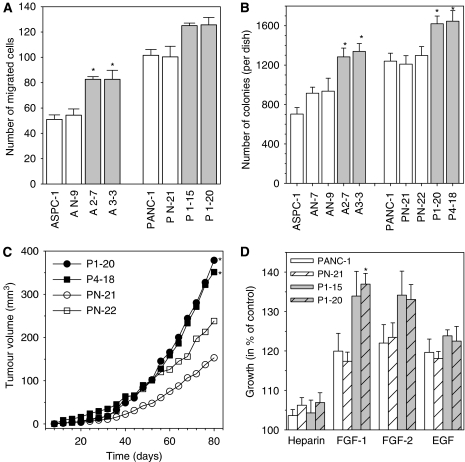
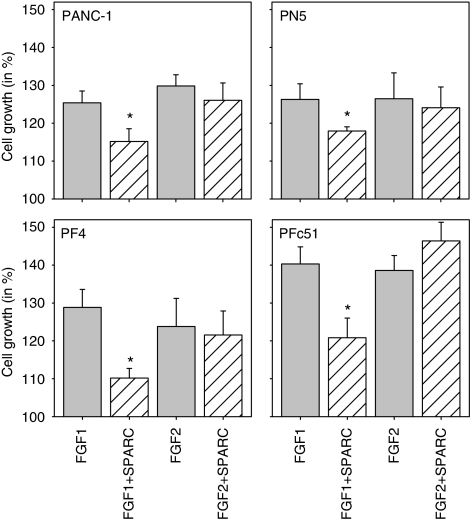
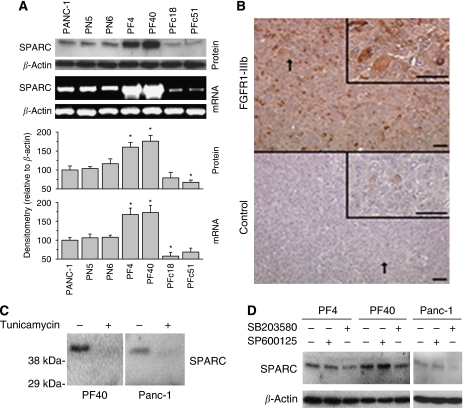
Exogenous SPARC inhibited growth, movement, and migration. ShRNA inhibition of endogenous SPARC in ASPC-1 and PANC-1 cells resulted in increased anchorage-dependent and -independent growth, transwell migration, and xenograft growth as well as increased mitogenic efficacy of fibroblast growth factor (FGF) 1 and FGF2. Endogenous SPARC expression in PANC-1 cells was increased in FGFR1-IIIb over-expressing cells, but decreased in FGFR1-IIIc over-expressing cells. The up-regulation of endogenous SPARC was abrogated by the p38-mitogen-activated protein kinase inhibitor SB203580. SPARC was detectable in conditioned medium of pancreatic stellate cells (PSCs), but not PDAC cells. Conditioned medium of PDAC cells reduced endogenous SPARC expression of PSCs.
Endogenous SPARC inhibits the malignant phenotype of PDAC cells and may, therefore, act as a tumour suppressor in PDAC. Endogenous SPARC expression can be modulated by FGFR1-III isoform expression. In addition, PDAC cells may inhibit endogenous SPARC expression in surrounding PSCs by paracrine actions.
富含半胱氨酸的酸性分泌蛋白(SPARC)是一种多功能蛋白,可以调节细胞-细胞和细胞-基质的相互作用。在癌症中,SPARC 不仅与高度侵袭性表型有关,还可以作为肿瘤抑制因子。本研究旨在研究 SPARC 的功能及其在胰腺导管腺癌(PDAC)中被成纤维细胞生长因子受体(FGFR)1 异构体调节的机制。
外源性 SPARC 抑制生长、运动和迁移。ASPC-1 和 PANC-1 细胞中内源性 SPARC 的 shRNA 抑制导致锚定依赖性和非依赖性生长、Transwell 迁移和异种移植物生长增加,以及成纤维细胞生长因子(FGF)1 和 FGF2 的有丝分裂功效增加。在 FGFR1-IIIb 过表达细胞中,PANC-1 细胞中内源性 SPARC 的表达增加,但在 FGFR1-IIIc 过表达细胞中减少。p38-丝裂原激活蛋白激酶抑制剂 SB203580 可阻断内源性 SPARC 的上调。胰腺星状细胞(PSC)的条件培养基中可检测到 SPARC,但 PDAC 细胞中不可检测到。PDAC 细胞的条件培养基可降低 PSCs 中的内源性 SPARC 表达。
内源性 SPARC 抑制 PDAC 细胞的恶性表型,因此可能在 PDAC 中发挥肿瘤抑制因子的作用。内源性 SPARC 的表达可被 FGFR1-III 异构体的表达所调节。此外,PDAC 细胞可能通过旁分泌作用抑制周围 PSCs 中的内源性 SPARC 表达。