Endocrinology and Metabolic Medicine, Imperial College London, Praed Street, London W2 1PG, U.K.
Clin Sci (Lond). 2009 Nov 23;118(5):315-32. doi: 10.1042/CS20090399.
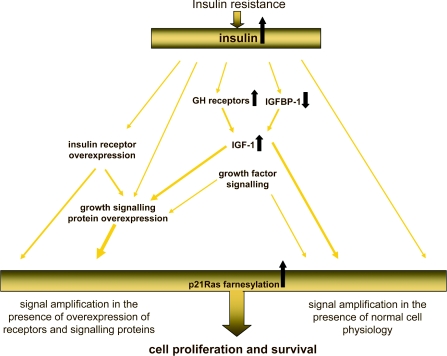
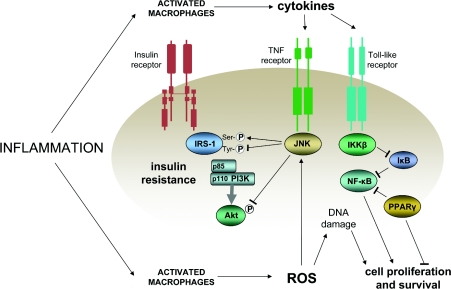
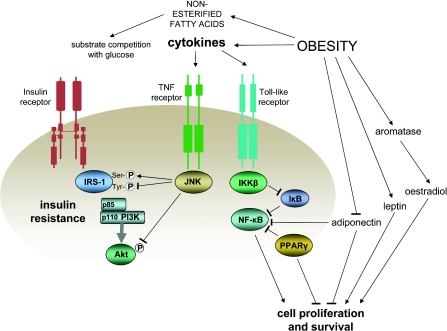
Experimental, epidemiological and clinical evidence implicates insulin resistance and its accompanying hyperinsulinaemia in the development of cancer, but the relative importance of these disturbances in cancer remains unclear. There are, however, theoretical mechanisms by which hyperinsulinaemia could amplify such growth-promoting effects as insulin may have, as well as the growth-promoting effects of other, more potent, growth factors. Hyperinsulinaemia may also induce other changes, particularly in the IGF (insulin-like growth factor) system, that could promote cell proliferation and survival. Several factors can independently modify both cancer risk and insulin resistance, including subclinical inflammation and obesity. The possibility that some of the effects of hyperinsulinaemia might then augment pro-carcinogenic changes associated with disturbances in these factors emphasizes how, rather than being a single causative factor, insulin resistance may be most usefully viewed as one strand in a network of interacting disturbances that promote the development and progression of cancer.
实验、流行病学和临床证据表明胰岛素抵抗及其伴随的高胰岛素血症与癌症的发生有关,但这些紊乱在癌症中的相对重要性尚不清楚。然而,存在理论机制表明高胰岛素血症可能放大胰岛素的促生长作用,以及其他更有效的生长因子的促生长作用。高胰岛素血症还可能引起其他变化,特别是在 IGF(胰岛素样生长因子)系统中,这些变化可能促进细胞增殖和存活。几种因素可以独立地改变癌症风险和胰岛素抵抗,包括亚临床炎症和肥胖。高胰岛素血症的一些影响可能会增强与这些因素紊乱相关的致癌变化的可能性,这强调了胰岛素抵抗如何不是单一的致病因素,而是最有用的,可以将其视为促进癌症发展和进展的相互作用紊乱网络中的一个环节。