Department of Pathology, University of Virginia, Charlottesville, VA 22908, USA.
J Immunol. 2009 Dec 15;183(12):7635-8. doi: 10.4049/jimmunol.0804251.
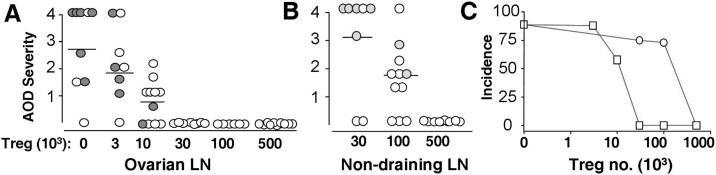
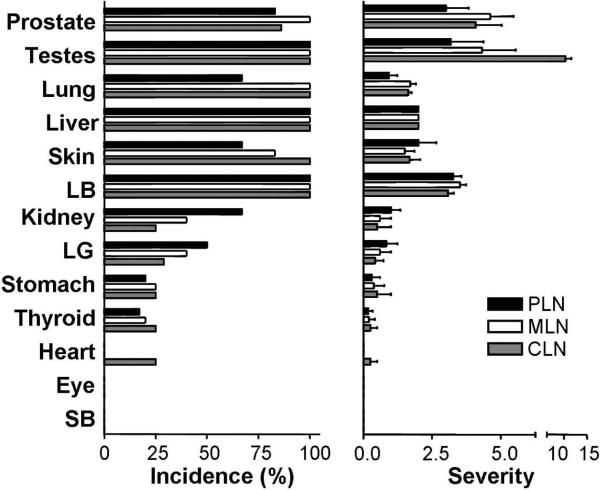
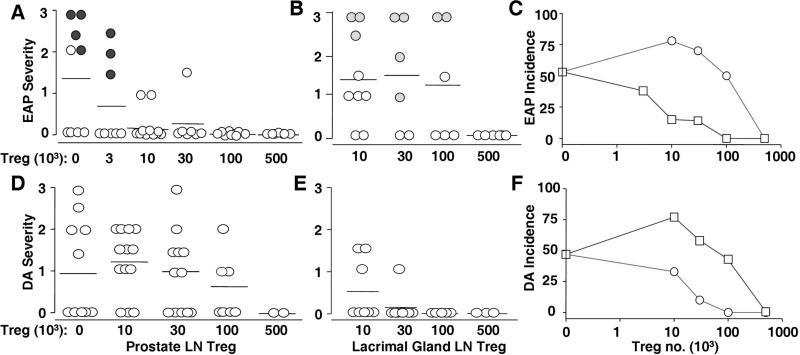
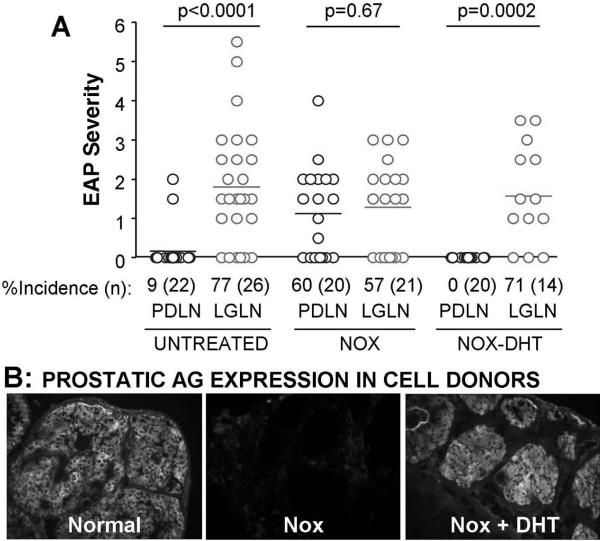
Natural CD4(+)CD25(+)Foxp3(+) regulatory T cells (Treg) effectively prevent autoimmune disease development, but their role in maintaining physiological tolerance against self-Ag of internal organs is not yet defined. In this study, we quantified disease-specific Treg (DS-Treg) as Treg that preferentially suppress one autoimmune disease over another in day 3 thymectomized recipients. A striking difference was found among individual lymph nodes (LN) of normal mice; Treg from draining LN were 15-50 times more efficient than those of nondraining LN at suppressing autoimmune diseases of ovary, prostate, and lacrimal glands. The difference disappeared upon auto-Ag ablation and returned upon auto-Ag re-expression. In contrast, the CD4(+)CD25(-) effector T cells from different individual LN induced multiorgan inflammation with comparable organ distribution. We propose that peripheral tolerance for internal organs relies on the control of autoreactive effector T cells by strategic enrichment of Ag-specific Treg in the regional LN.
天然 CD4(+)CD25(+)Foxp3(+)调节性 T 细胞(Treg)可有效预防自身免疫性疾病的发生,但它们在维持对内器官自身抗原的生理耐受中的作用尚不清楚。在这项研究中,我们将疾病特异性 Treg(DS-Treg)定义为在第 3 天胸腺切除受体中优先抑制一种自身免疫性疾病而非另一种疾病的 Treg。在正常小鼠的单个淋巴结(LN)中发现了惊人的差异;引流 LN 中的 Treg 在抑制卵巢、前列腺和泪腺自身免疫性疾病方面的效率比非引流 LN 中的 Treg 高 15-50 倍。这种差异在自身抗原消除后消失,在自身抗原再次表达后恢复。相比之下,来自不同个体 LN 的 CD4(+)CD25(-)效应 T 细胞可诱导多器官炎症,且具有相似的器官分布。我们提出,内部器官的外周耐受依赖于通过在区域性 LN 中特异性富集 Ag 特异性 Treg 来控制自身反应性效应 T 细胞。