Department of Cell and Molecular Pharmacology and Experimental Therapeutics, Medical University of South Carolina, Charleston, SC, USA.
Cell Cycle. 2009 Dec 15;8(24):4072-8. doi: 10.4161/cc.8.24.10242. Epub 2009 Dec 5.
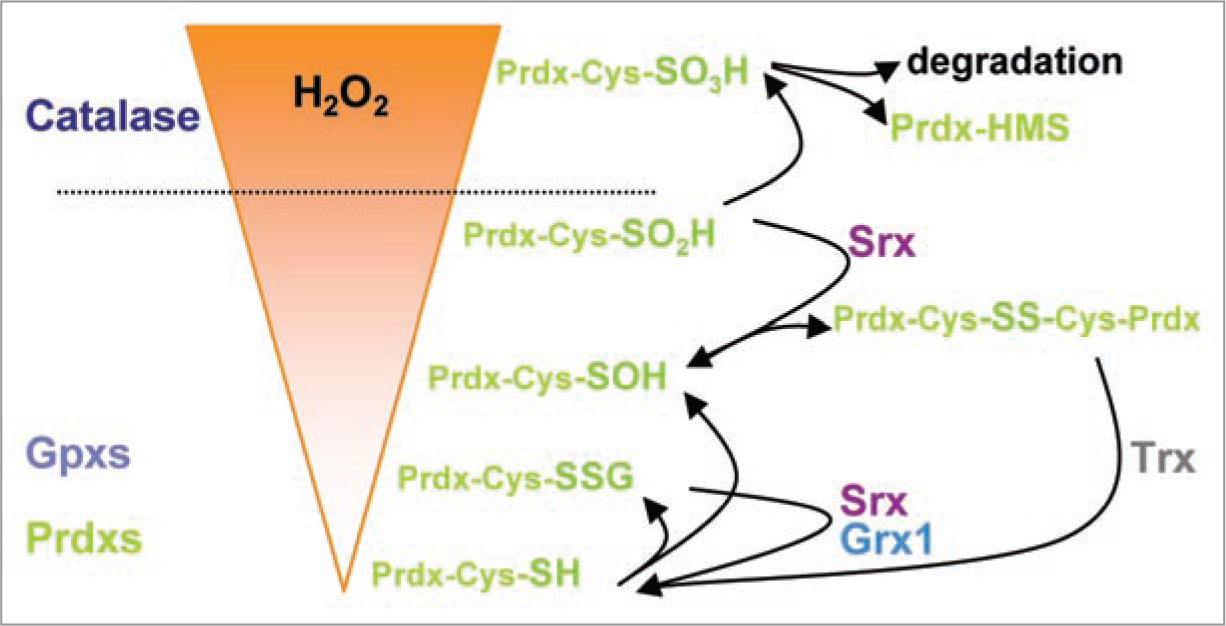
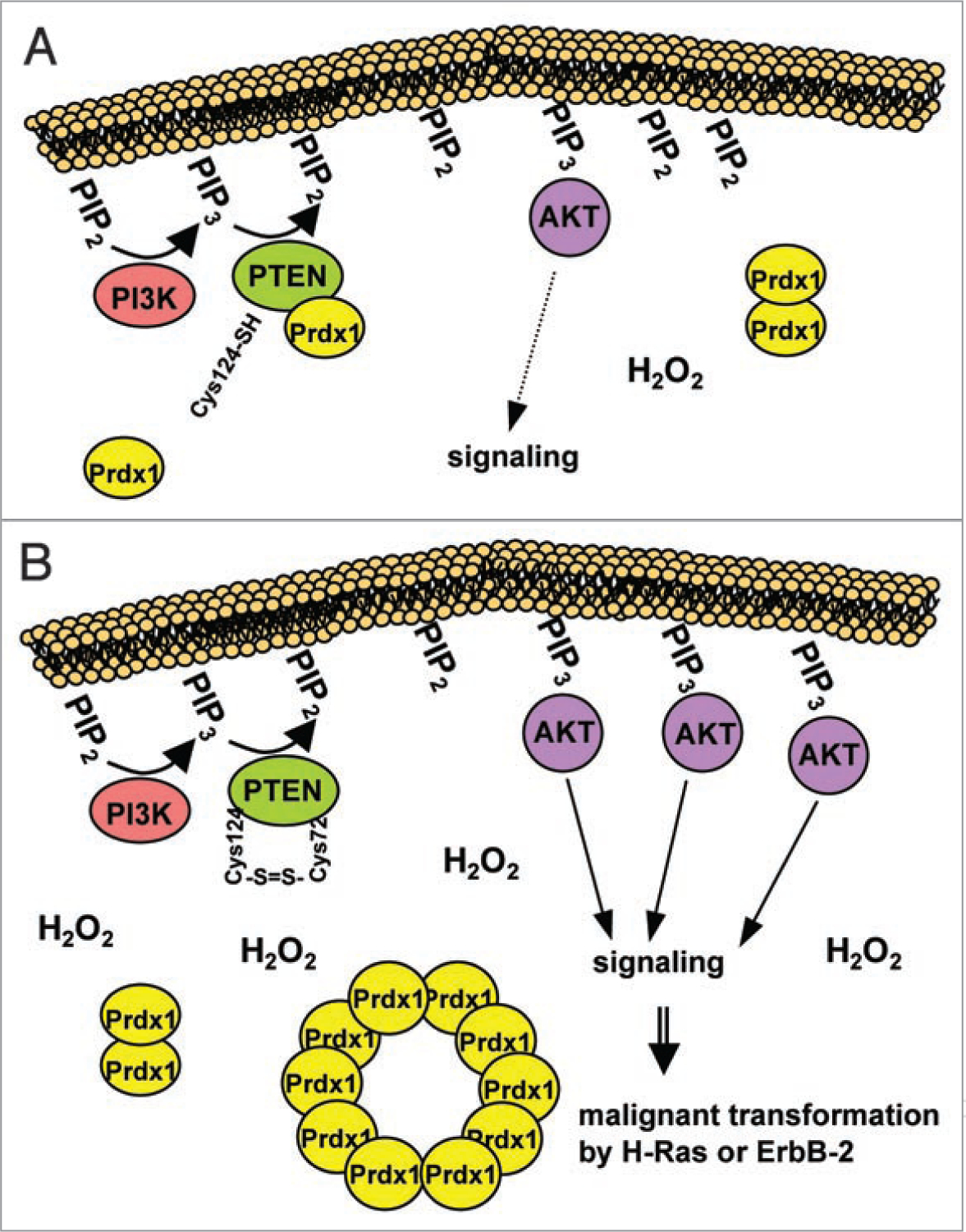
Peroxiredoxins (Prdxs) are a family of small (22-27 kDa) nonseleno peroxidases currently known to possess six mammalian isoforms. Although their individual roles in cellular redox regulation and antioxidant protection are quite distinct, they all catalyze peroxide reduction of H(2)O(2), organic hydroperoxides and peroxynitrite. They are found to be expressed ubiquitously and in high levels, suggesting that they are both an ancient and important enzyme family. Prdxs can be divided into three major subclasses: typical 2-cysteine (2-Cys) Prdxs (Prdx1-4), atypical 2-Cys Prdx (Prdx 5) and 1-Cys Prdx (Prdx 6). Recent evidence suggests that 2-Cys peroxiredoxins are more than "just simple peroxidases". This hypothesis has been discussed elegantly in recent review articles, considering "over"-oxidation of the protonated thiolate peroxidatic cysteine and post-translational modification of Prdxs as processes initiating a mechanistic switch from peroxidase to chaperon function. The process of over-oxidation of the peroxidatic cysteine (C(P)) occurs during catalysis in the presence of thioredoxin (Trx), thus rendering the sulfenic moiety to sulfinic acid, which can be reduced by sulfiredoxin (Srx). However, further oxidation to sulfonic acid is believed to promote Prdx degradation or, as recently shown, the formation of oligomeric peroxidase-inactive chaperones with questionable H(2)O(2)-scavenging capacity. In the light of this and given that Prdx1 has recently been shown by us and by others to interact directly with signaling molecules, we will explore the possibility that H(2)O(2) regulates signaling in the cell in a temporal and spatial fashion via oxidizing Prdx1. Therefore, this review will focus on H(2)O(2) modulating cell signaling via Prdxs by discussing: (1) the activity of Prdxs towards H(2)O(2); (2) sub cellular localization and availability of other peroxidases, such as catalase or glutathione peroxidases; (3) the availability of Prdxs reducing systems, such as thioredoxin and sulfiredoxin and lastly, (4) Prdx1 interacting signaling molecules.
过氧化物酶(Prdxs)是一个小(22-27 kDa)非硒过氧化物酶家族,目前已知哺乳动物有 6 种同工型。尽管它们在细胞内氧化还原调节和抗氧化保护中的作用各不相同,但它们都能催化 H(2)O(2)、有机过氧化物和过氧亚硝酸盐的过氧化物还原。它们广泛而高水平地表达,表明它们既是一个古老的、重要的酶家族。Prdxs 可分为三大亚类:典型的 2-半胱氨酸(2-Cys)过氧化物酶(Prdx1-4)、非典型的 2-Cys 过氧化物酶(Prdx5)和 1-Cys 过氧化物酶(Prdx6)。最近的证据表明,2-Cys 过氧化物酶不仅仅是“简单的过氧化物酶”。这一假设在最近的评论文章中得到了优雅的讨论,考虑到质子化的硫醇过氧物半胱氨酸的“过度”氧化和过氧化物酶的翻译后修饰作为从过氧化物酶向伴侣功能的机制转换的起始过程。过氧物半胱氨酸(C(P))的过氧化发生在存在硫氧还蛋白(Trx)的催化过程中,从而使亚磺酰基转化为亚磺酸,亚磺酸可以被硫氧还蛋白(Srx)还原。然而,进一步氧化为磺酸被认为会促进 Prdx 的降解,或者正如最近所显示的,形成具有可疑 H(2)O(2)清除能力的寡聚过氧化物酶失活伴侣。鉴于此,并且鉴于 Prdx1 最近已被我们和其他人证明直接与信号分子相互作用,我们将探讨 H(2)O(2)通过氧化 Prdx1 来调节细胞信号转导的可能性。因此,本综述将重点讨论 H(2)O(2)通过 Prdxs 调节细胞信号转导的方式,讨论:(1)Prdxs 对 H(2)O(2)的活性;(2)细胞内定位和其他过氧化物酶(如过氧化氢酶或谷胱甘肽过氧化物酶)的可用性;(3)Prdxs 还原系统(如硫氧还蛋白和硫氧还蛋白)的可用性,最后,(4)Prdx1 相互作用的信号分子。