Department of Molecular and Cellular Biology, University of California, Davis, One Shields Avenue, Davis, California 95616, USA.
Anal Chem. 2009 Dec 15;81(24):10179-85. doi: 10.1021/ac902186h.
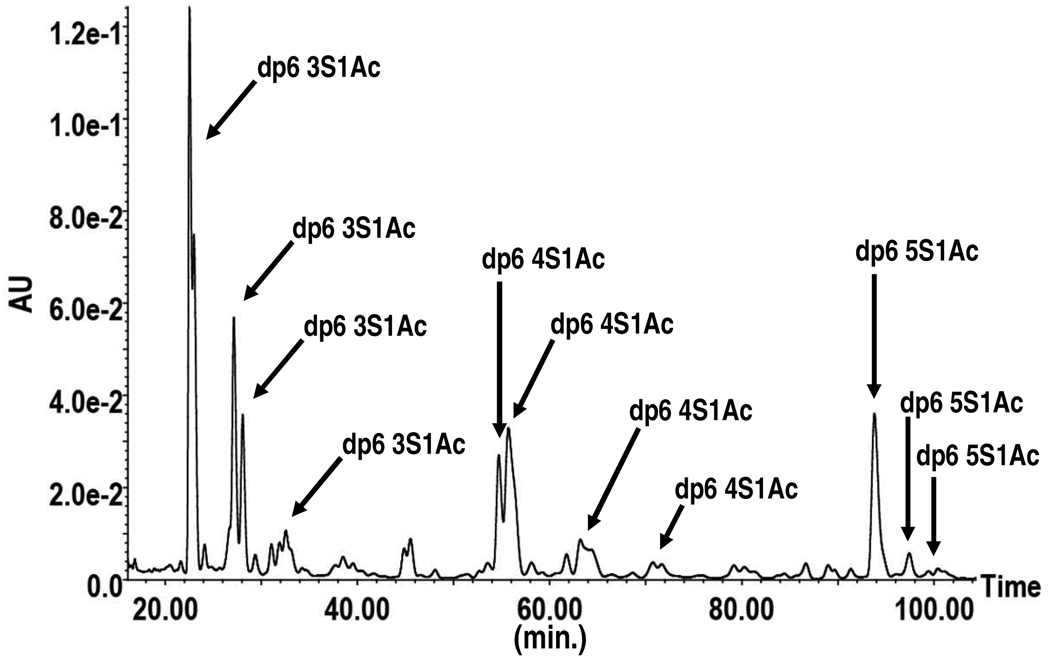
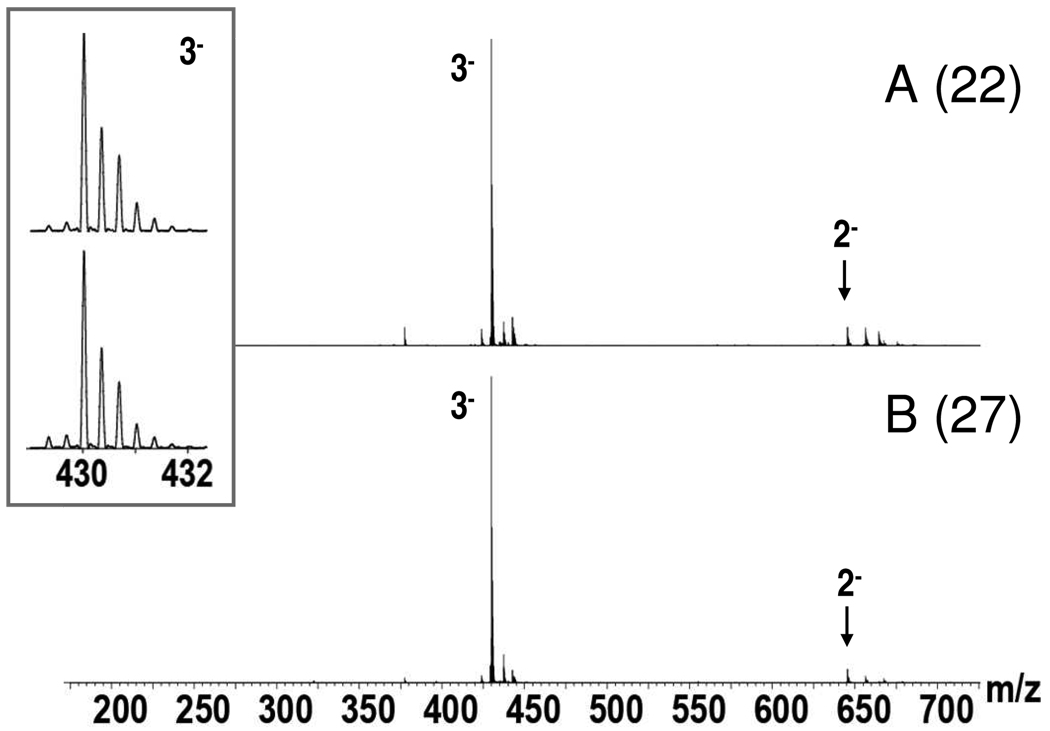
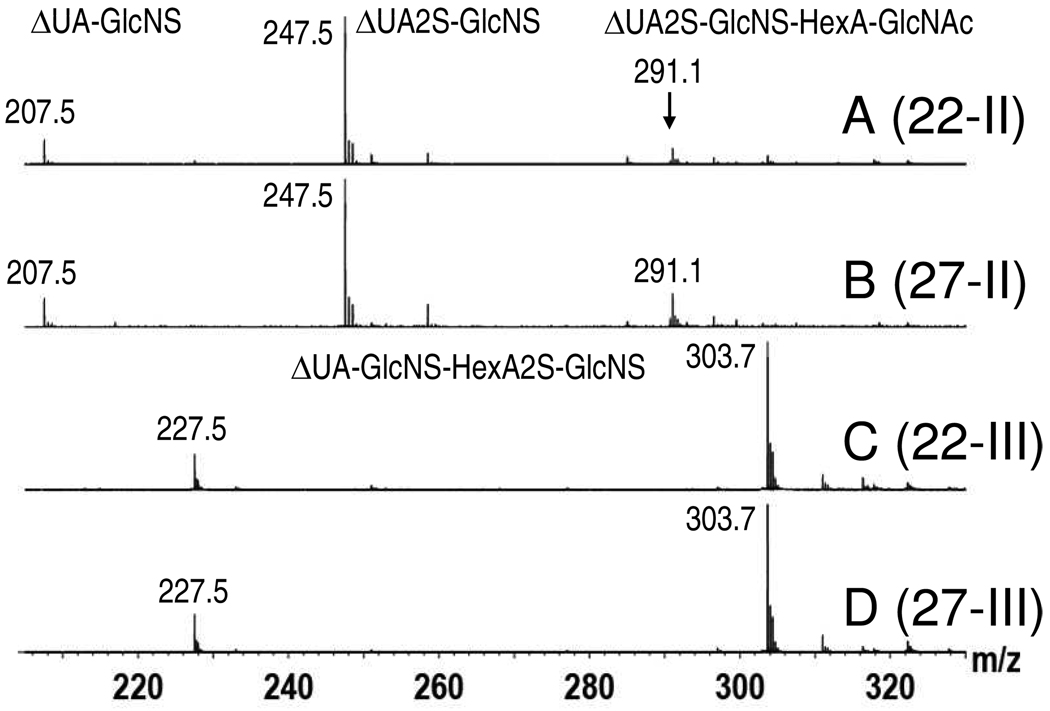
We describe the resolution of heparan sulfate (HS) isomers by chromatographic methods and their subsequent differentiation by mass spectrometry (MS), ion mobility, and (1)H nuclear magnetic resonance (NMR) analysis. The two purified hexasaccharide isomers produced nearly identical MS spectra, quantitative disaccharide profiles, and partial enzymatic digestions. However, both tandem spectrometry (MS(2)) and ion mobility spectrometry (IMS) indicated structural differences existed. All data suggested the distinction between the two hexasaccharides resided in their uronic acid stereochemistries. Glucuronic (GlcA) and iduronic acids (IdoA) were subsequently defined by (1)H NMR analysis completing the structural analysis and verifying the unique structures initially indicated by MS(2) and IMS. Our results suggest that IMS may be a powerful tool in the rapid differentiation of GlcA and IdoA containing isomers in the absence of prior structural knowledge.
我们描述了肝素硫酸盐(HS)异构体的色谱分离方法,以及随后通过质谱(MS)、离子淌度和(1)H 核磁共振(NMR)分析进行的区分。两种纯化的六糖异构体产生了几乎相同的 MS 谱、定量二糖图谱和部分酶解。然而,串联质谱(MS(2))和离子淌度谱(IMS)都表明存在结构差异。所有数据表明,这两种六糖之间的区别在于它们的糖醛酸立体化学。通过(1)H NMR 分析确定了葡萄糖醛酸(GlcA)和艾杜糖醛酸(IdoA),从而完成了结构分析,并验证了 MS(2)和 IMS 最初提示的独特结构。我们的结果表明,在缺乏先验结构知识的情况下,IMS 可能是快速区分含 GlcA 和 IdoA 异构体的有力工具。