Department of Pharmacology, University of Cambridge, Cambridge CB2 1PD, UK.
Biochemistry. 2009 Dec 29;48(51):12062-80. doi: 10.1021/bi901739t.
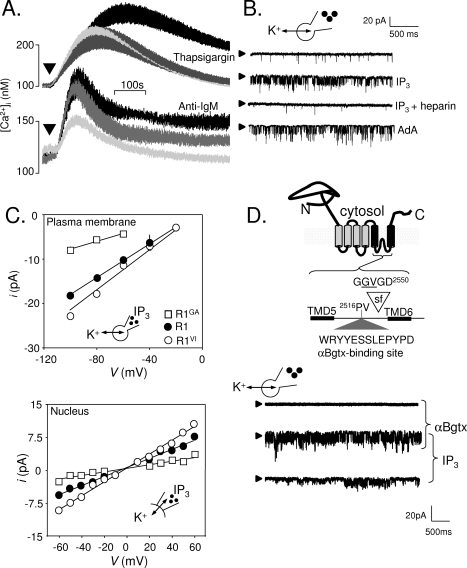
The versatility of Ca(2+) as an intracellular messenger derives largely from the spatial organization of cytosolic Ca(2+) signals, most of which are generated by regulated openings of Ca(2+)-permeable channels. Most Ca(2+) channels are expressed in the plasma membrane (PM). Others, including the almost ubiquitous inositol 1,4,5-trisphosphate receptors (IP(3)R) and their relatives, the ryanodine receptors (RyR), are predominantly expressed in membranes of the sarcoplasmic or endoplasmic reticulum (ER). Targeting of these channels to appropriate destinations underpins their ability to generate spatially organized Ca(2+) signals. All Ca(2+) channels begin life in the cytosol, and the vast majority are then functionally assembled in the ER, where they may either remain or be dispatched to other membranes. Here, by means of selective examples, we review two issues related to this trafficking of Ca(2+) channels via the ER. How do cells avoid wayward activity of Ca(2+) channels in transit as they pass from the ER via other membranes to their final destination? How and why do some cells express small numbers of the archetypal intracellular Ca(2+) channels, IP(3)R and RyR, in the PM?
Ca(2+)作为细胞内信使的多功能性在很大程度上源于细胞溶质 Ca(2+)信号的空间组织,其中大多数信号是通过调节性开放 Ca(2+)渗透性通道产生的。大多数 Ca(2+)通道表达在质膜(PM)上。其他通道,包括几乎普遍存在的肌醇 1,4,5-三磷酸受体(IP(3)R)及其相关的 Ryanodine 受体(RyR),主要表达在肌浆或内质网(ER)的膜上。这些通道靶向适当的目的地是其产生空间组织的 Ca(2+)信号的能力的基础。所有 Ca(2+)通道最初都存在于细胞质中,其中绝大多数随后在 ER 中进行功能性组装,它们可以留在 ER 中或被派往其他膜。在这里,我们通过选择性的例子来回顾与通过 ER 运输 Ca(2+)通道有关的两个问题。当 Ca(2+)通道从 ER 通过其他膜到达最终目的地时,细胞如何避免通道在运输过程中的任性活动?为什么有些细胞会在 PM 中表达少量的典型细胞内 Ca(2+)通道,即 IP(3)R 和 RyR?