First Department of Medicine, Hamamatsu University School of Medicine, Hamamatsu, Japan.
BMC Cancer. 2009 Nov 22;9:408. doi: 10.1186/1471-2407-9-408.
Protracted low-dose concurrent chemotherapy combined with radiation has been proposed for enhanced treatment results for esophageal cancer. We evaluated the efficacy and the toxicity of a novel regimen of daily low-dose nedaplatin (cis-diammine-glycolatoplatinum) and continuous infusion of 5-fluorouracil (5-FU) with radiation in patients with esophageal squamous cell carcinoma.
Between January 2003 and June 2008, 33 patients with clinical stage I to IVB esophageal squamous cell carcinoma were enrolled. Nedaplatin (10 mg/body/day) was administered daily and 5-FU (500 mg/body/day) was administered continuously for 20 days. Fractionated radiotherapy for a total dose of 50.4-66 Gy was administered together with chemotherapy. Additional chemotherapy with nedaplatin and 5-FU was optionally performed for a maximum of 5 courses after chemoradiotherapy. The primary end-point of this study was to evaluate the tumor response, and the secondary end-points were to evaluate the toxicity and the overall survival.
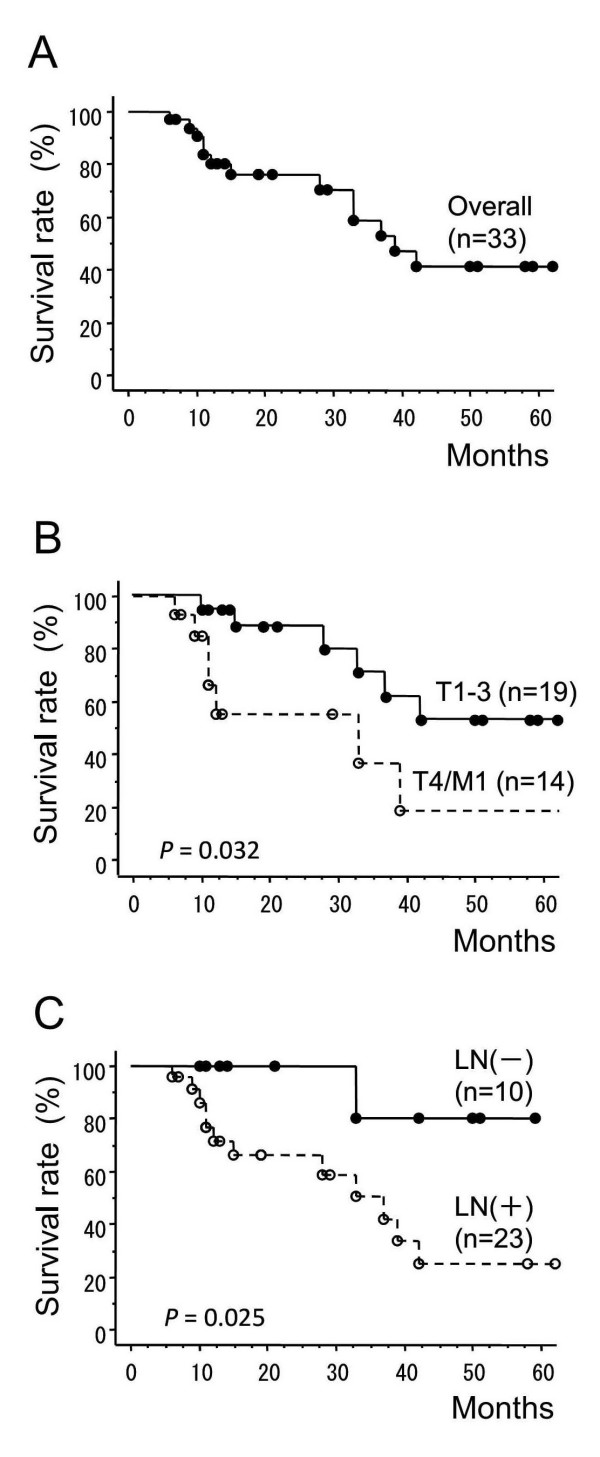
Twenty-two patients (72.7%) completed the regimen of chemoradiotherapy. Twenty patients (60.6%) achieved a complete response, 10 patients (30.3%) a partial response. One patient (3.0%) had a stable disease, and 2 (6.1%) a progressive disease. The overall response rate was 90.9% (95% confidence interval: 75.7%-98.1%). For grade 3-4 toxicity, leukopenia was observed in 75.8% of the cases, thrombocytopenia in 24.2%, anemia in 9.1%, and esophagitis in 36.4%, while late grade 3-4 cardiac toxicity occurred in 6.1%. Additional chemotherapy was performed for 26 patients (78.8%) and the median number of courses was 3 (range, 1-5). The 1-, 2- and 3-year survival rates were 83.9%, 76.0% and 58.8%, respectively. The 1- and 2-year survival rates were 94.7% and 88.4% in patients with T1-3 M0 disease, and 66.2% and 55.2% in patients with T4/M1 disease.
The treatment used in our study may yield a high complete response rate and better survival for each stage of esophageal squamous cell carcinoma.
ClinicalTrials.gov Identifier: NCT00197444.
为了提高食管癌的治疗效果,已经提出了延长低剂量同步化疗联合放疗的方案。我们评估了新的奈达铂(顺式-二氨-二甘氨酸铂)和 5-氟尿嘧啶(5-FU)持续输注联合放疗在食管鳞状细胞癌患者中的疗效和毒性。
2003 年 1 月至 2008 年 6 月期间,纳入了 33 例临床 I 至 IVB 期食管鳞状细胞癌患者。奈达铂(10mg/天)每日给药,5-FU(500mg/天)连续给药 20 天。给予分割放疗,总剂量为 50.4-66Gy,同时进行化疗。在放化疗后,可选择最多进行 5 个疗程的奈达铂和 5-FU 辅助化疗。本研究的主要终点是评估肿瘤反应,次要终点是评估毒性和总生存率。
22 例患者(72.7%)完成了放化疗方案。20 例患者(60.6%)达到完全缓解,10 例患者(30.3%)达到部分缓解。1 例患者(3.0%)疾病稳定,2 例患者(6.1%)疾病进展。总缓解率为 90.9%(95%置信区间:75.7%-98.1%)。对于 3-4 级毒性,75.8%的病例出现白细胞减少,24.2%的病例出现血小板减少,9.1%的病例出现贫血,36.4%的病例出现食管炎,6.1%的病例出现迟发性 3-4 级心脏毒性。26 例患者(78.8%)接受了辅助化疗,疗程中位数为 3 个(范围,1-5 个)。1、2 和 3 年生存率分别为 83.9%、76.0%和 58.8%。T1-3M0 疾病患者的 1 年和 2 年生存率分别为 94.7%和 88.4%,T4/M1 疾病患者分别为 66.2%和 55.2%。
我们研究中的治疗方法可能使每个阶段的食管鳞状细胞癌患者获得高完全缓解率和更好的生存率。
ClinicalTrials.gov 标识符:NCT00197444。