Mani Ram-Shankar, Tomlins Scott A, Callahan Kaitlin, Ghosh Aparna, Nyati Mukesh K, Varambally Sooryanarayana, Palanisamy Nallasivam, Chinnaiyan Arul M
Michigan Center for Translational Pathology, University of Michigan Medical School, Ann Arbor, MI 48109, USA.
Science. 2009 Nov 27;326(5957):1230. doi: 10.1126/science.1178124. Epub 2009 Oct 29.
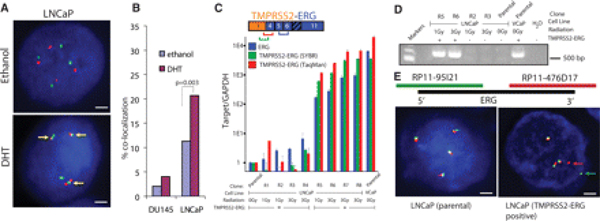
Gene fusions play a critical role in cancer progression. The mechanisms underlying their genesis and cell type specificity are not well understood. About 50% of human prostate cancers display a gene fusion involving the 5' untranslated region of TMPRSS2, an androgen-regulated gene, and the protein-coding sequences of ERG, which encodes an erythroblast transformation-specific (ETS) transcription factor. By studying human prostate cancer cells with fluorescence in situ hybridization, we show that androgen signaling induces proximity of the TMPRSS2 and ERG genomic loci, both located on chromosome 21q22.2. Subsequent exposure of the cells to gamma irradiation, which causes DNA double-strand breaks, facilitates the formation of the TMPRSS2-ERG gene fusion. These results may help explain why TMPRSS2-ERG fusions are restricted to the prostate, which is dependent on androgen signaling.
基因融合在癌症进展中起着关键作用。其产生的机制以及细胞类型特异性尚未得到很好的理解。大约50%的人类前列腺癌表现出一种基因融合,该融合涉及雄激素调节基因TMPRSS2的5'非翻译区和ERG的蛋白质编码序列,ERG编码一种成红细胞转化特异性(ETS)转录因子。通过荧光原位杂交研究人类前列腺癌细胞,我们发现雄激素信号传导诱导了TMPRSS2和ERG基因组位点的接近,这两个位点都位于21号染色体的22.2区域。随后将细胞暴露于γ射线照射下,γ射线会导致DNA双链断裂,这促进了TMPRSS2-ERG基因融合的形成。这些结果可能有助于解释为什么TMPRSS2-ERG融合仅限于依赖雄激素信号传导的前列腺。