Department of Veterans Affairs Serious Mental Illness Treatment, Research, and Evaluation Center, Health Services Research and Development, Ann Arbor, MI 48104, USA.
Schizophr Bull. 2011 Jul;37(4):727-36. doi: 10.1093/schbul/sbp121. Epub 2009 Nov 21.
Similar to patients with other chronic disorders, patients with serious mental illness (SMI) are often poorly adherent with prescribed medications.
We conducted a randomized controlled trial examining the effectiveness of a pharmacy-based intervention (Meds-Help) in increasing antipsychotic medication adherence among Department of Veterans Affairs (VA) patients with SMI. We also examined the impact of Meds-Help on psychiatric symptoms, quality of life, and satisfaction with care.
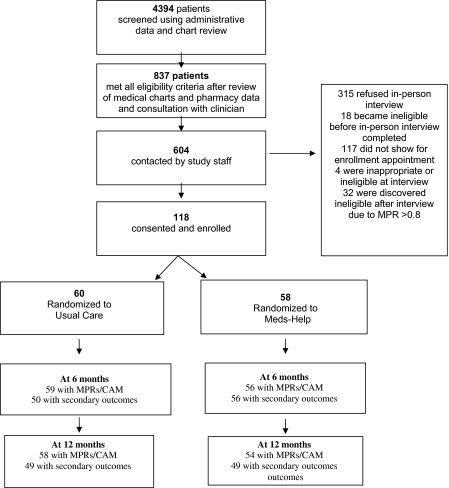
We enrolled 118 patients from 4 VA facilities with schizophrenia, schizoaffective, or bipolar disorder who were on long-term antipsychotics but had antipsychotic medication possession ratios (MPRs) <0.8 in the prior year. Patients were randomized to usual care (UC; n = 60) or the pharmacy-based intervention (Meds-Help; n = 58). We reassessed adherence at 6 and 12 months, at which time patients completed Positive and Negative Symptom Scales (PANSS), Quality of Well-being Scales (QWB), and Client Satisfaction Questionnaires (CSQ-8).
Prior to enrollment, Meds-Help and UC patients had mean antipsychotic MPRs of 0.54 and 0.55, respectively. At 6 months, mean MPRs were 0.91 for Meds-Help and 0.64 for UC patients; at 12 months, they were 0.86 for Meds-Help and 0.62 for UC patients. In multivariate analyses adjusting for patient factors, Meds-Help patients had significantly higher MPRs at 6 and 12 months (P < .0001). There were no significant differences between groups in PANSS, QWB, or CSQ-8 scores, but power to detect small effects was limited.
Congruent with prior studies of patients with other disorders, a practical pharmacy-based intervention increased antipsychotic adherence among patients with SMI. However, SMI patients may require additional care management components to improve outcomes.
与其他患有慢性疾病的患者类似,患有严重精神疾病(SMI)的患者通常不遵守规定的药物治疗方案。
我们进行了一项随机对照试验,以检验基于药房的干预措施(Meds-Help)在提高 VA 患有 SMI 的患者对抗精神病药物的依从性方面的有效性。我们还研究了 Meds-Help 对精神症状、生活质量和护理满意度的影响。
我们从 4 家 VA 机构招募了 118 名患有精神分裂症、分裂情感障碍或双相情感障碍的患者,他们长期服用抗精神病药物,但在前一年的抗精神病药物持有率(MPR)<0.8。患者被随机分配到常规护理(UC;n=60)或基于药房的干预(Meds-Help;n=58)。我们在 6 个月和 12 个月时重新评估了依从性,此时患者完成了阳性和阴性症状量表(PANSS)、生活质量量表(QWB)和客户满意度问卷(CSQ-8)。
入组前,Meds-Help 和 UC 患者的平均抗精神病药物 MPR 分别为 0.54 和 0.55。6 个月时,Meds-Help 和 UC 患者的平均 MPR 分别为 0.91 和 0.64;12 个月时,Meds-Help 和 UC 患者的平均 MPR 分别为 0.86 和 0.62。在调整了患者因素的多变量分析中,Meds-Help 患者在 6 个月和 12 个月时的 MPR 显著更高(P<0.0001)。两组在 PANSS、QWB 或 CSQ-8 评分方面均无显著差异,但检测小效应的能力有限。
与其他患有疾病的患者的先前研究一致,基于实际药房的干预措施提高了 SMI 患者对抗精神病药物的依从性。然而,SMI 患者可能需要额外的护理管理措施来改善治疗效果。