Ramakrishnan Muthannan A, Gramer Marie R, Goyal Sagar M, Sreevatsan Srinand
Veterinary Population Medicine Department, College of Veterinary Medicine, University of Minnesota, St. Paul, MN 55108, USA.
J Vet Sci. 2009 Dec;10(4):349-51. doi: 10.4142/jvs.2009.10.4.349.
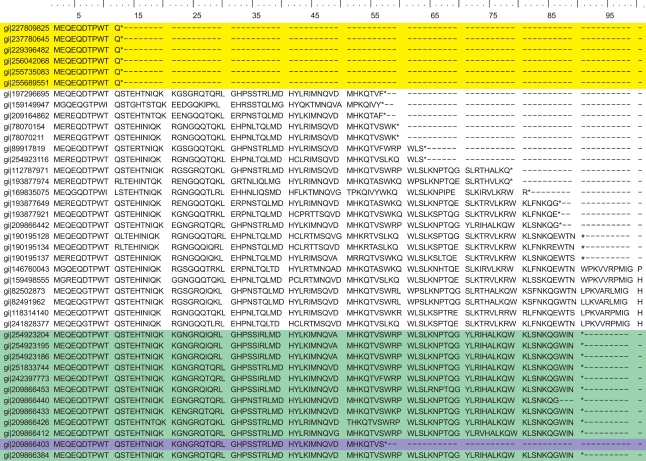
As the scientific community scrambles to define the ancestry and lineages of the eight segments of new pandemic H1N1 strain, we looked for unique genetic events in this virus's genome to explain the newly found enhanced virulence and transmissibility among humans. Genome annotations of this virus identified a stop mutation replacing serine at codon 12 (S12Stop) of the PB1-F2 protein, a virulence factor in influenza A viruses. Here, we discuss the significance of this finding and how it may contribute to host specialization, explaining the virtual absence of the H1N1 influenza A virus strain in pig populations. This finding is expected to lead to a better understanding of the transmission and pathogenesis of the 2009 pandemic strain.
随着科学界急于确定新型大流行性H1N1病毒株八个基因片段的谱系和起源,我们在该病毒的基因组中寻找独特的基因事件,以解释新发现的在人类中增强的毒力和传播力。对该病毒的基因组注释发现,PB1-F2蛋白(甲型流感病毒中的一种毒力因子)的第12位密码子处的丝氨酸被一个终止突变所取代(S12Stop)。在此,我们讨论这一发现的意义以及它如何可能导致宿主特异性,解释了猪群中甲型H1N1流感病毒株实际上不存在的现象。这一发现有望增进我们对2009年大流行毒株的传播和发病机制的理解。