Rossi Alessandro, Pacifico Roberta, Stratta Paolo
Department of Experimental Medicine at University of L'Aquila, Institute of Clinical Research 'Villa Serena' Department of Clinical Neuroscience, Città S. Angelo, Italy;
Patient Prefer Adherence. 2009 Nov 3;3:305-9. doi: 10.2147/ppa.s5590.
Our study uses data from a large clinical trial to further dissect the contributors attitude toward antipsychotic medication measured with the Drug Attitude Inventory (DAI) in schizophrenia.
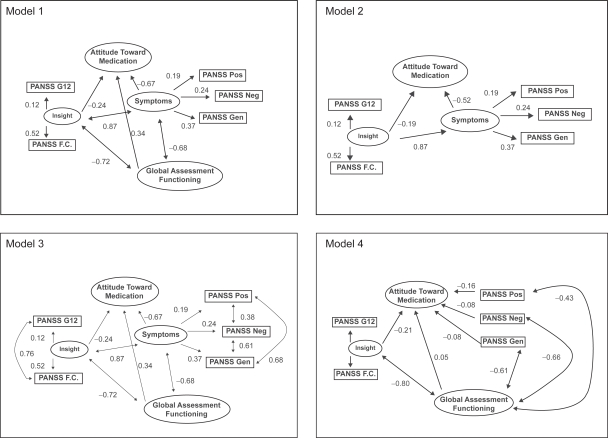
A total of 227 consecutive outpatients (140 males, 87 females) with schizophrenia or schizoaffective disorder according to DSM-IV criteria were evaluated. Structural equation models (SEM) were used to examine the relationship between attitudes toward medication as measured with the DAI and clinical variables assessed by Positive and Negative Syndrome Scale (PANSS) and Global Assessment of Functioning (GAF).
Among four models, the data better fit a model in which attitudes toward medication (DAI-30) was predicted by PANSS Positive and Insight measures, and GAF (goodness-of-fit = 0.99).
The data best fit a model where the most complex interaction of insight measures and positive symptoms does predict attitudes toward medication.
我们的研究使用来自一项大型临床试验的数据,以进一步剖析精神分裂症患者通过药物态度量表(DAI)测量的对抗精神病药物的态度的影响因素。
根据DSM-IV标准,对总共227例连续性门诊患者(140例男性,87例女性)进行评估,这些患者患有精神分裂症或分裂情感性障碍。使用结构方程模型(SEM)来检验通过DAI测量的药物态度与通过阳性和阴性症状量表(PANSS)及总体功能评估(GAF)评估的临床变量之间的关系。
在四个模型中,数据与一个模型拟合得更好,在该模型中,药物态度(DAI-30)由PANSS阳性量表得分和自知力测量值以及GAF预测(拟合优度=0.99)。
数据最符合一个模型,即自知力测量值和阳性症状的最复杂相互作用确实能预测药物态度。