Institute of Environmental Medicine, Karolinska Institutet, SE-171 77 Stockholm, Sweden.
Environ Health. 2009 Nov 25;8:53. doi: 10.1186/1476-069X-8-53.
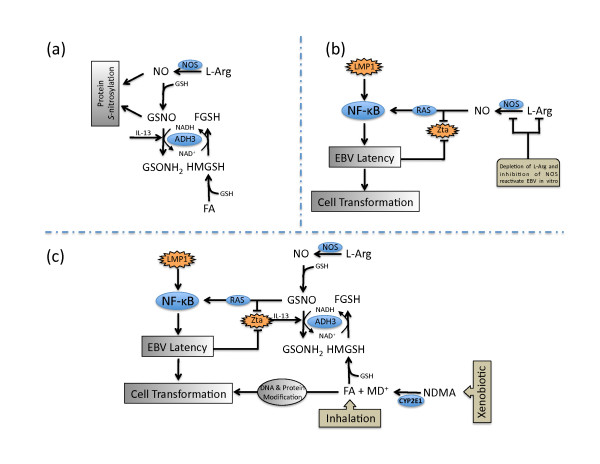
Occupational exposure to formaldehyde has been linked to nasopharyngeal carcinoma. To date, mechanistic explanations for this association have primarily focused on formaldehyde-induced cytotoxicity, regenerative hyperplasia and DNA damage. However, recent studies broaden the potential mechanisms as it is now well established that formaldehyde dehydrogenase, identical to S-nitrosoglutathione reductase, is an important mediator of cGMP-independent nitric oxide signaling pathways. We have previously described mechanisms by which formaldehyde can influence nitrosothiol homeostasis thereby leading to changes in pulmonary physiology. Considering evidences that nitrosothiols govern the Epstein-Barr virus infection cycle, and that the virus is strongly implicated in the etiology of nasopharyngeal carcinoma, studies are needed to examine the potential for formaldehyde to reactivate the Epstein-Barr virus as well as additively or synergistically interact with the virus to potentiate epithelial cell transformation.
职业性暴露于甲醛已被认为与鼻咽癌有关。迄今为止,对于这种关联的机制解释主要集中在甲醛诱导的细胞毒性、再生性增生和 DNA 损伤上。然而,最近的研究拓宽了潜在的机制,因为现在已经很清楚,甲醛脱氢酶与 S-亚硝基谷胱甘肽还原酶相同,是 cGMP 非依赖性一氧化氮信号通路的重要介质。我们之前已经描述了甲醛可以影响亚硝基硫醇动态平衡从而导致肺生理变化的机制。考虑到证据表明,亚硝基硫醇控制着 Epstein-Barr 病毒的感染周期,并且该病毒强烈暗示与鼻咽癌的病因有关,因此需要研究甲醛是否有能力重新激活 Epstein-Barr 病毒,以及是否与病毒附加或协同相互作用以增强上皮细胞转化。