Department of Public Health and Primary Care, University of Cambridge, UK.
Age Ageing. 2010 Jan;39(1):104-11. doi: 10.1093/ageing/afp210. Epub 2009 Nov 24.
dementia risk conferred by apolipoprotein-E (APOE) and angiotensin-1-converting enzyme (ACE) polymorphisms have been reported for the MRC Cognitive Function and Ageing Study (CFAS) at 6-year follow-up. We concentrate on incident dementia risk over 10 years.
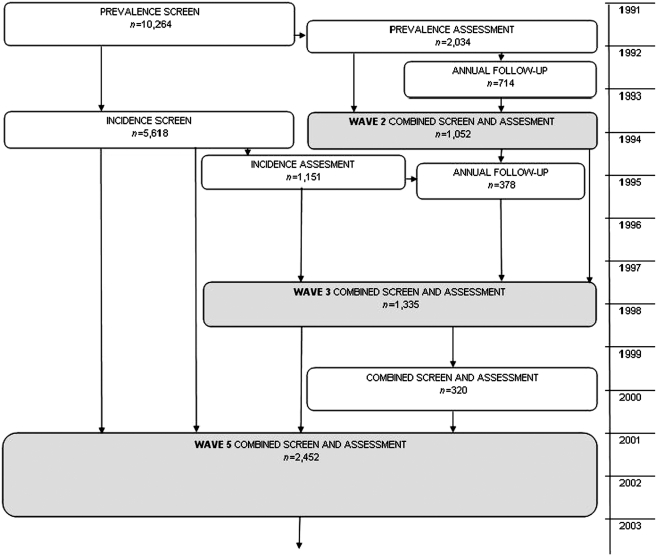
participants come from MRC CFAS, a multi-centre longitudinal population-based study of ageing in England and Wales. Three follow-up waves of data collection were used: 2, 6 and 10 years. Logistic regressions were undertaken to investigate associations between APOE (n = 955) and ACE (n = 856) alleles/genotypes and incident dementia. Two types of control groups were used: non-demented and highly functioning non-demented. Results were back-weighted.
compared to APOE epsilon3, epsilon2 conferred protection of odds ratio (OR) = 0.3 (95% confidence interval, CI = 0.1-0.6) and epsilon4 risk of OR = 2.9 (95% CI = 1.7-4.9) for incident dementia. Compared to epsilon3/epsilon3, the epsilon3/epsilon4 and epsilon4/epsilon4 genotypes conferred risks of OR = 3.6 (95% CI = 1.8-7.3) and OR = 7.9 (95% CI = 1.6-39.2), respectively. The epsilon3/epsilon2 genotype protected against dementia (OR = 0.2, 95% CI = 0.1-0.7), and epsilon2/epsilon2 had a similar protective effect but with wide CIs (OR = 0.3, 95% CI = 0.1-1.7). Restricting the control group accentuated these differentials. The effects of ACE alleles/genotypes on incident dementia risk were small.
APOE but not ACE is associated with late-onset incident dementia in the population. Using longer term follow-up with proper adjustment for attrition and incident cases increases estimates of risk.
载脂蛋白-E(APOE)和血管紧张素-1 转换酶(ACE)多态性对 MRC 认知功能和衰老研究(CFAS)在 6 年随访时的痴呆风险有报道。我们关注的是 10 年以上的新发痴呆风险。
参与者来自 MRC CFAS,这是一项在英格兰和威尔士进行的多中心纵向人群老龄化研究。使用了三次随访数据收集:2、6 和 10 年。进行逻辑回归分析以研究 APOE(n = 955)和 ACE(n = 856)等位基因/基因型与新发痴呆的关系。使用了两种类型的对照组:非痴呆和高功能非痴呆。结果进行了反向加权。
与 APOE epsilon3 相比,epsilon2 保护了比值比(OR)=0.3(95%置信区间,CI=0.1-0.6),epsilon4 风险的 OR = 2.9(95% CI = 1.7-4.9)。与 epsilon3/epsilon3 相比,epsilon3/epsilon4 和 epsilon4/epsilon4 基因型的风险比为 OR = 3.6(95% CI = 1.8-7.3)和 OR = 7.9(95% CI = 1.6-39.2)。epsilon3/epsilon2 基因型可预防痴呆(OR = 0.2,95% CI = 0.1-0.7),epsilon2/epsilon2 也有类似的保护作用,但置信区间较宽(OR = 0.3,95% CI = 0.1-1.7)。限制对照组会突出这些差异。ACE 等位基因/基因型对新发痴呆风险的影响较小。
APOE 而非 ACE 与人群中迟发性新发痴呆有关。使用更长时间的随访并适当调整流失和新发病例可增加风险估计。