Howard Hughes Medical Institute, Department of Developmental Biology, Stanford University School of Medicine, Stanford, CA 94305, USA.
J Cell Biol. 2009 Nov 2;187(3):365-74. doi: 10.1083/jcb.200907126. Epub 2009 Oct 26.
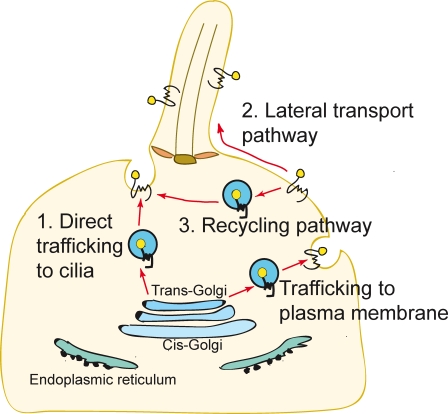
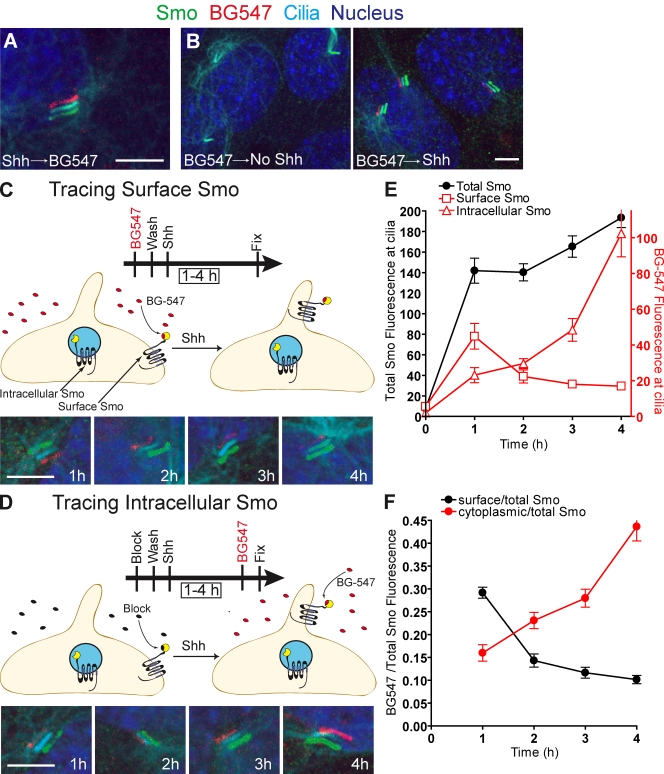
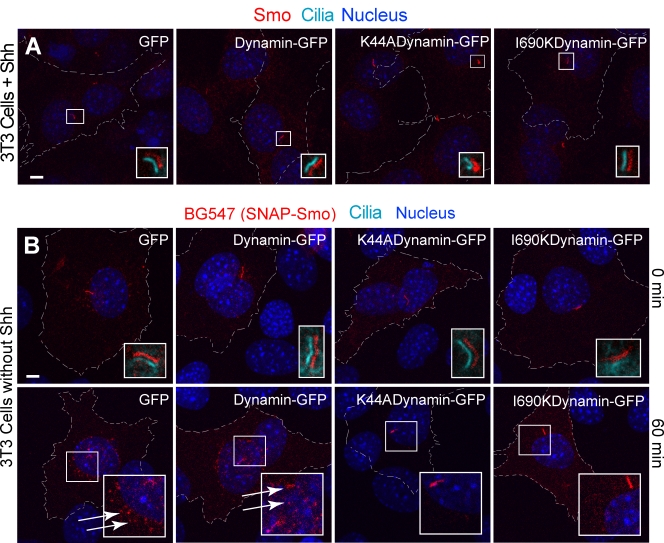
The function of primary cilia depends critically on the localization of specific proteins in the ciliary membrane. A major challenge in the field is to understand protein trafficking to cilia. The Hedgehog (Hh) pathway protein Smoothened (Smo), a 7-pass transmembrane protein, moves to cilia when a ligand is received. Using microscopy-based pulse-chase analysis, we find that Smo moves through a lateral transport pathway from the plasma membrane to the ciliary membrane. Lateral movement, either via diffusion or active transport, is quite distinct from currently studied pathways of ciliary protein transport in mammals, which emphasize directed trafficking of Golgi-derived vesicles to the base of the cilium. We anticipate that this alternative route will be used by other signaling proteins that function at cilia. The path taken by Smo may allow novel strategies for modulation of Hh signaling in cancer and regeneration.
初级纤毛的功能取决于纤毛膜中特定蛋白质的定位。该领域的一个主要挑战是理解蛋白质向纤毛的运输。Hedgehog (Hh) 途径蛋白 Smoothened (Smo) 是一种 7 次跨膜蛋白,当接收到配体时,它会转移到纤毛中。通过基于显微镜的脉冲追踪分析,我们发现 Smo 通过从质膜到纤毛膜的侧向转运途径移动。侧向运动,无论是通过扩散还是主动运输,与目前在哺乳动物中研究的纤毛蛋白运输途径有很大的不同,后者强调了高尔基衍生囊泡定向运输到纤毛底部。我们预计,其他在纤毛中起作用的信号蛋白也将使用这种替代途径。Smo 所走的路径可能为在癌症和再生中调节 Hh 信号提供新的策略。