Division of Cardiology, Department of Internal Medicine, College of Medicine, The Catholic University of Korea, Seoul, Korea.
Korean Circ J. 2009 May;39(5):185-9. doi: 10.4070/kcj.2009.39.5.185. Epub 2009 May 28.
It is known that angiotensin converting enzyme inhibitors and angiotensin II type 1 receptor blockers (ACEIs and ARBs, respectively) are effective in preventing atrial fibrillation (AF) in high-risk patients. However, it is not known whether ACEIs and ARBs are effective in preventing the recurrence of AF after catheter ablation.
One hundred fifty-two patients (mean age, 57+/-10 years; M : F=94 : 58) who underwent catheter ablation due to drug-refractory paroxysmal (mean age, 57+/-10 years; M : F=58 : 43) or persistent AF (mean age, 56+/-10 years; M : F=36 : 15) were enrolled. We compared the recurrence rates between the groups with and without ACEIs or ARBs use in paroxysmal and persistent AF. The mean duration of follow-up was 18+/-14 months.
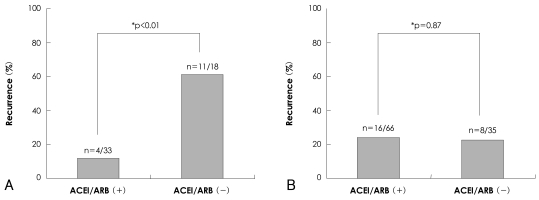
The overall recurrence rate after ablation therapy was 26% (n=39). The recurrence rate was significantly decreased in the patients with persistent AF with the use of ACEIs or ARBs (12.1% vs. 61.1%, p<0.01), but this difference was not observed in the patients with paroxysmal AF (24.2% vs. 22.9%, p=0.87). In patients with persistent AF with and without recurrence, the size of the left atrium (44.2+/-8.4 mm vs. 44.3+/-5.8 mm, respectively, p=0.45) and the ejection fraction (62+/-6.5% vs. 61.5+/-6.2%, respectively, p=0.28) were not significantly different. In multivariate analysis, the use of ACEIs or ARBs was independently associated with recurrence after adjusting for the size of the left atrium and the ejection fraction {odds ratio (OR)=0.078, 95% confidence interval (CI)=0.02-0.35, p<0.01}.
ACEIs and ARBs were shown to be effective in preventing AF recurrence after catheter ablation in patients with persistent AF.
已知血管紧张素转换酶抑制剂(ACEI)和血管紧张素Ⅱ 1 型受体阻滞剂(ARB)分别可有效预防高危患者心房颤动(AF)的发生。然而,目前尚不清楚 ACEI 和 ARB 是否能预防导管消融后 AF 的复发。
本研究共纳入 152 例行导管消融的药物难治性阵发性 AF(平均年龄 57+/-10 岁;M:F=94:58)和持续性 AF(平均年龄 56+/-10 岁;M:F=36:15)患者。我们比较了 ACEI 或 ARB 用于阵发性和持续性 AF 患者中的复发率。平均随访时间为 18+/-14 个月。
消融治疗后总的复发率为 26%(n=39)。持续性 AF 患者中使用 ACEI 或 ARB 后复发率明显降低(12.1% vs. 61.1%,p<0.01),但在阵发性 AF 患者中未观察到这种差异(24.2% vs. 22.9%,p=0.87)。持续性 AF 患者中复发组和未复发组左心房大小(44.2+/-8.4 mm 与 44.3+/-5.8 mm,p=0.45)和射血分数(62+/-6.5%与 61.5+/-6.2%,p=0.28)差异无统计学意义。多变量分析显示,在校正左心房大小和射血分数后,ACEI 或 ARB 的使用与复发独立相关(比值比[OR]=0.078,95%置信区间[CI]:0.02-0.35,p<0.01)。
ACEI 和 ARB 可有效预防持续性 AF 患者导管消融后 AF 的复发。